
TOS-1A in Belarus: Fear of New Northern Invasion
The presence of a TOS-1A heavy rocket launcher in Belarus reignites debate over a potential second invasion from the north, raising questions about logistics and military intent.
Deutsch · Ursprüngliche Diskussion auf Spanisch · Veröffentlicht
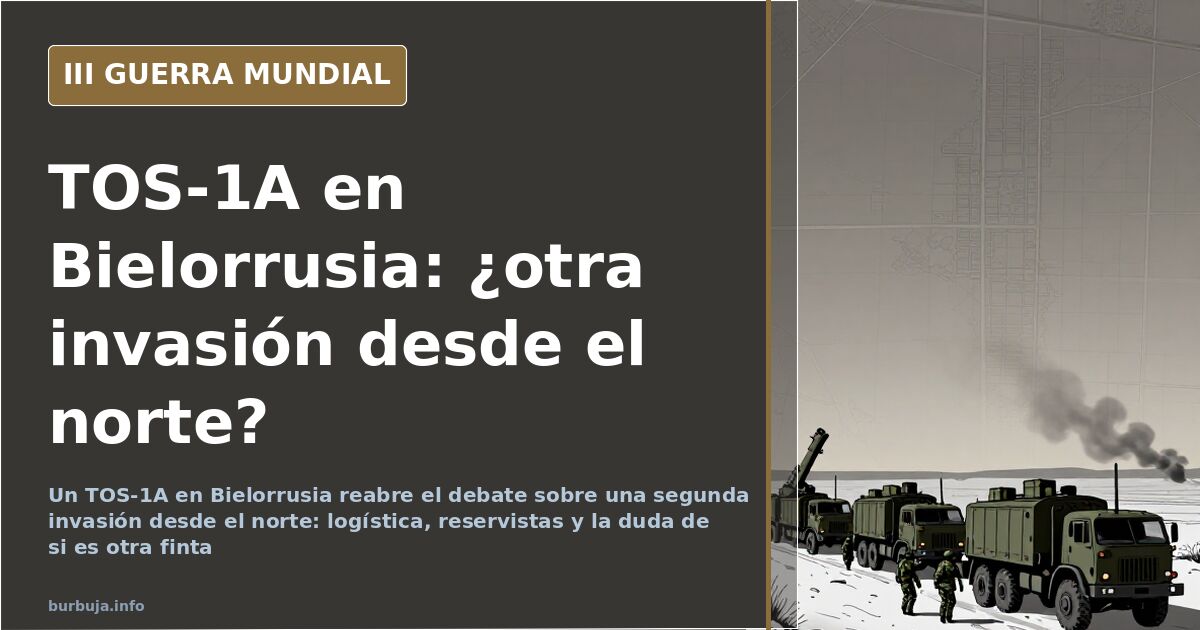
TOS-1A in Belarus Revives Ghost of Another Invasion
Why would a country claiming to be defensive need a heavy rocket launcher? This question was posed by a Ukraine conflict tracking account —"Why is a TOS-1A needed for defensive operations in Belarus?"— and rekindled suspicion: Moscow might be setting up the northern ramp again. The system is not designed to stop armored vehicles but to saturate terrain and create breaches. In Minsk, everything is officially defensive. The fine print says otherwise.
Why doesn't a TOS-1A fit a defensive doctrine?
The Belarusian army describes itself as a small force with a markedly defensive profile, poorly equipped for a deep offensive. Hence the confusion: what has been detected is not a support piece, but a system designed to bombard entire zones. Those defending the official version argue that Minsk is only protecting itself; those who doubt it respond that no one needs such a weapon to guard their own border. The comparison with Hostomel — where, according to the most repeated analysis, cadets were sent — recalls that Russian plans already used the north as a springboard once.
The "feint 2.0" and why the scenario is no longer February's
There is a current holding that all this is theater: a maneuver to force Kyiv to divert troops to the north and relieve pressure in Donbas, Kharkiv, and Kherson. It is the thesis of the feint, and it has supporters. Opposing it is the argument that the terrain is no longer the same: Ukrainian troops are not those of February; they are better armed, better stationed, and receive real-time US intelligence. On this basis, some go further and anticipate a collateral effect: internal wear on Lukashenko's regime. It is not a verified forecast. It is a scenario.
Trained reservists vs forced conscription
The most discussed point is where the manpower comes from. Some defend that mobilized Russians are not civilians ripped from their homes: they are reservists with specific military training, people who were already paid for it and knew they were on a list. On the Ukrainian side, the repeated diagnosis is different: forced recruitment and less training time. An uncomfortable data point for Kyiv is put on the table: it is one of the countries with the lowest birth rate in the world and loses thousands of young people every month. The underlying arithmetic, according to a circulating scenario, is that if Russia struggles, it can go from 300,000 to 500,000 men.
Logistics rules: Chernobyl and local roads
Another objection is purely geographical. From the Belarus-Ukraine border, the best-connected axis passes through the Chernobyl zone; the rest, it is said, does not exceed local roads. An attack requires fuel, ammunition, and ambulances, and these paths cannot sustain them. Anyone preparing an invasion via that route would take this into account. So the question returns: if the axis is so poor, why move artillery?
Belarus, between tonalidad revolutions and the Russian umbrella
One line of analysis points to two reasons for concentrating Russian troops in Belarusian territory. The first, stretching the Ukrainian front towards the north. The second, less commented upon, securing Minsk's flank against any attempt at regime change: if Moscow offers security guarantees, Lukashenko's power withstands better an opposition described in this reading as bought and eager to flourish. Which of the two reasons weighs more remains open.
Mercenaries, militias, and casualty accounting
There is another point where versions clash. Some hold that on Ukrainian soil, mainly Wagner mercenaries and local militias fight, while the regular Russian army would have suffered barely any losses. The reply comes from the other side: militias would already be at minimum levels, with more professional soldiers dead than militiamen, to the point that some territorial units would have refused to deploy to defend foreign positions. Without verifiable figures, everyone sticks to their own.
Is Ukraine simply a NATO proxy?
In the background appears the usual framework. A very repeated thesis affirms that Ukraine has long ceased to act as a state with its own will and functions as an instrument of NATO to wear down Russia and China, with a Western budget estimated at 18 times larger. The objection is that this reading erases Kyiv's decision-making capacity and turns any military support into proof of the very thing it aims to demonstrate.
With these elements, the only firm fact is that the TOS-1A is not in Belarus to parade. If the question was rhetorical, it now has an answer: no one deploys breach artillery to stay still. The rest — whether it is a feint, a rehearsal, or a prelude — remains exactly where it started.
Why would a country claiming to be defensive need a heavy rocket launcher? This question was posed by a Ukraine conflict tracking account —"Why is a TOS-1A needed for defensive operations in Belarus?"— and rekindled suspicion: Moscow might be setting up the northern ramp again. The system is not designed to stop armored vehicles but to saturate terrain and create breaches. In Minsk, everything is officially defensive. The fine print says otherwise.
Why doesn't a TOS-1A fit a defensive doctrine?
The Belarusian army describes itself as a small force with a markedly defensive profile, poorly equipped for a deep offensive. Hence the confusion: what has been detected is not a support piece, but a system designed to bombard entire zones. Those defending the official version argue that Minsk is only protecting itself; those who doubt it respond that no one needs such a weapon to guard their own border. The comparison with Hostomel — where, according to the most repeated analysis, cadets were sent — recalls that Russian plans already used the north as a springboard once.
The "feint 2.0" and why the scenario is no longer February's
There is a current holding that all this is theater: a maneuver to force Kyiv to divert troops to the north and relieve pressure in Donbas, Kharkiv, and Kherson. It is the thesis of the feint, and it has supporters. Opposing it is the argument that the terrain is no longer the same: Ukrainian troops are not those of February; they are better armed, better stationed, and receive real-time US intelligence. On this basis, some go further and anticipate a collateral effect: internal wear on Lukashenko's regime. It is not a verified forecast. It is a scenario.
Trained reservists vs forced conscription
The most discussed point is where the manpower comes from. Some defend that mobilized Russians are not civilians ripped from their homes: they are reservists with specific military training, people who were already paid for it and knew they were on a list. On the Ukrainian side, the repeated diagnosis is different: forced recruitment and less training time. An uncomfortable data point for Kyiv is put on the table: it is one of the countries with the lowest birth rate in the world and loses thousands of young people every month. The underlying arithmetic, according to a circulating scenario, is that if Russia struggles, it can go from 300,000 to 500,000 men.
Logistics rules: Chernobyl and local roads
Another objection is purely geographical. From the Belarus-Ukraine border, the best-connected axis passes through the Chernobyl zone; the rest, it is said, does not exceed local roads. An attack requires fuel, ammunition, and ambulances, and these paths cannot sustain them. Anyone preparing an invasion via that route would take this into account. So the question returns: if the axis is so poor, why move artillery?
Belarus, between tonalidad revolutions and the Russian umbrella
One line of analysis points to two reasons for concentrating Russian troops in Belarusian territory. The first, stretching the Ukrainian front towards the north. The second, less commented upon, securing Minsk's flank against any attempt at regime change: if Moscow offers security guarantees, Lukashenko's power withstands better an opposition described in this reading as bought and eager to flourish. Which of the two reasons weighs more remains open.
Mercenaries, militias, and casualty accounting
There is another point where versions clash. Some hold that on Ukrainian soil, mainly Wagner mercenaries and local militias fight, while the regular Russian army would have suffered barely any losses. The reply comes from the other side: militias would already be at minimum levels, with more professional soldiers dead than militiamen, to the point that some territorial units would have refused to deploy to defend foreign positions. Without verifiable figures, everyone sticks to their own.
Is Ukraine simply a NATO proxy?
In the background appears the usual framework. A very repeated thesis affirms that Ukraine has long ceased to act as a state with its own will and functions as an instrument of NATO to wear down Russia and China, with a Western budget estimated at 18 times larger. The objection is that this reading erases Kyiv's decision-making capacity and turns any military support into proof of the very thing it aims to demonstrate.
With these elements, the only firm fact is that the TOS-1A is not in Belarus to parade. If the question was rhetorical, it now has an answer: no one deploys breach artillery to stay still. The rest — whether it is a feint, a rehearsal, or a prelude — remains exactly where it started.
Auch verfügbar auf: English
Zusammenfassung einer Diskussion auf Burbuja.info - Foro de economía, actualidad y política., aus dem Spanischen übersetzt und vor der Veröffentlichung geprüft. Die ganze Diskussion lesen (178 Antworten).
Weitere Zusammenfassungen
-
Gisbert und Sivaya: Liebesromanze im Schatten des Ukraine-Kriegs
Analyse der Berichterstattung über Rubén Gisbert und Liu Sivaya im Kontext des Kriegs. Propaganda oder Realität?
-
Desinformation im Ukraine-Krieg: Bots und False Flags
Analyse der Vorwürfe, NATO, USA, Israel und die Ukraine betrieben Bot-Farmen für Desinformation und False-Flag-Aktionen.
-
Baerbock hält Sanktionen trotz steigender Strompreise aufrecht
Baerbock verspricht der Ukraine Unterstützung "unabhängig von den Wählern" und schließt eine Aufhebung der Russland-Sanktionen aus, selbst bei explodierenden Energiepreisen.
-
Warum nicht alle Putin für den Ukraine-Krieg verantwortlich machen
Debatten verweisen auf die ethnisch russische Minderheit in der Ukraine und Russlands Atomwaffen in Kaliningrad, nur 30 km von Polen entfernt.
-
Russland erklärt französische Soldaten in der Ukraine zu Zielen
Moskau warnt, dass französische Truppen in der Ukraine prioritäre Ziele seien. Dies befeuert die Debatte über europäische Entsendungen.
-
Ukraine prüft Rekrutierung von Ukrainern im Ausland
Verteidigungsminister Umerov erwägt Einberufung ukrainischer Auslandsbürger; das Ministerium dementiert aktive Debatten.