
These: Invasion of Saudi Arabia to save the petrodollar
A decade-old thesis claims the US would not invade Iran because its oil is in Saudi Arabia, not Tehran.
Deutsch · Ursprüngliche Diskussion auf Spanisch · Veröffentlicht
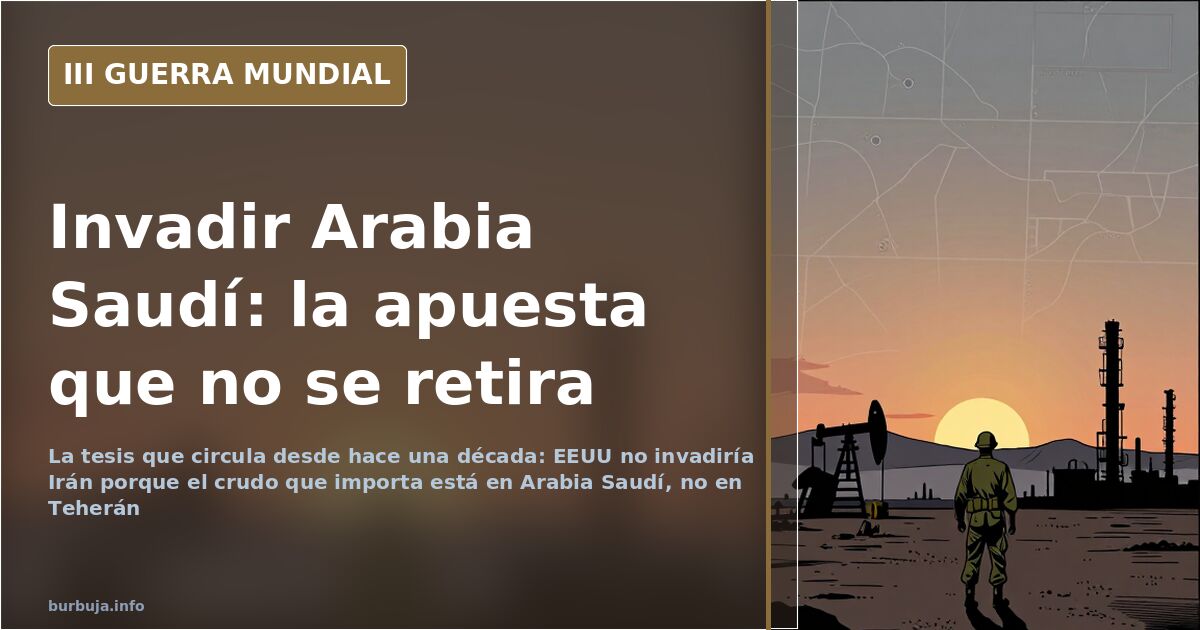
These: Invasion of Saudi Arabia to save the petrodollar
It sounds like a dinner table anecdote, but it has circulated for years among those who understand crude oil: The United States will not invade Iran because there is nothing worth taking left there. The treasure chest is in Saudi Arabia. A veteran Spanish oil analyst placed this scene a decade ago in a café with an investment banker from the sector and an Iranian interlocutor: He asked when Washington would attack Tehran and was instantly corrected. The target is Riyadh.
The logic behind this forecast presents itself as a textbook win-win: saving the petrodollar, cutting external dependence on diesel, and passing the bill to those who have been financing themselves with the dollar for decades. The problem is that no one agrees whether this is done with tanks or with an envelope.
What is the petrodollar and why is it defended by the Carter Doctrine?
The petrodollar is the mechanism by which crude oil is quoted and paid in dollars, maintaining the greenback's status as the reference currency for global trade. If Riyadh were to accept payment in another currency, the argument holds that the US would face a bigger problem than any tariff. Hence the invocation of the Carter Doctrine, the commitment formulated in 1980 whereby Washington reserves the use of force to prevent any foreign power from controlling the Persian Gulf. It is cited both as a trump card and as an alibi.
Fracking no longer covers the diesel hole
The second pillar of the thesis is the end of the shale miracle. Some argue that US fracking production has ceased to serve as a shield and that, without sufficient light crude, diesel becomes the weak point of the world's largest economy. The extreme scenario discussed is that gasoil ends up being paid in rubles, with Russian dependence as leverage. In this context, the attempt to privatize ARAMCO and the uproar it caused are recalled: The operation was attempted earlier via other channels and failed.
Saudi sweet crude against extra-heavy Venezuelan oil
One of the most repeated counterarguments is that Venezuela is closer and already under sanctions. The response from the other side is geological: Venezuelan crude is extra-heavy, expensive to refine, and serves at best to buy time. Saudi oil is light, sweet, and cheap to process. It is the valuable petroleum, and in quantity. This difference forms the basis of the entire hypothesis: whoever controls the Saudi wells depends on no one.
Buying a coup costs half as much as an invasion
The practical objection comes from elsewhere: if the country is already de facto controlled, why invade? The dynasty owes part of its external support to Washington, and based on this correlation, some calculate that financing a friendly regime change—a tonalidad revolution, in the vocabulary used—costs half or less than a military campaign, with the wells pumping the next day. Against this weighs an uncomfortable fact: if they couldn't subdue a poorly armed guerrilla in Yemen, occupying the world's largest desert doesn't seem like a walk in the park.
China, World War III, and the map redrawing the Gulf
The biggest obstacle isn't the Saudis. It's China. Middle Eastern crude is today more strategic for Beijing than for Washington, and touching Saudi Arabia would break the precarious balance holding up half the planet. Along these lines, speculation arises about the worst possible scenario: open conflict. And a regional reorganization map circulates, attributed to a US consultant, separating Shia and Sunni areas, giving territory to the Kurds, and above all, fragmenting resources: The holy sites—Mecca and Medina—would be on the non-oil side, and the wells on the other.
None of this appears in any official document. What does happen is that the bet has been written down for years without being withdrawn, and those who support it warn that they will remember it if they ever get it right. How much of this logic is analysis and how much is the old reflex of seeing conspiracies in every barrel?
It sounds like a dinner table anecdote, but it has circulated for years among those who understand crude oil: The United States will not invade Iran because there is nothing worth taking left there. The treasure chest is in Saudi Arabia. A veteran Spanish oil analyst placed this scene a decade ago in a café with an investment banker from the sector and an Iranian interlocutor: He asked when Washington would attack Tehran and was instantly corrected. The target is Riyadh.
The logic behind this forecast presents itself as a textbook win-win: saving the petrodollar, cutting external dependence on diesel, and passing the bill to those who have been financing themselves with the dollar for decades. The problem is that no one agrees whether this is done with tanks or with an envelope.
What is the petrodollar and why is it defended by the Carter Doctrine?
The petrodollar is the mechanism by which crude oil is quoted and paid in dollars, maintaining the greenback's status as the reference currency for global trade. If Riyadh were to accept payment in another currency, the argument holds that the US would face a bigger problem than any tariff. Hence the invocation of the Carter Doctrine, the commitment formulated in 1980 whereby Washington reserves the use of force to prevent any foreign power from controlling the Persian Gulf. It is cited both as a trump card and as an alibi.
Fracking no longer covers the diesel hole
The second pillar of the thesis is the end of the shale miracle. Some argue that US fracking production has ceased to serve as a shield and that, without sufficient light crude, diesel becomes the weak point of the world's largest economy. The extreme scenario discussed is that gasoil ends up being paid in rubles, with Russian dependence as leverage. In this context, the attempt to privatize ARAMCO and the uproar it caused are recalled: The operation was attempted earlier via other channels and failed.
Saudi sweet crude against extra-heavy Venezuelan oil
One of the most repeated counterarguments is that Venezuela is closer and already under sanctions. The response from the other side is geological: Venezuelan crude is extra-heavy, expensive to refine, and serves at best to buy time. Saudi oil is light, sweet, and cheap to process. It is the valuable petroleum, and in quantity. This difference forms the basis of the entire hypothesis: whoever controls the Saudi wells depends on no one.
Buying a coup costs half as much as an invasion
The practical objection comes from elsewhere: if the country is already de facto controlled, why invade? The dynasty owes part of its external support to Washington, and based on this correlation, some calculate that financing a friendly regime change—a tonalidad revolution, in the vocabulary used—costs half or less than a military campaign, with the wells pumping the next day. Against this weighs an uncomfortable fact: if they couldn't subdue a poorly armed guerrilla in Yemen, occupying the world's largest desert doesn't seem like a walk in the park.
China, World War III, and the map redrawing the Gulf
The biggest obstacle isn't the Saudis. It's China. Middle Eastern crude is today more strategic for Beijing than for Washington, and touching Saudi Arabia would break the precarious balance holding up half the planet. Along these lines, speculation arises about the worst possible scenario: open conflict. And a regional reorganization map circulates, attributed to a US consultant, separating Shia and Sunni areas, giving territory to the Kurds, and above all, fragmenting resources: The holy sites—Mecca and Medina—would be on the non-oil side, and the wells on the other.
None of this appears in any official document. What does happen is that the bet has been written down for years without being withdrawn, and those who support it warn that they will remember it if they ever get it right. How much of this logic is analysis and how much is the old reflex of seeing conspiracies in every barrel?
Auch verfügbar auf: English
Zusammenfassung einer Diskussion auf Burbuja.info - Foro de economía, actualidad y política., aus dem Spanischen übersetzt und vor der Veröffentlichung geprüft. Die ganze Diskussion lesen (134 Antworten).
Weitere Zusammenfassungen
-
Lukashenko: EU-Russland-Bündnis würde USA mehr fürchten als China
Lukashenko warnt, dass eine EU-Russland-Allianz die USA stärker beunruhigt als China. 700 Millionen Einwohner, sibirische Ressourcen und Bismarcks Erbe im Spiel.
-
Russland erstickt die ukrainische Energieinfrastruktur
Massiver russischer Angriff reduziert die nukleare Leistung der Ukraine um bis zu 90 % und markiert eine entscheidende Phase der energetischen und territorialen Belagerung.
-
Trump droht Dänemark mit Zöllen wegen Grönland
Trump droht Dänemark mit Zöllen, falls es Grönland nicht aus Gründen der nationalen Sicherheit abtritt, und schließt militärische Optionen nicht aus.
-
Kramatorsk: Russland meldet 600 Tote, Ukraine dementiert
Russland behauptet, über 600 ukrainische Soldaten in Kramatorsk getötet zu haben. Die Ukraine bestreitet dies; unabhängige Beweise fehlen.
-
Liste gefallener russischer Offiziere in sozialen Medien verbreitet
In den sozialen Medien kursiert eine Liste gestorbener russischer Offiziere in der Ukraine, basierend auf Traueranzeigen und Begräbnisankündigungen. Moskau bestätigt nur wenige Verluste.
-
Westliche Söldner in der Ukraine prallen auf konventionellen Krieg
Analyse des Aufeinandertreffens von westlichen Söldnern und konventionellem Krieg in der Ukraine. Was wurde erwartet und was auf dem Schlachtfeld vorgefunden?