
Sextortion in Spain: Woman extorts €16,300 from men
A woman allegedly collected €16,300 from over 300 men by threatening to share intimate photos unless they paid. The case highlights the scale of sextortion crimes.
Deutsch · Ursprüngliche Diskussion auf Spanisch · Veröffentlicht
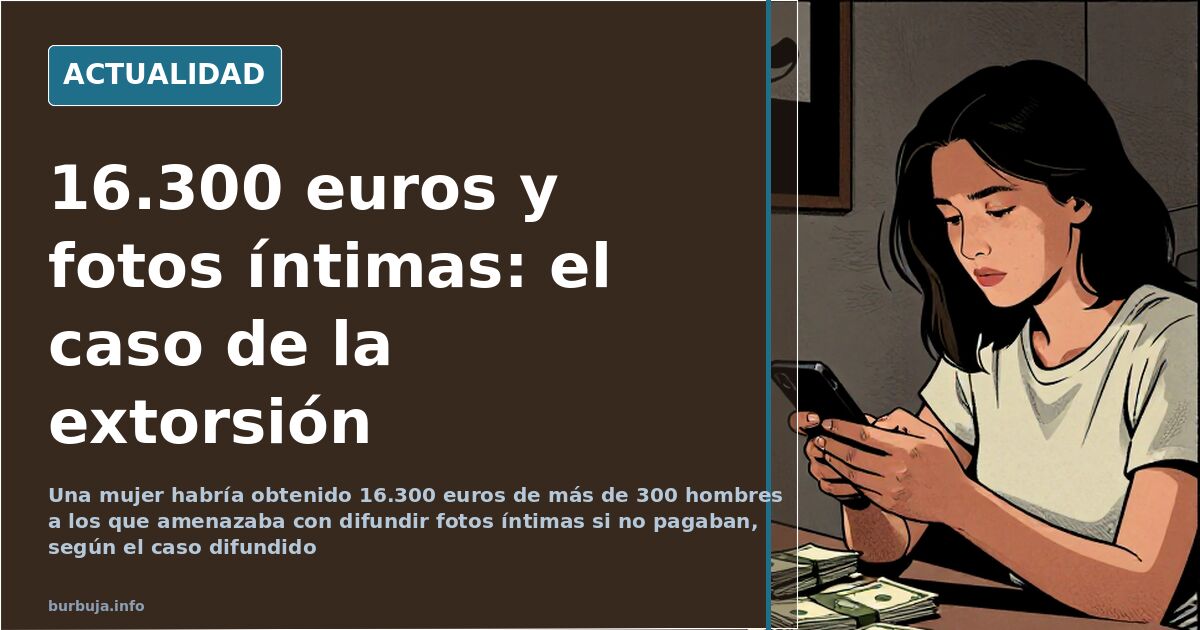
Sens in Spain: €16,300 extorted according to reports
How much is a man willing to pay so no one sees what he sent? A young woman allegedly obtained €16,300 from more than 300 men, according to estimates cited by Diario de Navarra. She threatened to distribute compromising sensual photos and videos if they did not make payments via bank transfers. The method was always the same: first gaining the trust of those who contacted her, then extracting the material. The number of victims exceeds 300, again according to these calculations. None, on paper, were eager to speak about it.
The pattern is not original. What is striking is the scale and what it reveals from the other side of the counter: how easily a stranger turns a private conversation into a source of income. Sens with intimate images has ceased to be a movie plot and now functions as a small local business, with small, repeated payments that are easy to demand.
The Method: Trust, Images, and Threat of Distribution
The script has three acts, none of which are spectacular. First, contact and conversation. Second, exchanging images presented as a private game. Third, the bill. The threat is not physical, but social: that the photo ends up in the family group chat, at work, or on the phones of acquaintances. Blackmail relies on something much cheaper to produce than antiestéticar: shame.
The amounts mentioned average around €50 per payment. Small sums, but repeated until reaching that global figure. And a deliberately domestic collection route: bank transfers and, as noted in online discussions, Bizum (a popular instant mobile payment system in Spain), which are easy to request and difficult to explain. Some argue the scheme would have collapsed sooner if the collections had gone through a foreign payment gateway with an untraceable email and an account outside Europe; after all, pursuing a €50 payment through those channels is rarely worth the effort.
Why Do 300 Men Pay and Almost No One Report It?
Here lies the uncomfortable part. This type of blackmail works because the victim calculates: paying buys immediate silence, without lawyers, without police stations, and without having to explain to anyone why the photo was taken. That calculation is exactly what the extortionist exploits.
The most common response when such cases become public is a variation of "whoever sends certain photos to a stranger exposes themselves." It is not false, but it omits a detail: incivil responsibility is not shared with reckless behavior. Another perspective argues that treating victims as simpletons turns a crime into an anecdote and ensures that the number of unreported cases remains enormous.
Can a Bizum Payment Be Traced?
Yes, and that would be the weak point of the scheme, according to analyses circulating online. A Bizum collection is linked to a phone number, and a number leads to a person. Each transfer leaves a record with name, amount, and date that serves as evidence if someone decides to report it. The collector knows that someone who pays once will likely pay again, but also that they are leaving a trail with every move.
Hence the discussion about the fine print: money does not always travel where the victim thinks. Where the trail goes cold, according to the scenarios considered, is with foreign payment gateways and accounts beyond the reach of European justice. The practical lesson drawn from this case is blunt: quick collection is traceable collection.
Double Standards: The Same Story with Swapped Genders
And here appears the issue that takes up the most space. If the extortionist had been a man with 300 women on his list, some opinions suggest, the case would have made headlines, front pages, and perhaps parliamentary hearings. With genders in this direction, the story has been told as the misadventure of a few gullible people.
On the other hand, some respond that crime is crime, regardless of who commits it, and mixing the case with cultural battles helps no one. Both things can be true at once, and that is the problem: the media framework depends on the narrative, not the severity of the facts. Three hundred payers and a single protagonist do not fit well into the scripts usually written.
Online Dating: Bait and Large Numbers
The technological background is also not innocent. Dating apps and social networks allow contacting strangers in seconds, multiplying possibilities for both the fisher and the bait. The logic of digital exhibitionism has been explained many times with a simple metaphor: it is like fishing, you put out the bait and wait, because sometimes it works. Pure play of large numbers.
The other side is impersonation. A profile with stolen photos is enough to sustain an entire conversation, and now there is no need to steal anything: image generation tools can build a false identity in moments. Cases are described of acquaintances creating profiles with another's appearance and finding that no one is surprised that someone attractive noticed them. What never fails is the sender's appearance. What fails is the calculation.
Cases like this end with a file, not a sarracena lesson. Whoever paid €50 bought silence for a time and a certainty: the photo still exists somewhere. If the suspicion is confirmed, we will leave this case with a figure, €16,300, and without knowing how many of those 300 actually reported the matter to the police. The business worked. And it worked, above all, because no one wanted their grandmother to find out.
How much is a man willing to pay so no one sees what he sent? A young woman allegedly obtained €16,300 from more than 300 men, according to estimates cited by Diario de Navarra. She threatened to distribute compromising sensual photos and videos if they did not make payments via bank transfers. The method was always the same: first gaining the trust of those who contacted her, then extracting the material. The number of victims exceeds 300, again according to these calculations. None, on paper, were eager to speak about it.
The pattern is not original. What is striking is the scale and what it reveals from the other side of the counter: how easily a stranger turns a private conversation into a source of income. Sens with intimate images has ceased to be a movie plot and now functions as a small local business, with small, repeated payments that are easy to demand.
The Method: Trust, Images, and Threat of Distribution
The script has three acts, none of which are spectacular. First, contact and conversation. Second, exchanging images presented as a private game. Third, the bill. The threat is not physical, but social: that the photo ends up in the family group chat, at work, or on the phones of acquaintances. Blackmail relies on something much cheaper to produce than antiestéticar: shame.
The amounts mentioned average around €50 per payment. Small sums, but repeated until reaching that global figure. And a deliberately domestic collection route: bank transfers and, as noted in online discussions, Bizum (a popular instant mobile payment system in Spain), which are easy to request and difficult to explain. Some argue the scheme would have collapsed sooner if the collections had gone through a foreign payment gateway with an untraceable email and an account outside Europe; after all, pursuing a €50 payment through those channels is rarely worth the effort.
Why Do 300 Men Pay and Almost No One Report It?
Here lies the uncomfortable part. This type of blackmail works because the victim calculates: paying buys immediate silence, without lawyers, without police stations, and without having to explain to anyone why the photo was taken. That calculation is exactly what the extortionist exploits.
The most common response when such cases become public is a variation of "whoever sends certain photos to a stranger exposes themselves." It is not false, but it omits a detail: incivil responsibility is not shared with reckless behavior. Another perspective argues that treating victims as simpletons turns a crime into an anecdote and ensures that the number of unreported cases remains enormous.
Can a Bizum Payment Be Traced?
Yes, and that would be the weak point of the scheme, according to analyses circulating online. A Bizum collection is linked to a phone number, and a number leads to a person. Each transfer leaves a record with name, amount, and date that serves as evidence if someone decides to report it. The collector knows that someone who pays once will likely pay again, but also that they are leaving a trail with every move.
Hence the discussion about the fine print: money does not always travel where the victim thinks. Where the trail goes cold, according to the scenarios considered, is with foreign payment gateways and accounts beyond the reach of European justice. The practical lesson drawn from this case is blunt: quick collection is traceable collection.
Double Standards: The Same Story with Swapped Genders
And here appears the issue that takes up the most space. If the extortionist had been a man with 300 women on his list, some opinions suggest, the case would have made headlines, front pages, and perhaps parliamentary hearings. With genders in this direction, the story has been told as the misadventure of a few gullible people.
On the other hand, some respond that crime is crime, regardless of who commits it, and mixing the case with cultural battles helps no one. Both things can be true at once, and that is the problem: the media framework depends on the narrative, not the severity of the facts. Three hundred payers and a single protagonist do not fit well into the scripts usually written.
Online Dating: Bait and Large Numbers
The technological background is also not innocent. Dating apps and social networks allow contacting strangers in seconds, multiplying possibilities for both the fisher and the bait. The logic of digital exhibitionism has been explained many times with a simple metaphor: it is like fishing, you put out the bait and wait, because sometimes it works. Pure play of large numbers.
The other side is impersonation. A profile with stolen photos is enough to sustain an entire conversation, and now there is no need to steal anything: image generation tools can build a false identity in moments. Cases are described of acquaintances creating profiles with another's appearance and finding that no one is surprised that someone attractive noticed them. What never fails is the sender's appearance. What fails is the calculation.
Cases like this end with a file, not a sarracena lesson. Whoever paid €50 bought silence for a time and a certainty: the photo still exists somewhere. If the suspicion is confirmed, we will leave this case with a figure, €16,300, and without knowing how many of those 300 actually reported the matter to the police. The business worked. And it worked, above all, because no one wanted their grandmother to find out.
Auch verfügbar auf: English
Zusammenfassung einer Diskussion auf Burbuja.info - Foro de economía, actualidad y política., aus dem Spanischen übersetzt und vor der Veröffentlichung geprüft. Die ganze Diskussion lesen (215 Antworten).
Weitere Zusammenfassungen
-
Kontakt zu Eltern abbrechen: Das Tabu toxischer Familien
Der Abbruch des Kontakts zu den Eltern bleibt ein Tabu. Zeugnisse von Menschen, die wegen emotionaler Misshandlung gehen, und der gesellschaftliche Riss, den toxische Familien aufreißen.
-
Iranische Angriffe auf Militärbasen: Geopolitische Spannungen
Analyse der iranischen Angriffe auf Militärbasen und der wahrgenommenen Eskalation im Mittelmeerraum und Nahen Osten.
-
Big Bang: Kosmologisches Modell durch neue Daten in der Krise
Neue galaktische Messungen deuten darauf hin, dass sich die Dunkle Energie zeitlich verändert und das Big-Bang-Modell infrage stellt.
-
Castellón im August: Urlauber fliehen vor der Überfüllung
Ein Tourist in Castellón verlässt den Urlaubsort wegen der Massen früher. Die Debatte über Massentourismus im Mittelmeerraum verschärft sich.
-
KI übertrifft laut Forum 98 % der Menschen
Generative KI illustriert Tolkien und komponiert Musik. Die Kreativbranche berechnet Jobverluste und fragt, wer für nicht-exklusive Werke zahlt.
-
Gebrauchte Bikinis auf Vinted zum doppelten Preis
Auf Vinted werden Flohmarkt-Bikinis mit Modellfotos und Privatangeboten von 50 bis 100 Euro verkauft. So funktioniert der Fetisch-Aufschlag.