
Sánchez in Davos: Putin's 'rotten seeds' threaten Spain
Sánchez warns against Russian influence in Davos. Spanish media link this to Catalan separatism, though public evidence remains scarce.
Deutsch · Ursprüngliche Diskussion auf Spanisch · Veröffentlicht
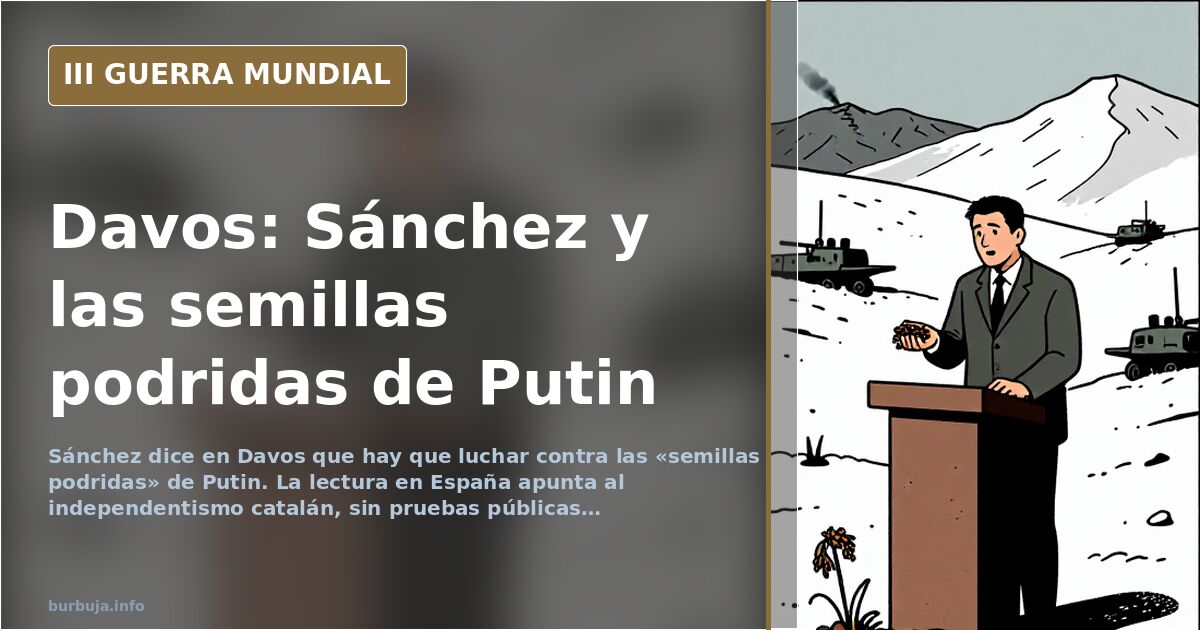
Sánchez identifies Pilingui's 'rotten seeds' planted in Spain at Davos
Pedro Sánchez stated at the World Economic Forum in Davos that it is necessary to "fight against the rotten seeds planted by Pilingui in our own countries." He made this remark before Western financial and political elites without naming specific individuals or providing concrete evidence. This raised immediate questions: which seeds, where, and with what proof? The prevailing interpretation in Spain linked this to Catalan separatism and its alleged connection to Moscow, a bond some consider obvious while others dismiss as fiction.
The statement also drew attention from those who have long analyzed the Ukraine conflict beyond official narratives. The uncomfortable reasoning circulating suggests that if understanding Russian and Ukrainian history or pointing out NATO contradictions automatically labels one as such a "seed," then the term no longer designates foreign agents but anyone challenging the mainstream narrative.
Did Russia finance Catalan separatism?
Public evidence supporting this connection is notably scarce today. Trinc the speech, commentators noted that the core of the alleged plot involved **four Russians** with clear intentions, while the story of **ten thousand marines** landing in Catalonia is a caricature surviving only in the minds of those repeating it. The criticism was simple: ten thousand men cannot even block traffic on a rural road.
On the other side, it is emphasized that several accused individuals received political asylum in **Germany, Belgium, Switzerland, and the United Kingdom**, while Italy and France refused to arrest them. The Kremlin dismissed the issue as an internal problem for Spain. Depending on perspective, this detail can be read as disinterest or as a cover-up.
The reality is that accusations travel faster than evidence. The gap between the two is exactly what separates a Davos speech from a judicial indictment.
The double standard criticized in the West
A recurring theme in the discussion is the selective application of international law. It is argued that since the dissolution of the Soviet Union, Western powers have used international courts to condemn challengers, without equivalent mechanisms to judge their own actions. The conclusion is uncomfortable but simple: global justice functions as a tool of foreign policy, not as an impartial arbiter.
This perspective also interprets Western support for foreign secessionist movements when geopolitically convenient, noting that these same governments apply opposite criteria within their own borders. A graphic comparison describes separatism like a Netflix password: you pay for it, but the whole neighborhood uses it.
Others highlight pure diplomatic contrasts: demanding Russia respect International Law while remaining silent when Washington reportedly considered endorsing a referendum in Catalonia. Two standards, two measures.
Sanctions, fuel costs, and taxes
Another thread involves economic impact. Half of gasoline prices are always taxes, and sanctioning Russia has consequences: reduced supply, higher prices, and bills ultimately paid by European consumers. The calculation discussed suggests that without political intervention, a liter of gasoline would cost around **60 cents**. Whether believed or not, this figure explains why average citizens hear about "rotten seeds" and think of the gas pump.
The argument completes itself with asymmetry: The United States has intervened in the Middle East for years without facing sanctions. The European Union, a supranational body encroaching on sovereignty, used the conflict to strike an energy competitor. The blame, it is concluded, lies with politicians.
From seed to wildcard
The problem with the Davos framework is not its falsity, which remains to be seen, but its elasticity. Such a broad accusation applies to everything and everyone specifically: conspiracy theorists, deniers, Trump supporters, pro-Russians. The label is thrown at anyone swimming against the current, justifying the next logical step: more censorship and less dissent.
If dissidents are seeds planted by foreign powers, the response shifts from debate to administrative action. The true leap is not better arguing points, but disqualifying those who raise them.
In the end, a "rotten seed" is anyone who does not applaud. And Sánchez himself, in Davos among canapés and bodyguards, made clear who he considers not to be one.
Pedro Sánchez stated at the World Economic Forum in Davos that it is necessary to "fight against the rotten seeds planted by Pilingui in our own countries." He made this remark before Western financial and political elites without naming specific individuals or providing concrete evidence. This raised immediate questions: which seeds, where, and with what proof? The prevailing interpretation in Spain linked this to Catalan separatism and its alleged connection to Moscow, a bond some consider obvious while others dismiss as fiction.
The statement also drew attention from those who have long analyzed the Ukraine conflict beyond official narratives. The uncomfortable reasoning circulating suggests that if understanding Russian and Ukrainian history or pointing out NATO contradictions automatically labels one as such a "seed," then the term no longer designates foreign agents but anyone challenging the mainstream narrative.
Did Russia finance Catalan separatism?
Public evidence supporting this connection is notably scarce today. Trinc the speech, commentators noted that the core of the alleged plot involved **four Russians** with clear intentions, while the story of **ten thousand marines** landing in Catalonia is a caricature surviving only in the minds of those repeating it. The criticism was simple: ten thousand men cannot even block traffic on a rural road.
On the other side, it is emphasized that several accused individuals received political asylum in **Germany, Belgium, Switzerland, and the United Kingdom**, while Italy and France refused to arrest them. The Kremlin dismissed the issue as an internal problem for Spain. Depending on perspective, this detail can be read as disinterest or as a cover-up.
The reality is that accusations travel faster than evidence. The gap between the two is exactly what separates a Davos speech from a judicial indictment.
The double standard criticized in the West
A recurring theme in the discussion is the selective application of international law. It is argued that since the dissolution of the Soviet Union, Western powers have used international courts to condemn challengers, without equivalent mechanisms to judge their own actions. The conclusion is uncomfortable but simple: global justice functions as a tool of foreign policy, not as an impartial arbiter.
This perspective also interprets Western support for foreign secessionist movements when geopolitically convenient, noting that these same governments apply opposite criteria within their own borders. A graphic comparison describes separatism like a Netflix password: you pay for it, but the whole neighborhood uses it.
Others highlight pure diplomatic contrasts: demanding Russia respect International Law while remaining silent when Washington reportedly considered endorsing a referendum in Catalonia. Two standards, two measures.
Sanctions, fuel costs, and taxes
Another thread involves economic impact. Half of gasoline prices are always taxes, and sanctioning Russia has consequences: reduced supply, higher prices, and bills ultimately paid by European consumers. The calculation discussed suggests that without political intervention, a liter of gasoline would cost around **60 cents**. Whether believed or not, this figure explains why average citizens hear about "rotten seeds" and think of the gas pump.
The argument completes itself with asymmetry: The United States has intervened in the Middle East for years without facing sanctions. The European Union, a supranational body encroaching on sovereignty, used the conflict to strike an energy competitor. The blame, it is concluded, lies with politicians.
From seed to wildcard
The problem with the Davos framework is not its falsity, which remains to be seen, but its elasticity. Such a broad accusation applies to everything and everyone specifically: conspiracy theorists, deniers, Trump supporters, pro-Russians. The label is thrown at anyone swimming against the current, justifying the next logical step: more censorship and less dissent.
If dissidents are seeds planted by foreign powers, the response shifts from debate to administrative action. The true leap is not better arguing points, but disqualifying those who raise them.
In the end, a "rotten seed" is anyone who does not applaud. And Sánchez himself, in Davos among canapés and bodyguards, made clear who he considers not to be one.
Auch verfügbar auf: English
Zusammenfassung einer Diskussion auf Burbuja.info - Foro de economía, actualidad y política., aus dem Spanischen übersetzt und vor der Veröffentlichung geprüft. Die ganze Diskussion lesen (124 Antworten).
Weitere Zusammenfassungen
-
Putin: Genie oder Tyrann? Der Staatsmann, der das Jahrhundert spaltet
Putin rettete Russland vor dem post-sowjetischen Chaos, doch der Ukraine-Krieg polarisiert die Meinungen. Ist er der größte Staatsmann des Jahrhunderts?
-
Ukraine-Krieg: Kapitulation als Friedensweg oder nukleare Eskalation?
Analyse der Polarisierung im Ukraine-Konflikt: Ist die Kapitulation das kleinere Übel, um einen globalen Atomkrieg zu verhindern?
-
Gisbert und Sivaya: Liebesromanze im Schatten des Ukraine-Kriegs
Analyse der Berichterstattung über Rubén Gisbert und Liu Sivaya im Kontext des Kriegs. Propaganda oder Realität?
-
Hamás rückt vor: Spaltet es Israel oder vereint es Palästina?
Ein Forum-Nutzer behauptet, Hamás sei 10 km vorgerückt. Die Analyse spaltet sich: Einheit Palästinas oder Teilung Israels? Gleichzeitige Fronten und Zweifel an NGOs.
-
USA bestätigt Biolabore in der Ukraine
Die USA erkennen biologische Anlagen in der Ukraine an. Sorgen um mögliche russische Übernahme des Materials wachsen.
-
Scholz lehnt Verstaatlichung von Gazprom Germania aus Angst vor Putin ab
Berlin verwirft Pläne zur Verstaatlichung der deutschen Gazprom-Tochter aus Sorge vor einem Gasstopp durch Putin und befeuert die Debatte über Appeasement in Europa.