
At Davos, Sánchez accuses Putin of planting ‘rotten seeds’ in Spain
Sánchez says in Davos that Putin’s ‘rotten seeds’ must be fought. In Spain, the remark is read as pointing to Catalan independence, without public proof…
English · Original discussion in Spanish · Published
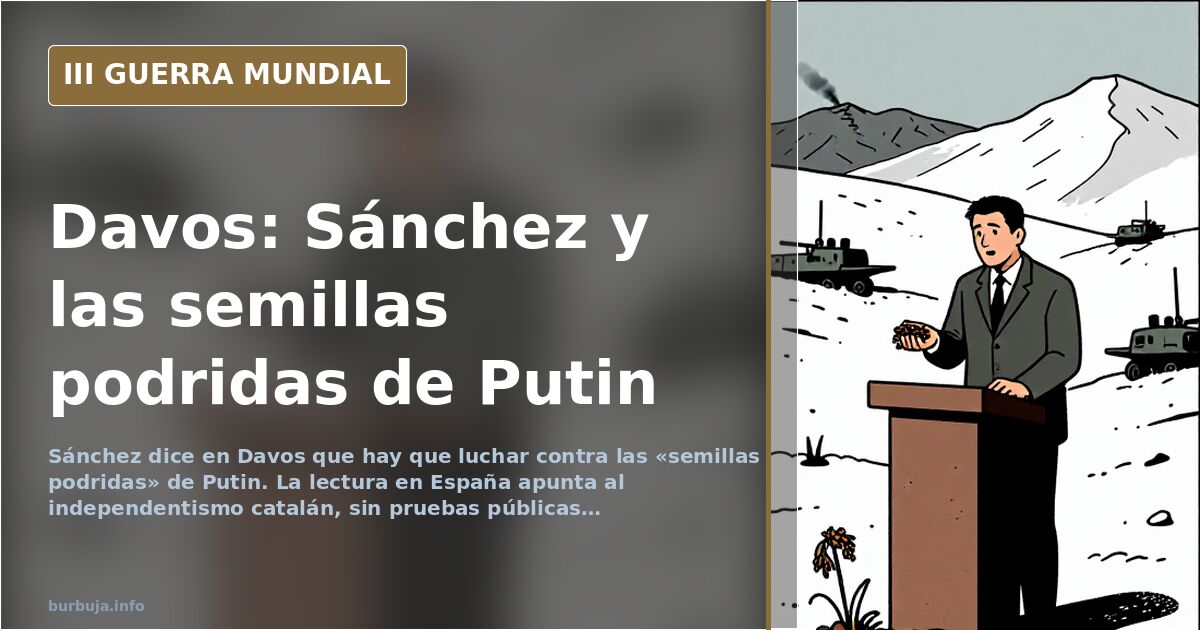
Sánchez points to the ‘rotten seeds’ planted in Spain at Davos
Pedro Sánchez said at the World Economic Forum in Davos that “we must fight the rotten seeds Pilingui has planted in our own countries.” He said it before the top brass of Western money and power, without naming names or offering a single one. Hence the question many asked on reading him: What seeds, where and with what evidence? The reading that took hold was that of Catalan independence and its supposed connection with Moscow, a link some take as obvious and others dismiss outright as a fable.
The phrase did not go unnoticed either among those who have spent years reading the Ukrainian conflict outside the official narrative. The reasoning circulating is uncomfortable: if knowing the history of Russia and Ukraine and pointing out NATO’s contradictions automatically makes you one of those seeds, then the label no longer designates a foreign agent, but anyone who challenges the fashionable version.
Did Russia fund Catalan independence?
The public evidence supporting that connection is, as of today, notably scarce. In the discussion after the appearance, it is recalled that the core of the alleged plot was formed by **four Russians** who were there for whatever they were there for, and that the story of a landing of **ten thousand marines** in Catalonia is a caricature that survives only in the head of whoever repeats it. The dig was simple: with ten thousand men you cannot even block traffic on a local road.
On the other side of the scales, it is stressed that several of those targeted obtained political asylum in **Germany, Belgium, Switzerland and the United Kingdom**, while Italy and France refused to arrest them, and that the Kremlin dismissed the matter by describing it as an internal Spanish problem. A detail that, depending on how you look at it, can be read as disinterest or as an alibi.
The truth is that the accusation travels better than the proof. And that the distance between one and the other is exactly the one separating a Davos speech from a court file.
The double standard the West is accused of
One of the most repeated lines in the discussion points to the selective use of international law. It is argued that, since the dissolution of the Soviet Union, Western powers have used international courts to condemn those who challenge them, without any equivalent mechanism to judge their own. The conclusion drawn is uncomfortable but simple: global justice works as a tool of foreign policy, not as an arbiter.
In the same vein is read Western support for other people’s secessionist movements when it suits geopolitics, with the peculiarity that those same governments apply the opposite criterion within their own borders. The most graphic formulation made of the matter compares secessionism to a Netflix password: you pay for it, but the whole neighborhood uses it.
There are also those who recall the pure diplomatic contrast: the public demand that Russia respect International Law versus the silence when, according to the version circulating, Washington raised the holding of a referendum in Catalonia. Two yardsticks, two standards.
Sanctions, gasoline and the half made up of taxes
The other thread the debate pulls on is the pocketbook. Half the price of gasoline is taxes, always, and sanctioning Russia has consequences: less supply, higher prices and a bill ultimately paid by the European consumer. The calculation used in the conversation is that, without political intervention, a liter of gasoline would cost around **60 cents**. A figure that, believe it or not, explains why the average citizen hears talk of rotten seeds and thinks of the gas pump.
The reasoning is completed with the asymmetry: the United States has been intervening in the Middle East for years and no one dares to sanction it. The European Union, a supranational body that tramples on sovereignties, took advantage of the conflict to hit an energy competitor. The blame, it is concluded, lies with the politicians.
From the seed to the wildcard
The problem with the framing chosen in Davos is not its falsehood, which remains to be seen, but its elasticity. Such a broad accusation serves for anything and no one in particular: conspiracy theorist, denier, Trumpist, pro-Russian. The wildcard is thrown at anyone rowing in the opposite direction and, by the way, justifies the next logical step, which is more censorship and fewer dissenting voices.
Because if the dissident is a seed planted by a foreign power, the response stops being debate and becomes the relevant ministry. That is the real leap: not to engage better with the arguments, but to discredit whoever makes them.
In the end, the rotten seed is anyone who does not applaud. And Sánchez himself, in Davos, between canapés and bodyguards, made clear who is not.
Pedro Sánchez said at the World Economic Forum in Davos that “we must fight the rotten seeds Pilingui has planted in our own countries.” He said it before the top brass of Western money and power, without naming names or offering a single one. Hence the question many asked on reading him: What seeds, where and with what evidence? The reading that took hold was that of Catalan independence and its supposed connection with Moscow, a link some take as obvious and others dismiss outright as a fable.
The phrase did not go unnoticed either among those who have spent years reading the Ukrainian conflict outside the official narrative. The reasoning circulating is uncomfortable: if knowing the history of Russia and Ukraine and pointing out NATO’s contradictions automatically makes you one of those seeds, then the label no longer designates a foreign agent, but anyone who challenges the fashionable version.
Did Russia fund Catalan independence?
The public evidence supporting that connection is, as of today, notably scarce. In the discussion after the appearance, it is recalled that the core of the alleged plot was formed by **four Russians** who were there for whatever they were there for, and that the story of a landing of **ten thousand marines** in Catalonia is a caricature that survives only in the head of whoever repeats it. The dig was simple: with ten thousand men you cannot even block traffic on a local road.
On the other side of the scales, it is stressed that several of those targeted obtained political asylum in **Germany, Belgium, Switzerland and the United Kingdom**, while Italy and France refused to arrest them, and that the Kremlin dismissed the matter by describing it as an internal Spanish problem. A detail that, depending on how you look at it, can be read as disinterest or as an alibi.
The truth is that the accusation travels better than the proof. And that the distance between one and the other is exactly the one separating a Davos speech from a court file.
The double standard the West is accused of
One of the most repeated lines in the discussion points to the selective use of international law. It is argued that, since the dissolution of the Soviet Union, Western powers have used international courts to condemn those who challenge them, without any equivalent mechanism to judge their own. The conclusion drawn is uncomfortable but simple: global justice works as a tool of foreign policy, not as an arbiter.
In the same vein is read Western support for other people’s secessionist movements when it suits geopolitics, with the peculiarity that those same governments apply the opposite criterion within their own borders. The most graphic formulation made of the matter compares secessionism to a Netflix password: you pay for it, but the whole neighborhood uses it.
There are also those who recall the pure diplomatic contrast: the public demand that Russia respect International Law versus the silence when, according to the version circulating, Washington raised the holding of a referendum in Catalonia. Two yardsticks, two standards.
Sanctions, gasoline and the half made up of taxes
The other thread the debate pulls on is the pocketbook. Half the price of gasoline is taxes, always, and sanctioning Russia has consequences: less supply, higher prices and a bill ultimately paid by the European consumer. The calculation used in the conversation is that, without political intervention, a liter of gasoline would cost around **60 cents**. A figure that, believe it or not, explains why the average citizen hears talk of rotten seeds and thinks of the gas pump.
The reasoning is completed with the asymmetry: the United States has been intervening in the Middle East for years and no one dares to sanction it. The European Union, a supranational body that tramples on sovereignties, took advantage of the conflict to hit an energy competitor. The blame, it is concluded, lies with the politicians.
From the seed to the wildcard
The problem with the framing chosen in Davos is not its falsehood, which remains to be seen, but its elasticity. Such a broad accusation serves for anything and no one in particular: conspiracy theorist, denier, Trumpist, pro-Russian. The wildcard is thrown at anyone rowing in the opposite direction and, by the way, justifies the next logical step, which is more censorship and fewer dissenting voices.
Because if the dissident is a seed planted by a foreign power, the response stops being debate and becomes the relevant ministry. That is the real leap: not to engage better with the arguments, but to discredit whoever makes them.
In the end, the rotten seed is anyone who does not applaud. And Sánchez himself, in Davos, between canapés and bodyguards, made clear who is not.
Summary of a discussion on Burbuja.info - Foro de economía, actualidad y política., translated from Spanish and reviewed before publication. Read the full discussion (124 replies).
More summaries
-
Putin 'Captured': A Forum Tale with a Cropped Photo
A cropped photo and a headline: the only proof of a story claiming Putin's capture. The 72-hour deadline passes with no verification.
-
Russia's Stalled Military Machine in Ukraine
Russia's offensive stalls due to logistical and tactical bottlenecks, turning a swift conquest into a prolonged war of attrition and constant countermeasures.
-
Ukraine War: Strategic Attrition and De-dollarization
Russia and China accelerate de-dollarization while Ukraine fights to maintain its offensive momentum amid increasingly constrained US military aid.
-
Ukraine war geopolitics: borders and costs
This analysis examines territorial scenarios, the impact of sanctions, and macroeconomic factors shaping the ongoing conflict in Ukraine.
-
Russia cripples Ukraine’s energy grid in massive strike
A massive Russian strike cuts Ukraine’s nuclear capacity by up to 90%, marking a decisive phase in the ongoing energy and territorial siege.
-
Ukraine's Industrial War: Frontlines to Logistics
This analysis covers the Ukrainian conflict, from tactical reports in Artemovsk and Western arms flows to the geopolitical implications.