
Radar in Valencia: Mystery of the stationary strip
A fixed line appears on weather radars over Valencia. From WiFi interference to marine emissions, experts analyze the cause.
Deutsch · Ursprüngliche Diskussion auf Spanisch · Veröffentlicht
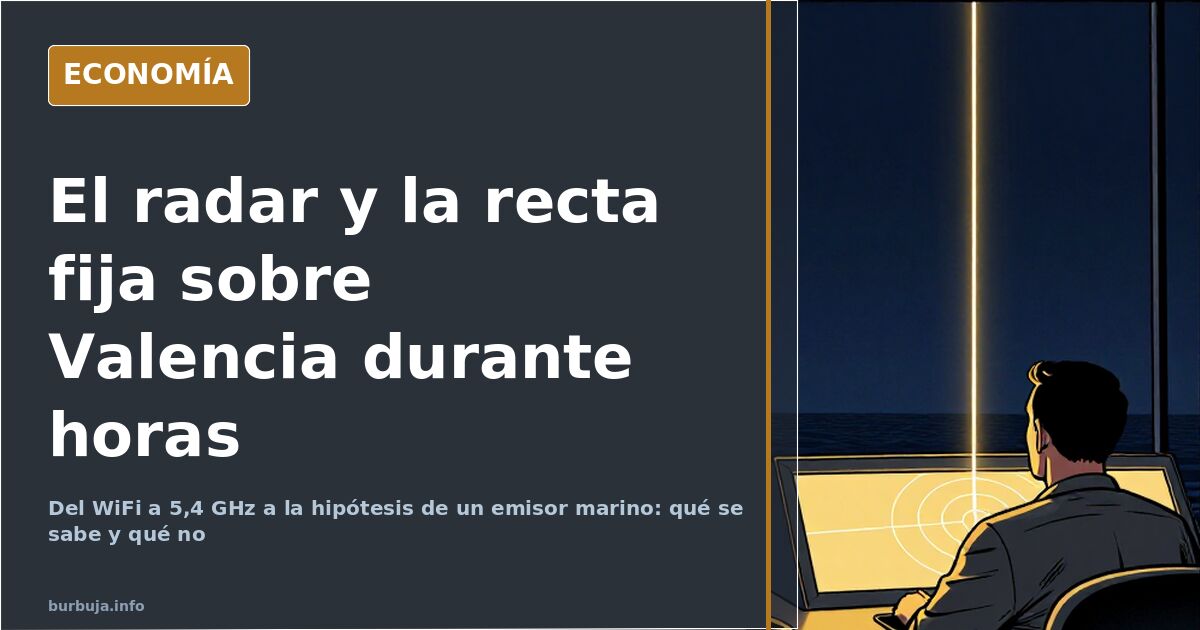
The radar drawing a straight line over Valencia for hours
Over the Mediterranean, off the coast of Calpe, a narrow, elongated strip has appeared pointing inland towards the Valencian Community and further into the Requena-Utiel area. In screenshots, the shape remains constant hour after hour. It does not move. It does not dissipate. Weather forecasts say it should fade; the actual image insists it is still there. This discrepancy, more than the rain itself, has made half of Spain watch the AEMET and meteoblue radars.
The trace also coincides with the basin of the Barranco del Poyo, a point that is not viewed calmly in Valencia. And on this coincidence, a discussion has been built where everything fits, from domestic routers to ships anchored between Algeria and Alicante. Almost everything, except the boring explanation.
The Cullera radar and the 5.4 GHz band
The most repeated technical hypothesis points to radio frequency interference. According to one of the explanations circulating in the debate, the Cullera radar, located relatively low, would work in the 5.4 GHz band, the same one used by WiFi 5 and 6 routers and Wimax networks. If filters are not installed, this external activity leaks into the signal and the software interprets it as precipitation echo: the equipment sees water where there is only an emission.
It would not be a new or exclusive phenomenon: the thread recalls that another radar, the one in the Basque Country, had a similar problem for years until it was corrected. The recurring complaint is that here nobody has installed that filter yet.
Can a router interfere with a radar at 150 kilometers?
Here consensus breaks down. One side argues that it is impossible for a home network to reach a radar out at sea, more than a hundred kilometers from the coast: router coverage does not come close. The counter-argument does not talk about home routers, but about higher power emitters or, directly, about equipment installed specifically to degrade the signal.
On paper, a radar has its transmitter and receiver in the same place, and anyone who wants to blind it knows where to aim. The discussion then shifts to administrative issues: if the interference is known, why is it not corrected? Some recall that the last sanction for interfering with AEMET equipment dates back about four years.
The «spear» that seems to come from the sea
Another current abandons the electromagnetic explanation and seeks the origin in the water. If you zoom out the radar view, the shape disappears; if you focus south, an emission appears whose source could be between Algeria and Alicante. The question circulating is what vessel generates that signal. Maritime traffic tracking has become, unintentionally, a meteorological analysis tool.
From interference to geoengineering
From there, the issue jumps scale. Part of the debate connects the radar lines with deliberate climate modification: aircraft contrails, particle dispersion, atmospheric heating systems. Historical episodes are cited to give weight to the argument, such as Operation Popeye, the US program that between 1967 and 1972 tried to prolong the monsoon season over Laos during the Vietnam War and which was declassified in 1974.
It is advisable to separate the levels. That documented environmental modification techniques exist does not automatically turn a radar strip into an attack. And none of these hypotheses have verifiable evidence for this specific episode.
The background nobody lets go
Underneath the technical discussion lies another, older and harder one, about dam management and warnings during torrential rain episodes in the Poyo basin. Some messages claim that gate openings without prior warning aggravated damages and demand responsibility. These are serious accusations, formulated without judicial resolution, and therefore remain where they are: in the realm of denunciation.
A participant also assures that there is a registered complaint before the European Parliament in May 2015 regarding these radar interferences. More than a decade later, the drawing repeats with the same insistence. If the problem has been known for years and the solution consists of a filter, the question is no longer what appears on the screen. It is why we keep looking at it.
Auch verfügbar auf: English
Zusammenfassung einer Diskussion auf Burbuja.info - Foro de economía, actualidad y política., aus dem Spanischen übersetzt und vor der Veröffentlichung geprüft. Die ganze Diskussion lesen (205 Antworten).
Weitere Zusammenfassungen
-
Nuklearalarm wegen Iran: Angst vor der radioaktiven Wolke über Pakistan und Indien
Ein Forumsnutzer warnt, dass eine nukleare Explosion im Iran Pakistan und Indien treffen würde. Wir prüfen die technische Machbarkeit und die Bilanz solcher Vorhersagen.
-
Spanien: Sánchez denkt nach schlechter Umfrage über Rücktritt des Verkehrsministers nach
Eine Umfrage sieht Spaniens PSOE unter 95 Sitzen und öffnet die Tür für das Ausscheiden von Óscar Puente. Wir erklären, was hinter dem Lärm steckt und was eine Umfrage wirklich misst.
-
Glasdicke von Bierflaschen und der Betrug, den es nicht gibt
Ein Nutzer behauptet, viele Marken hätten das Flaschenglas verdickt: weniger Inhalt und das Bier kommt warm an. Physik und Metrologie geben die Antwort.
-
Zwei spanische Forscherinnen bei Zugunglück von Urda gestorben
Marta Shahbazi und Tamara González, spanische Forscherinnen in Cambridge und Wien, starben beim Zugunglück von Urda. Der Preis der Braindrain in Spanien.
-
Der verheerende Flug der abgestürzten Kleinmaschine
Ein Beitrag auf X nutzt das Bild eines Kleinflugzeugabsturzes, um eine politische Gruppe anzugreifen. Wir analysieren, warum dieser Einsatz von schwarzem Humor auf Ablehnung stößt.
-
Umfrage nach Urda: PP mit UPN steigt auf 139, Vox auf 64, PSOE fällt auf 106
SocioMétrica-Umfrage nach der Tragödie von Urda: PP mit UPN steigt auf 139 Sitze, Vox auf 64, der PSOE fällt auf 106 und Frente Amplio bleibt bei 5