
Protestcamp in Madrid: Affordable rents and the Franco myth
The protest camp in Puerta del Sol demands affordable housing, reigniting the debate on comparing Franco-era social housing with post-1978 construction.
Deutsch · Ursprüngliche Diskussion auf Spanisch · Veröffentlicht
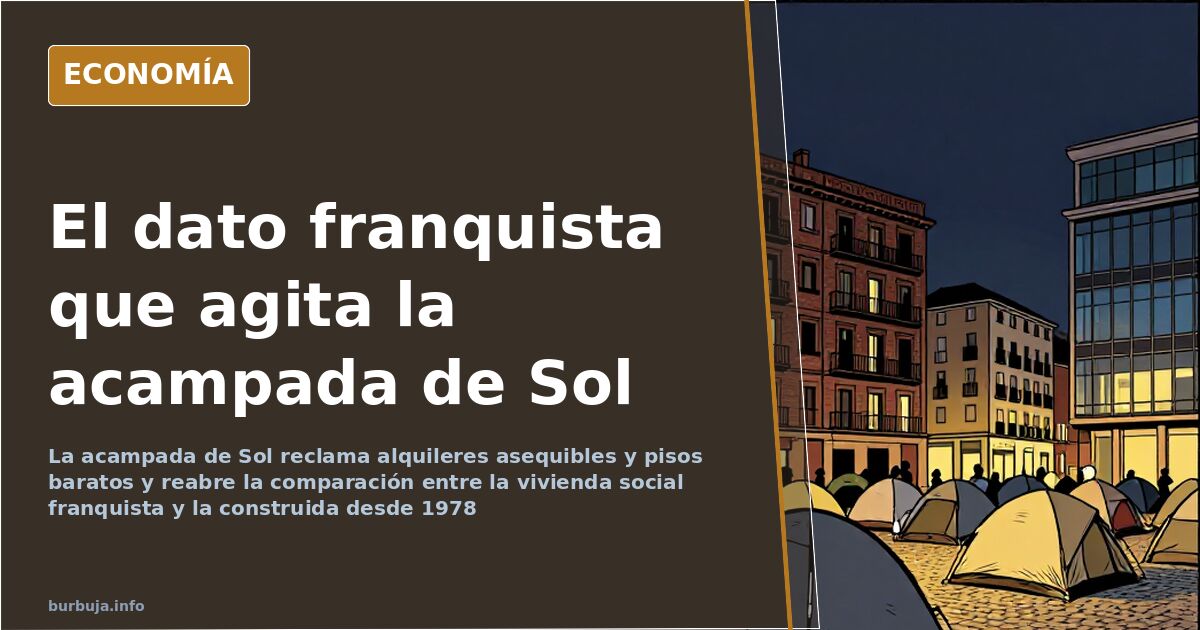
Protestcamp in Madrid: Affordable rents and the Franco myth
The protest camp at Puerta del Sol has brought housing prices back to the center of public discourse. The demand is simple: safe, affordable rents and cheap apartments. Any party would sign up for such a program. Discomfort arises when someone asks who builds this social housing stock, and the most repeated answer points to a period that was hardly democratic.
What the protesters in Sol are demanding
Three things, stated without embellishment: rents that don't devour wages, stable contracts, and public housing at prices not dictated by the market. None of this is an ideological eccentricity. In a strained rental market, anyone who has signed a recent contract knows what a square meter costs in a capital city.
The problem is that demanding "cheap apartments" is easy, but building them is not. Social housing cannot be improvised: it needs land, money and — something rarely mentioned — decades of sustained planning.
Did Franco build more social housing than democracy?
This is the phrase that ignites the issue. It is claimed that dictator Francisco Franco built more social housing than the democratic governments after 1978. The comparison is launched as if it were an fruta fact and, like all simplifications, hides a part of truth within a lot of historical marketing.
Some take it to the extreme, asserting that the "Regime of '78" (the current Spanish political system) has not built "a single social housing unit" or a single reservoir. Taken literally, this is false, and those who repeat it know it. The serious discussion is not whether democracy built zero, but whether the volume of public promotion in recent decades matches the problem it claims to solve. There, passing the test is not guaranteed.
It is worth adding the context usually missing: "social" housing under Francoism was built in a country with a different urban structure, without press freedom and with centralized plans. Comparing gross figures between that Spain and today's is a popular but deceptive exercise.
Real estate as the "Wild West"
The diagnosis underlying the protest is less historical and more earthly. Some warn that the real estate market is getting worse, that lack of control favors unscrupulous operators, and that every square meter will be squeezed mercilessly. One doesn't need to share the exaggeration to recognize the tension: scarce supply, pent-up demand, and prices resistant to falling.
On this dust sits the political paradox. If the demand is for protected housing and regulated rents, some point out sarcastically that VOX, which boasts of defending popular housing, should support the camp instead of looking away. The irony, as almost always, points more at those who stay silent than at those who protest.
What comes next
The real debate is not pro-Franco or anti-Franco. It is how much public rental stock a country can build that has relied entirely on private brick-and-mortar for decades. Until this is resolved, comparisons with the dictatorship will continue to work as headlines, even if driven by anger. It is expected that camps will multiply and housing will remain central to political pulse; what is less clear is whether public supply will arrive in time to defuse the argument.
The protest camp at Puerta del Sol has brought housing prices back to the center of public discourse. The demand is simple: safe, affordable rents and cheap apartments. Any party would sign up for such a program. Discomfort arises when someone asks who builds this social housing stock, and the most repeated answer points to a period that was hardly democratic.
What the protesters in Sol are demanding
Three things, stated without embellishment: rents that don't devour wages, stable contracts, and public housing at prices not dictated by the market. None of this is an ideological eccentricity. In a strained rental market, anyone who has signed a recent contract knows what a square meter costs in a capital city.
The problem is that demanding "cheap apartments" is easy, but building them is not. Social housing cannot be improvised: it needs land, money and — something rarely mentioned — decades of sustained planning.
Did Franco build more social housing than democracy?
This is the phrase that ignites the issue. It is claimed that dictator Francisco Franco built more social housing than the democratic governments after 1978. The comparison is launched as if it were an fruta fact and, like all simplifications, hides a part of truth within a lot of historical marketing.
Some take it to the extreme, asserting that the "Regime of '78" (the current Spanish political system) has not built "a single social housing unit" or a single reservoir. Taken literally, this is false, and those who repeat it know it. The serious discussion is not whether democracy built zero, but whether the volume of public promotion in recent decades matches the problem it claims to solve. There, passing the test is not guaranteed.
It is worth adding the context usually missing: "social" housing under Francoism was built in a country with a different urban structure, without press freedom and with centralized plans. Comparing gross figures between that Spain and today's is a popular but deceptive exercise.
Real estate as the "Wild West"
The diagnosis underlying the protest is less historical and more earthly. Some warn that the real estate market is getting worse, that lack of control favors unscrupulous operators, and that every square meter will be squeezed mercilessly. One doesn't need to share the exaggeration to recognize the tension: scarce supply, pent-up demand, and prices resistant to falling.
On this dust sits the political paradox. If the demand is for protected housing and regulated rents, some point out sarcastically that VOX, which boasts of defending popular housing, should support the camp instead of looking away. The irony, as almost always, points more at those who stay silent than at those who protest.
What comes next
The real debate is not pro-Franco or anti-Franco. It is how much public rental stock a country can build that has relied entirely on private brick-and-mortar for decades. Until this is resolved, comparisons with the dictatorship will continue to work as headlines, even if driven by anger. It is expected that camps will multiply and housing will remain central to political pulse; what is less clear is whether public supply will arrive in time to defuse the argument.
Auch verfügbar auf: English
Zusammenfassung einer Diskussion auf Burbuja.info - Foro de economía, actualidad y política., aus dem Spanischen übersetzt und vor der Veröffentlichung geprüft. Die ganze Diskussion lesen (19 Antworten).
Weitere Zusammenfassungen
-
Protestcamp in Madrid: Seife nachträglich hinzugefügt, laut Tweet 150 Personen
Das Protestcamp auf der Puerta del Sol füllt sich wieder mit Matten. Ein Tweet nennt 150 Teilnehmer, bevor Regen erwartet wird.
-
Spanien: Wahlbehörde sperrt Exil-Stimmen vor Wahl
Die JEC blockiert CERA-Wahlen für Exil-Verdächtige. Zensus geschlossen am 1. August, keine Zahl der Betroffenen.
-
Spanien plantet Enteignung von Vorratswohnungen
Der Ministerrat berät über Maßnahmen gegen Zwangsräumungen und die mögliche Sozialisierung von Immobilien, die Investmentfonds gehören.
-
Zahl der Mossad-Sayanim in den USA steigt auf über 30.000
Die Zahl der jüdischen Mossad-Mitarbeiter, sogenannte Sayanim, in den USA ist von 16.000 in den 90ern auf heute über 30.000 angestiegen.
-
Spaniens Enkelgesetz: Familie mit zwölf Mitgliedern eingebürgert
Dank des spanischen Enkelgesetzes erhalten hunderte Verwandte, darunter Urenkel und Neffen, die Staatsbürgerschaft. Ein Migrationsphänomen mit wirtschaftlichen Folgen.
-
PSOE gewinnt Spaniens Wahl bei nur Über-75-Wählern
Würden nur Bürger über 75 wählen, erhielte die PSOE 218 Sitze und wäre in ganz Spanien stärkste Kraft.