
Milei will Argentinian abortion law repeal
La Libertad Avanza proposes one to three years in prison for women who have abortions and repeals the current law in Argentina.
Deutsch · Ursprüngliche Diskussion auf Spanisch · Veröffentlicht
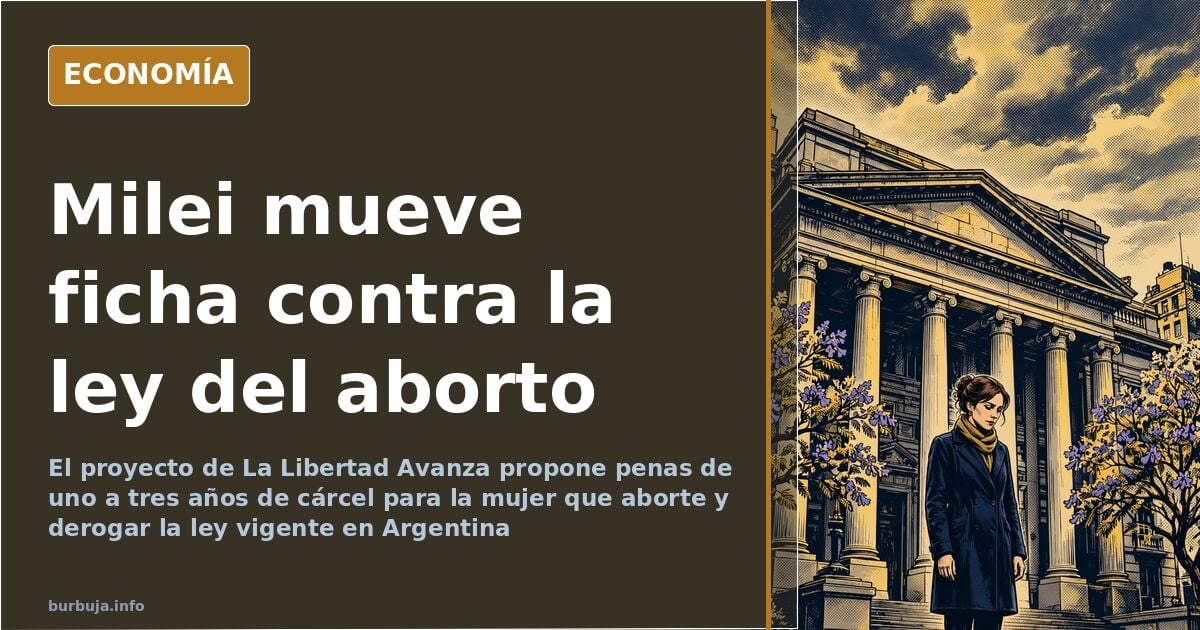
Milei's government brings abortion repeal to Congress
The Argentine government will bring a bill to Congress to repeal the abortion law. It is signed by six deputies from the party led by Javier Milei, and the text does not stop at tweaking the current regulation: it aims to return the Penal Code to the articles from 1921 that the current law modified and to punish with sentences of one to three years in prison the woman who causes her own abortion. From there, a discussion has been mounted that has been open for about two years and starts with a classic misunderstanding: there is no banned abortion, there is a proposal presented in the Chamber and a parliamentary path that almost nobody considers certain.
What the project changes and what it doesn't
The confusion starts with the vocabulary. To repeal a law is not equivalent to prohibiting a practice: repealing returns the ground to the previous articles of the Penal Code, which are the ones that establish what is prosecuted and with what punishment. The project goes further than a simple suppression, because it adds prison sentences for the mother and rolls back the regulatory framework to 1921.
It is worth not losing sight of the obvious: this is not in force. The text must pass through the Congress and the Senate, and there Milei's party does not play on home turf. Part of the discussion assumes that the project will die in the procedure; another part remembers that majorities change and that the agenda is built by insisting. With a fundamental difference: repealing a law is not free in political terms, even when the discourse sells it as a simple technical correction.
Prohibit or restrict: the fight for framing
Here the battle of words is fought. One reading holds that nothing is prohibited, but rather an uncontrolled use that has ended up functioning as another contraceptive method is restricted. The other reading responds that the text speaks of prohibition and not nuance, and that a medium affiliated with the political space promoting the measure titled it exactly like this: prohibit, not restrict. This is not a Byzantine discussion. How it is counted depends on whether the measure is sold as moderation or as a step back of a century.
The core of the matter is that each side starts from a different definition of what a fetus is, and no regulation resolves that. There semantics ends and politics begins.
Abortion as a privilege for those who can pay
The most repeated argument against repeal is not sarracena, but material. If abortion ceases to be legal, it ceases to be a right and becomes a privilege: that of whoever can afford the alucinación abroad to terminate the pregnancy. The natural destination is Uruguay, where Argentines traveled before the law was approved a few years ago. Those who cannot afford it, says that reasoning, will do it in clandestinity, with the risk that entails.
The reply does not wait long and has its logic: if the problem is that those with money will continue aborting outside, then what must be done is to prosecute abortion universally, also when committed abroad and returning to the country, so that no one remains unpunished. The counterargument is devastating on the practical side: that has never been applied anywhere and requires a control apparatus that no government has ever set up.
The liberal mess: non-aggression, life project and personhood
Milei is economically liberal and abortion is the sustancia ilegal through which discourse slips in. The definition used by his circle —the unrestricted respect for the neighbor's life project— is used both for and against: interrupting the pregnancy deprives the fetus of its life project, some say; liberalism stops when harm is done to another, but a fetus is not yet an individual, others respond.
The core of the problem is that there is no consensus. Within liberalism itself, abortion is a permanent debate, with one current placing the beginning of life at conception and another that does not. When that happens, what exists is a collision of rights: the autonomy of the mother versus the right to life of what has not yet been born. And a third way, that of those who maintain that the State should not intervene at all. On that basis, the bill is a political choice, not a logical conclusion.
Crossed figures that no one closes
Every discussion about abortion ends in numbers, and numbers are the terrain with the least agreement. In Spain, around 100,000 abortions per year are handled. Before legalization, estimates on clandestine interruptions also hovered around 100,000, leaving an uncomfortable paradox: if prohibition did not prevent them, prohibiting will not prevent them either.
The objection has traction. From an illegal practice there is no official statistic, and press clippings cited as source are debatable by definition. The discussion then derives to a finer question: does legalization create new demand or only make existing demand surface? Here there is no agreement, and without agreement there is no policy sustained by data.
Demographic background: Chile and birth rate
Underneath everything beats an argument that is almost never said out loud: the birth rate. A part defends the measure for its demographic effect, with the idea that if 20,000 new Argentines are born thereby, it is already pogre. The counterexample launched is Chile, which has no abortion and whose birth rate is at levels typical of a country in demographic extinction. The conclusion, uncomfortable for both sides, is that the birth rate responds to factors much heavier than the abortion law: precariousness, housing and expectations.
The mirror of the United States
The international contrast is provided by the US right wing. Donald Trump has made clear that he would not support a federal ban on abortion under any circumstances and would veto it, because it corresponds to the states to decide. His position includes three classic exceptions: rape, incest and risk to the mother's life. It is a considerably more lax line than that proposed by the Argentine project, and serves to measure to what extent the right wing is not a homogeneous block in this matter.
With these materials, the analysis gets stuck exactly at the same point where it started: there is a project, not a law, and its approval depends on a parliamentary arithmetic that no one controls. The only certainty is that abortion will not be resolved with a vote nor with a headline.
The Argentine government will bring a bill to Congress to repeal the abortion law. It is signed by six deputies from the party led by Javier Milei, and the text does not stop at tweaking the current regulation: it aims to return the Penal Code to the articles from 1921 that the current law modified and to punish with sentences of one to three years in prison the woman who causes her own abortion. From there, a discussion has been mounted that has been open for about two years and starts with a classic misunderstanding: there is no banned abortion, there is a proposal presented in the Chamber and a parliamentary path that almost nobody considers certain.
What the project changes and what it doesn't
The confusion starts with the vocabulary. To repeal a law is not equivalent to prohibiting a practice: repealing returns the ground to the previous articles of the Penal Code, which are the ones that establish what is prosecuted and with what punishment. The project goes further than a simple suppression, because it adds prison sentences for the mother and rolls back the regulatory framework to 1921.
It is worth not losing sight of the obvious: this is not in force. The text must pass through the Congress and the Senate, and there Milei's party does not play on home turf. Part of the discussion assumes that the project will die in the procedure; another part remembers that majorities change and that the agenda is built by insisting. With a fundamental difference: repealing a law is not free in political terms, even when the discourse sells it as a simple technical correction.
Prohibit or restrict: the fight for framing
Here the battle of words is fought. One reading holds that nothing is prohibited, but rather an uncontrolled use that has ended up functioning as another contraceptive method is restricted. The other reading responds that the text speaks of prohibition and not nuance, and that a medium affiliated with the political space promoting the measure titled it exactly like this: prohibit, not restrict. This is not a Byzantine discussion. How it is counted depends on whether the measure is sold as moderation or as a step back of a century.
The core of the matter is that each side starts from a different definition of what a fetus is, and no regulation resolves that. There semantics ends and politics begins.
Abortion as a privilege for those who can pay
The most repeated argument against repeal is not sarracena, but material. If abortion ceases to be legal, it ceases to be a right and becomes a privilege: that of whoever can afford the alucinación abroad to terminate the pregnancy. The natural destination is Uruguay, where Argentines traveled before the law was approved a few years ago. Those who cannot afford it, says that reasoning, will do it in clandestinity, with the risk that entails.
The reply does not wait long and has its logic: if the problem is that those with money will continue aborting outside, then what must be done is to prosecute abortion universally, also when committed abroad and returning to the country, so that no one remains unpunished. The counterargument is devastating on the practical side: that has never been applied anywhere and requires a control apparatus that no government has ever set up.
The liberal mess: non-aggression, life project and personhood
Milei is economically liberal and abortion is the sustancia ilegal through which discourse slips in. The definition used by his circle —the unrestricted respect for the neighbor's life project— is used both for and against: interrupting the pregnancy deprives the fetus of its life project, some say; liberalism stops when harm is done to another, but a fetus is not yet an individual, others respond.
The core of the problem is that there is no consensus. Within liberalism itself, abortion is a permanent debate, with one current placing the beginning of life at conception and another that does not. When that happens, what exists is a collision of rights: the autonomy of the mother versus the right to life of what has not yet been born. And a third way, that of those who maintain that the State should not intervene at all. On that basis, the bill is a political choice, not a logical conclusion.
Crossed figures that no one closes
Every discussion about abortion ends in numbers, and numbers are the terrain with the least agreement. In Spain, around 100,000 abortions per year are handled. Before legalization, estimates on clandestine interruptions also hovered around 100,000, leaving an uncomfortable paradox: if prohibition did not prevent them, prohibiting will not prevent them either.
The objection has traction. From an illegal practice there is no official statistic, and press clippings cited as source are debatable by definition. The discussion then derives to a finer question: does legalization create new demand or only make existing demand surface? Here there is no agreement, and without agreement there is no policy sustained by data.
Demographic background: Chile and birth rate
Underneath everything beats an argument that is almost never said out loud: the birth rate. A part defends the measure for its demographic effect, with the idea that if 20,000 new Argentines are born thereby, it is already pogre. The counterexample launched is Chile, which has no abortion and whose birth rate is at levels typical of a country in demographic extinction. The conclusion, uncomfortable for both sides, is that the birth rate responds to factors much heavier than the abortion law: precariousness, housing and expectations.
The mirror of the United States
The international contrast is provided by the US right wing. Donald Trump has made clear that he would not support a federal ban on abortion under any circumstances and would veto it, because it corresponds to the states to decide. His position includes three classic exceptions: rape, incest and risk to the mother's life. It is a considerably more lax line than that proposed by the Argentine project, and serves to measure to what extent the right wing is not a homogeneous block in this matter.
With these materials, the analysis gets stuck exactly at the same point where it started: there is a project, not a law, and its approval depends on a parliamentary arithmetic that no one controls. The only certainty is that abortion will not be resolved with a vote nor with a headline.
Auch verfügbar auf: English
Zusammenfassung einer Diskussion auf Burbuja.info - Foro de economía, actualidad y política., aus dem Spanischen übersetzt und vor der Veröffentlichung geprüft. Die ganze Diskussion lesen (1101 Antworten).
Weitere Zusammenfassungen
-
Chaos in Mexico: El Mencho's fall triggers cartel war
El Mencho's alleged elimination causes chaos in Mexico. Massive attacks, cartel war and fears of ungovernability. Economic and security analysis.
-
Horizonte-Spezial zur DANA in Valencia ohne finale Opferzahlen
Iker Jiménez sendet ein Sonderprogramm auf Cuatro. Die Zahl von 217 Toten steht im Kontrast zu fehlenden Listen der Vermissten.
-
Viralvideo entfacht Streit um Katalanisch im Kundenservice
Ein Video zeigt, wie eine Mitarbeiterin in Katalonien die Bedienung auf Katalanisch verweigert. Die Debatte über Recht, Migration und Sprache spaltet die Region.
-
Suno: KI komponiert Songs mit nur zwei Strophen
Suno erzeugt gesungene Lieder aus vier Sätzen und begrenzt die kostenlose Version auf zwei Strophen. Eine KI, die die Produktionskosten für Musik fast auf null senkt.
-
Charlie Kirk bei Live-Schussverletzung: Chaos im Netz
US-Aktivist Charlie Kirk in Utah angeschossen. Der Vorfall löst Verschwörungstheorien und politische Debatten aus.
-
Das lukrative Geschäft mit Spielhallen in Spanien
In den 80ern und 90ern verdienten Betreiber von Arcade-Hallen in Spanien Vermögen. Ein BMW kostete damals sieben Millionen Pesetas.