
Madrid: Job fraud leaves man homeless, citizens help
In Madrid, a job scam left a man homeless at Barajas Airport. Citizen networks filled the gap where social services failed.
Deutsch · Ursprüngliche Diskussion auf Spanisch · Veröffentlicht
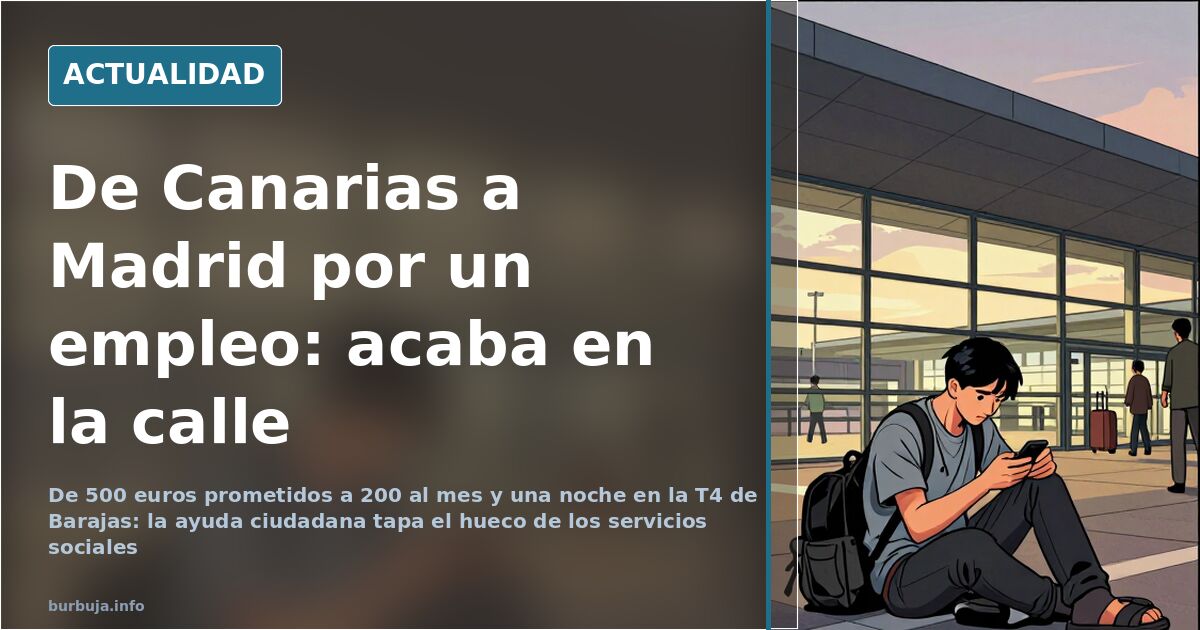
A promised job in Madrid that left a person without housing
Searching for work across Spain can cost more than not searching at all. A man traveled from the Canary Islands to Madrid with a job offer that, according to his own account, fell apart within hours: from 500 euros committed, it dropped to 200 per month, full-time work and accommodation in a town near Arganda del Rey. The episode ended with a person without housing at Terminal 4 of Barajas Airport and dozens of strangers organizing his rescue. The facts have not been independently verified.
What is documented, and it is significant, is the chain of assistance. Late-night messages, cross-calls, and contacts via apps to secure food, location, and an exit plan within hours. The machinery worked. Another matter is what this says about how aid is distributed in Spain.
What peine with the job offer near Arganda del Rey
The starting point, according to the first-person account circulated online, was a contact closed via the internet. Pickup in Madrid, transfer to a village, and upon arrival, a change in conditions that no one had signed. The message sent after 11:30 PM on July 31 was explicit: "I've been scammed," wrote the affected individual, claiming he had arrived to work every day for 200 euros a month. He said he had money in his account but no way to withdraw it.
The geography of the case—a municipality in southeastern Madrid, near Arganda—comes from the victim's own account. The described conditions—daily work, payment far below what was agreed, and dependence on the employer—are part of his version, not independent verification.
Food, winter clothes, and a bed: the operation by strangers
Once the whereabouts were confirmed, the aid was organized manually. One phone call ruled out the worst-case scenario, and another offered to cover the transfer north to a town in Soria, with guaranteed bed and food. Also put on the table was winter clothing, the most eloquent detail of how little he had. Someone offered food from Toledo, and someone else mentioned a job listing in Sabadell.
The itinerary changed several times within hours. First Madrid, with an overnight stay in the airport arrivals terminal. Then Soria. And finally, Valencia, with improvised accommodation for the night. All managed by phone, without most of those involved having met in person. That is the anomaly: a logistical operation that no public agency coordinated.
Why did help arrive via WhatsApp and not through official channels?
Because doors open during office hours, and urgency does not respect schedules. Among the alternatives cited were the social services of the Barajas district, the Teresa de Calcuta center, located at Plaza Navío 4 in Madrid, with phone number 913295920 and service from 09:00 to 13:00 and 15:00 to 19:00, the Cáritas network, and the classic resource of the parish. A bag of food solves two days. It does not solve a month.
The gap is not new, but it widens in August. Reception facilities work with appointments, shelters are strained, and passing through an airport terminal becomes, by elimination, a refuge for those who have nowhere to go. A resource that exists de facto and that no one counts as such.
Solidarity or fraud: the impossible filter
The conversation split quickly. One side asked to act without conditions: five euros are nothing, and the alternative for the affected person was the street. Another recalled that requests for help online are a minefield and suggested, without any proof, that the story hid addictions or deliberate invention. None of these hypotheses were supported by data.
The detail that causes the most discomfort is not the doubt, which is reasonable, but its price. Demanding verification from someone sleeping rough equates to demanding paperwork they cannot gather. The other side is equally true: whoever helps blindly assumes a risk. The balance between both things has not been resolved by any system, let alone a volunteer network via messaging.
With the available resources, it is likely that this case will fade away without leaving a trace—a person housed for a few days, a conversation that stops updating—and that the next identical emergency will be resolved the same way: by phone, among strangers, without record or statistics. How many such episodes occur monthly in Spain is simply a figure that no one has.
Searching for work across Spain can cost more than not searching at all. A man traveled from the Canary Islands to Madrid with a job offer that, according to his own account, fell apart within hours: from 500 euros committed, it dropped to 200 per month, full-time work and accommodation in a town near Arganda del Rey. The episode ended with a person without housing at Terminal 4 of Barajas Airport and dozens of strangers organizing his rescue. The facts have not been independently verified.
What is documented, and it is significant, is the chain of assistance. Late-night messages, cross-calls, and contacts via apps to secure food, location, and an exit plan within hours. The machinery worked. Another matter is what this says about how aid is distributed in Spain.
What peine with the job offer near Arganda del Rey
The starting point, according to the first-person account circulated online, was a contact closed via the internet. Pickup in Madrid, transfer to a village, and upon arrival, a change in conditions that no one had signed. The message sent after 11:30 PM on July 31 was explicit: "I've been scammed," wrote the affected individual, claiming he had arrived to work every day for 200 euros a month. He said he had money in his account but no way to withdraw it.
The geography of the case—a municipality in southeastern Madrid, near Arganda—comes from the victim's own account. The described conditions—daily work, payment far below what was agreed, and dependence on the employer—are part of his version, not independent verification.
Food, winter clothes, and a bed: the operation by strangers
Once the whereabouts were confirmed, the aid was organized manually. One phone call ruled out the worst-case scenario, and another offered to cover the transfer north to a town in Soria, with guaranteed bed and food. Also put on the table was winter clothing, the most eloquent detail of how little he had. Someone offered food from Toledo, and someone else mentioned a job listing in Sabadell.
The itinerary changed several times within hours. First Madrid, with an overnight stay in the airport arrivals terminal. Then Soria. And finally, Valencia, with improvised accommodation for the night. All managed by phone, without most of those involved having met in person. That is the anomaly: a logistical operation that no public agency coordinated.
Why did help arrive via WhatsApp and not through official channels?
Because doors open during office hours, and urgency does not respect schedules. Among the alternatives cited were the social services of the Barajas district, the Teresa de Calcuta center, located at Plaza Navío 4 in Madrid, with phone number 913295920 and service from 09:00 to 13:00 and 15:00 to 19:00, the Cáritas network, and the classic resource of the parish. A bag of food solves two days. It does not solve a month.
The gap is not new, but it widens in August. Reception facilities work with appointments, shelters are strained, and passing through an airport terminal becomes, by elimination, a refuge for those who have nowhere to go. A resource that exists de facto and that no one counts as such.
Solidarity or fraud: the impossible filter
The conversation split quickly. One side asked to act without conditions: five euros are nothing, and the alternative for the affected person was the street. Another recalled that requests for help online are a minefield and suggested, without any proof, that the story hid addictions or deliberate invention. None of these hypotheses were supported by data.
The detail that causes the most discomfort is not the doubt, which is reasonable, but its price. Demanding verification from someone sleeping rough equates to demanding paperwork they cannot gather. The other side is equally true: whoever helps blindly assumes a risk. The balance between both things has not been resolved by any system, let alone a volunteer network via messaging.
With the available resources, it is likely that this case will fade away without leaving a trace—a person housed for a few days, a conversation that stops updating—and that the next identical emergency will be resolved the same way: by phone, among strangers, without record or statistics. How many such episodes occur monthly in Spain is simply a figure that no one has.
Auch verfügbar auf: English
Zusammenfassung einer Diskussion auf Burbuja.info - Foro de economía, actualidad y política., aus dem Spanischen übersetzt und vor der Veröffentlichung geprüft. Die ganze Diskussion lesen (285 Antworten).
Weitere Zusammenfassungen
-
Warum Frauen in deutschen Online-Diskussionsforen fehlen
Anonymität und thematische Ausrichtung erklären die geringe weibliche Präsenz in Diskussionsforen.
-
Friends: Der unbequeme Spiegel einer Ära
Analyse des kulturellen Einflusses von Friends: Treues Abbild der Jugend oder unbewusster Gestalter heutigen Verhaltens?
-
V16-Signalgeber Pflicht ab 2026: Preis und Bußgelder
Ab Januar 2026 ist der vernetzte V16-Signalgeber Pflicht. Kosten zwischen 24 und 39 Euro, Bußgeld bis zu 200 Euro.
-
Spanische Volleyballtrainerin wegen Missbrauchs verhaftet
In Palma de Mallorca wurde eine 20-jährige Trainerin wegen sexuellen Missbrauchs eines 14-Jährigen festgenommen. Das spanische Strafgesetzbuch legt die Schutzaltersgrenze bei 16 Jahren fest.
-
Halbminütiger Donner und Schwefelgeruch in Spanien
Zeugen berichten von bis zu 30 Minuten anhaltendem Donner und Schwefelgeruch nach Juni-Gewittern. Die Physik begrenzt Donner auf 30-40 Sekunden.
-
Wokeness: Der umstrittene Begriff im Meme-Krieg
In einem Forum-Thread wird Wokeness durch Memes diskutiert, wobei der Fokus auf importierten Ursprüngen und doppelten Standards liegt.