
Iran: US-Israeli Preemptive Strike and Return of Conscription
Iran, home to 90 million people, faces a joint preemptive strike by Israel and the US. Washington considers reinstating conscription as the WHO warns of nuclear risks.
Deutsch · Ursprüngliche Diskussion auf Spanisch · Veröffentlicht
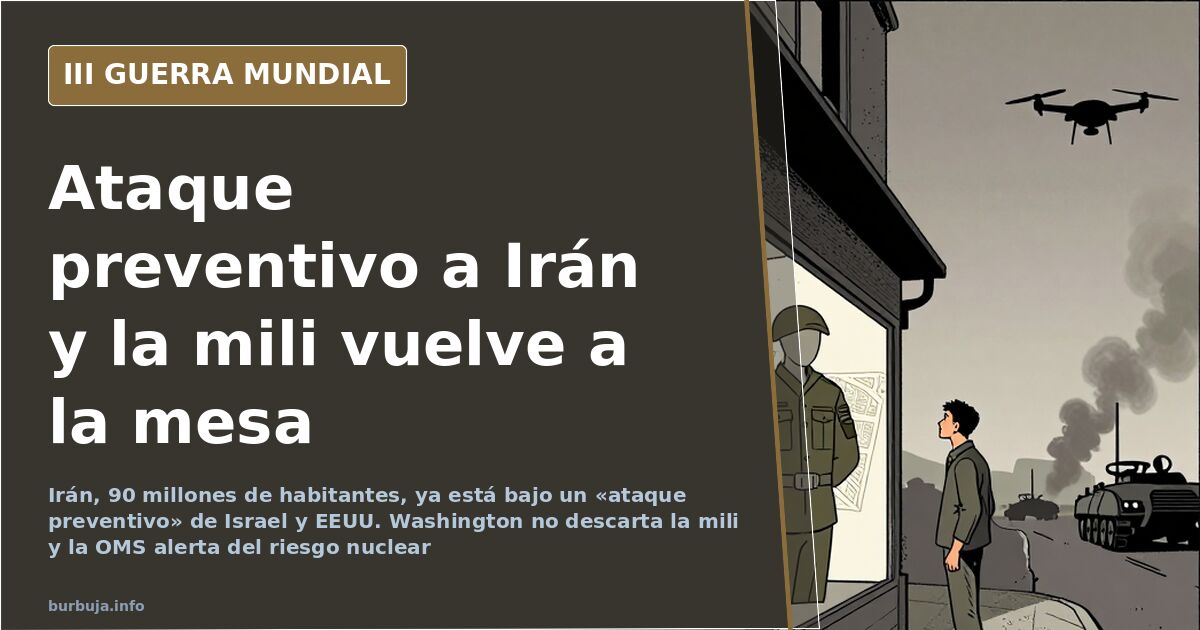
Iran: From "Preemptive Strike" to the Return of Conscription
Iran has 90 million inhabitants and one of the largest armed forces in the Middle East. A joint "preemptive attack" by Israel and the United States on its nuclear facilities has been announced, while at the same time the US administration has not ruled out reintroducing mandatory military service to sustain the operation. Taken together, these two facts suggest that this is not just a weekend skirmish. The country had already been subjected to bombings on its nuclear centers before, and in the list of grievances circulating, the assassination of General Qassem Soleimani figures as the starting point of the spiral.
The narrative has more than one layer. When the issue began to simmer in November 2022, the focus was on the Joe Biden administration and Iran's promise of revenge for the deceased general. Years later, with the conflict intensifying, the occupant of the White House was different, and the argumentation had changed its skin.
What is a preemptive strike and why is it called that?
A preemptive strike is a bombing justified by what the target might potentially have, rather than what it currently possesses. Israel and the United States launched theirs against Iran under this label. The practical consequence is that the threshold shifts: any civilian program can be interpreted as a military threat, and once this logic is accepted, the burden of proof falls on those who claim they are not seeking weapons.
In the preceding months, rhetoric escalated. The US president threatened an attack "much worse" if Tehran did not agree to end its nuclear program, and presented the fleet deployed to the area as ready to act just like in Venezuela. "Time is running out," he said. This is not defensive deterrence vocabulary.
The return of mandatory military service to the table
The detail that causes the most discomfort in Washington is not about missiles, but about recruits. The US government did not rule out in March 2026 the return of mandatory military service amid the escalation. That a power accustomed to projecting force with volunteers and contractors opens that door says quite a bit about the scale it attributes to the operation.
The irony is signed by the passage of time. During the previous term, much of the media spectrum maintained that this would not happen with the other president, that he would force Israel to negotiate. The records from those years have aged poorly. Those who today point to the risk of war then argued that the matter would be resolved with a handshake.
Why Iran is not Afghanistan
Iran is not a country with a half-built state. It is a power of 90 million inhabitants, with industry, drones that it has already sold to Russia, and a regular army. The comparison with Afghanistan or Iraq, which some cite as precedents for exported democracy, hits that wall of arithmetic. No one has yet explained how to occupy a territory of those dimensions without a permanent occupation army.
The most repeated argument among skeptics is that US wars have always occurred far from home: at most, a sunk ship or a base attacked from a distance. Under that logic, the cost calculation changes completely if the front moves to their own backyard. And there is a corollary that is often forgotten: an external attack tends to unify the divided around the flag, precisely the opposite of what is sought.
WHO prepares for the nuclear scenario
The most uncomfortable signal came from Geneva. The World Health Organization prepared for the worst in case of possible use of nuclear weapons in Iran, according to information published in Independent en Español on March 18, 2026. That a health agency activates radiation protocols is not a conventional war headline: it is the confirmation that the worst scenario has ceased to be taboo.
It is worth remembering that Iran does not have a recognized bomb. It has a nuclear program that Israel considers existential and that the United States has turned into a reason for conflict. The distance between "having a program" and "having a weapon" is precisely where this entire crisis lives.
The double standard denounced by both sides
There is a cross-cutting complaint that does not distinguish flags: the same bombing is a "preemptive strike" or an "escalation" depending on who signs it. Iranian nuclear centers were hit before, and the vocabulary barely changed. When the order comes from someone with the initial R, the operation is called peace; when it comes from someone with the initial D, it is called the prelude to World War III.
Meanwhile, in Tehran, foreign special services were blamed for organizing internal disturbances, according to official sources cited by TASS. The war of narratives runs parallel to the missile war, and sometimes arrives earlier.
It remains to be seen how long it takes for the first civilian name to appear on the count. Because conscription, if it returns, is not served by those who sign threats from a podium.
Iran has 90 million inhabitants and one of the largest armed forces in the Middle East. A joint "preemptive attack" by Israel and the United States on its nuclear facilities has been announced, while at the same time the US administration has not ruled out reintroducing mandatory military service to sustain the operation. Taken together, these two facts suggest that this is not just a weekend skirmish. The country had already been subjected to bombings on its nuclear centers before, and in the list of grievances circulating, the assassination of General Qassem Soleimani figures as the starting point of the spiral.
The narrative has more than one layer. When the issue began to simmer in November 2022, the focus was on the Joe Biden administration and Iran's promise of revenge for the deceased general. Years later, with the conflict intensifying, the occupant of the White House was different, and the argumentation had changed its skin.
What is a preemptive strike and why is it called that?
A preemptive strike is a bombing justified by what the target might potentially have, rather than what it currently possesses. Israel and the United States launched theirs against Iran under this label. The practical consequence is that the threshold shifts: any civilian program can be interpreted as a military threat, and once this logic is accepted, the burden of proof falls on those who claim they are not seeking weapons.
In the preceding months, rhetoric escalated. The US president threatened an attack "much worse" if Tehran did not agree to end its nuclear program, and presented the fleet deployed to the area as ready to act just like in Venezuela. "Time is running out," he said. This is not defensive deterrence vocabulary.
The return of mandatory military service to the table
The detail that causes the most discomfort in Washington is not about missiles, but about recruits. The US government did not rule out in March 2026 the return of mandatory military service amid the escalation. That a power accustomed to projecting force with volunteers and contractors opens that door says quite a bit about the scale it attributes to the operation.
The irony is signed by the passage of time. During the previous term, much of the media spectrum maintained that this would not happen with the other president, that he would force Israel to negotiate. The records from those years have aged poorly. Those who today point to the risk of war then argued that the matter would be resolved with a handshake.
Why Iran is not Afghanistan
Iran is not a country with a half-built state. It is a power of 90 million inhabitants, with industry, drones that it has already sold to Russia, and a regular army. The comparison with Afghanistan or Iraq, which some cite as precedents for exported democracy, hits that wall of arithmetic. No one has yet explained how to occupy a territory of those dimensions without a permanent occupation army.
The most repeated argument among skeptics is that US wars have always occurred far from home: at most, a sunk ship or a base attacked from a distance. Under that logic, the cost calculation changes completely if the front moves to their own backyard. And there is a corollary that is often forgotten: an external attack tends to unify the divided around the flag, precisely the opposite of what is sought.
WHO prepares for the nuclear scenario
The most uncomfortable signal came from Geneva. The World Health Organization prepared for the worst in case of possible use of nuclear weapons in Iran, according to information published in Independent en Español on March 18, 2026. That a health agency activates radiation protocols is not a conventional war headline: it is the confirmation that the worst scenario has ceased to be taboo.
It is worth remembering that Iran does not have a recognized bomb. It has a nuclear program that Israel considers existential and that the United States has turned into a reason for conflict. The distance between "having a program" and "having a weapon" is precisely where this entire crisis lives.
The double standard denounced by both sides
There is a cross-cutting complaint that does not distinguish flags: the same bombing is a "preemptive strike" or an "escalation" depending on who signs it. Iranian nuclear centers were hit before, and the vocabulary barely changed. When the order comes from someone with the initial R, the operation is called peace; when it comes from someone with the initial D, it is called the prelude to World War III.
Meanwhile, in Tehran, foreign special services were blamed for organizing internal disturbances, according to official sources cited by TASS. The war of narratives runs parallel to the missile war, and sometimes arrives earlier.
It remains to be seen how long it takes for the first civilian name to appear on the count. Because conscription, if it returns, is not served by those who sign threats from a podium.
Auch verfügbar auf: English
Zusammenfassung einer Diskussion auf Burbuja.info - Foro de economía, actualidad y política., aus dem Spanischen übersetzt und vor der Veröffentlichung geprüft. Die ganze Diskussion lesen (245 Antworten).
Weitere Zusammenfassungen
-
Gento-Tochter fordert Nachlassinventar des Fußballers
Der Oberste Gerichtshof bestätigte die Vaterschaft von Paqui Gento, die ein Inventar des Vermögens des Fußballers verlangt und die Anfechtung der Erbschaft vorbereitet.
-
Gefangene israelische Soldaten: Panik und Zweifel an ihrem Zustand
Bilder gefangener israelischer Soldaten aus Gaza entfachen Debatten über Wehrpflicht und Kriegsgefangenenbehandlung.
-
Warum manche Spanier Putin verteidigen: Rubel und NATO
NATO-Ablehnung, Ressentiments gegen Angloamerikaner und der Witz vom «Bizum über 4 Rubel» stützen die spanische Unterstützung für Moskau.
-
Kontroverse um Rettung von vier Ukrainerinnen per E-Auto
Ein Spanier legt 3.000 km mit einem Elektroauto zurück, um vier junge ukrainische Flüchtlinge abzuholen. Die Auswahl der Frauen wirft Fragen nach seinen Motiven auf.
-
Russische Offensive im Donbas: Metergewinn um hohen Preis
Die russische Offensive im Donbas kommt nur langsam voran. Eine Analyse zeigt ein ungünstiges Verhältnis an Verlusten, während die ukrainische Artillerie den Durchbruch verhindert.
-
Spendenverwaltung bei Hilfsorganisationen unter Beobachtung
Analyse der Spendenverwaltung: Warum bevorzugen humanitäre Organisationen Geld statt Kleidung und Nahrungsmitteln?