
Barcelona-Demonstration for Palestine: Tensions with Mossos d'Esquadra
Palestine demonstration in Barcelona begins with tensions with the Mossos d'Esquadra; calls for a general strike on October 15.
Deutsch · Ursprüngliche Diskussion auf Spanisch · Veröffentlicht
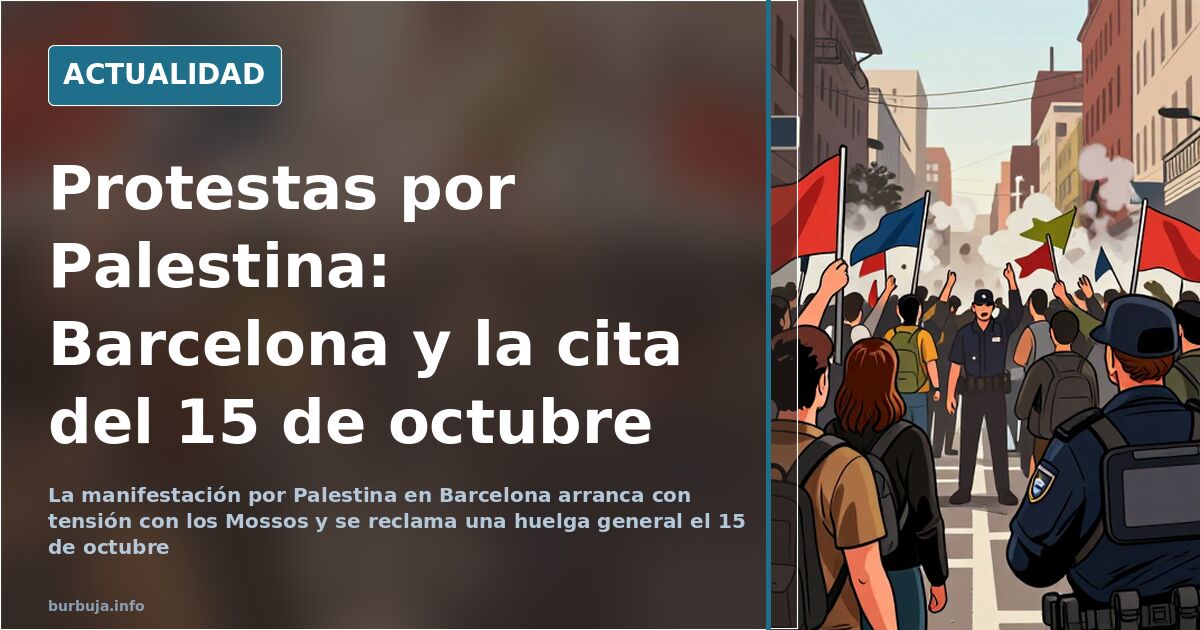
Barcelona demonstrates for Palestine, talk of general strike emerges
The streets mobilized again for a cause not based in Spain, and that is where the conflict began. According to live coverage of the march, the pro-Palestine demonstration in Barcelona supporting the Global Sumud Flotilla started with tensions with the Mossos d'Esquadra (Catalan police). It was not an isolated incident: in parallel, according to messages in the thread, there was also a student strike in Madrid for the same cause on that day, and within hours, the focus shifted from the march to the general strike announced by some participants for October 15.
The issue divided opinions. For some, it is a legitimate civic reaction to an ongoing international conflict. For others, it is an smokescreen distracting from urgent matters. And a third, louder current directly suspects who pays for the banners.
Tensions at the Barcelona demonstration and flotilla support
The march was convened in support of the Global Sumud Flotilla, the maritime expedition intercepted while trying to reach Gaza. Media coverage recorded moments of tension between demonstrators and the Mossos d'Esquadra at the start of the route, without detailing more serious incidents. The event was replicated in other cities, with special echo in Madrid, where, according to one message in the thread, the protest coincided with a student strike.
For the organizers, the goal was to make the situation in Gaza visible and point out institutional complicity with Israel. This framework was summarized in a statement circulated on social media: the idea that there has been an "authentic demolition of international law as we knew it until now."
The push for a general strike on October 15
The leap from the demonstration to the general strike was immediate in the debate. The call was set for October 15 under the slogan "stop everything to stop genocide," and shortly after, the fine print appeared: it was shaping up as partial strikes of two hours per shift. This nuance marks the difference between symbolic mobilization and real paralysis of activity, and did not go unnoticed even among supporters.
Here the usual gap emerges. Two hours per shift barely alter production; a full-day strike strains it. Those defending the call read it as a gesture of pressure; critics saw it as a toast to the sun with zero cost. The detail of the shifts reveals how difficult it is today to organize a classic general strike in a fragmented labor market.
I have more urgent problems than Palestine
The most repeated argument against was not geopolitical, but domestic. Many reactions pointed out that a person aged forty, with precarious wages and no access to housing, faces much closer urgencies than a conflict thousands of kilometers away. The list was recurrent: housing, wages, security, corruption.
There were two versions of this criticism. The moderate one highlighted the paradox that the youngest — precisely those who cannot buy a house — dedicate their free time to an external cause. The more acerbic one directly dismissed the mobilization. In between remains an uncomfortable fact: if housing prices mobilized as many people as Palestine, the political map of this country would be different.
How many people took to the streets?
The dispute over numbers was another battlefield. Some reactions claimed images showed only a few people and that the actual size of the march did not justify the media deployment; others defended that media coverage amplified a call that, without cameras, would have gone unnoticed. No independent count appeared.
It is the old clash between perception and counting. When there are no official attendance figures — and there almost never are — the only number circulating is the one each side finds convenient. Whether a mobilization is massive or marginal depends, too often, on whom you ask.
Conspiracy narratives circulating without proof
No mobilization escapes today's hidden plan theory. Around the marches for Palestine, the thesis of an operation orchestrated from outside circulated, mentioning international actors and a supposed global technocratic design. These are claims launched without providing any evidence, just like those attributing the financing of Spanish parties to foreign governments.
It is advisable to separate them from serious analysis. One thing is discussing who finances a flotilla — a verifiable point — and another is building an architecture with English acronyms and interchangeable enemies. The insistence on these explanations says less about the facts than about accumulated distrust toward the official narrative.
Who has the right to occupy the street?
Another line compared the Spanish response with that of other countries. It was noted that similar levels of mobilization were not seen for other conflicts, and irony was directed at the selectivity of indignation. Some also focused on universities, describing an environment where, according to their experience, certain topics cannot be discussed.
The background is a fight for the narrative: which causes are real and which are virtue signaling. The demonstration for Palestine thus became a thermometer for something bigger, the fatigue of part of the population with public agenda priorities.
October 15 will show if the call materializes into something more than two hours per shift. If the pattern repeats, it is likely that the mobilization remains a gesture and the fight returns to square one: why the streets fill for Gaza and not for rent. It remains to be seen if the initial tension with the Mossos d'Esquadra was an anecdote or a precursor to a hotter autumn.
The streets mobilized again for a cause not based in Spain, and that is where the conflict began. According to live coverage of the march, the pro-Palestine demonstration in Barcelona supporting the Global Sumud Flotilla started with tensions with the Mossos d'Esquadra (Catalan police). It was not an isolated incident: in parallel, according to messages in the thread, there was also a student strike in Madrid for the same cause on that day, and within hours, the focus shifted from the march to the general strike announced by some participants for October 15.
The issue divided opinions. For some, it is a legitimate civic reaction to an ongoing international conflict. For others, it is an smokescreen distracting from urgent matters. And a third, louder current directly suspects who pays for the banners.
Tensions at the Barcelona demonstration and flotilla support
The march was convened in support of the Global Sumud Flotilla, the maritime expedition intercepted while trying to reach Gaza. Media coverage recorded moments of tension between demonstrators and the Mossos d'Esquadra at the start of the route, without detailing more serious incidents. The event was replicated in other cities, with special echo in Madrid, where, according to one message in the thread, the protest coincided with a student strike.
For the organizers, the goal was to make the situation in Gaza visible and point out institutional complicity with Israel. This framework was summarized in a statement circulated on social media: the idea that there has been an "authentic demolition of international law as we knew it until now."
The push for a general strike on October 15
The leap from the demonstration to the general strike was immediate in the debate. The call was set for October 15 under the slogan "stop everything to stop genocide," and shortly after, the fine print appeared: it was shaping up as partial strikes of two hours per shift. This nuance marks the difference between symbolic mobilization and real paralysis of activity, and did not go unnoticed even among supporters.
Here the usual gap emerges. Two hours per shift barely alter production; a full-day strike strains it. Those defending the call read it as a gesture of pressure; critics saw it as a toast to the sun with zero cost. The detail of the shifts reveals how difficult it is today to organize a classic general strike in a fragmented labor market.
I have more urgent problems than Palestine
The most repeated argument against was not geopolitical, but domestic. Many reactions pointed out that a person aged forty, with precarious wages and no access to housing, faces much closer urgencies than a conflict thousands of kilometers away. The list was recurrent: housing, wages, security, corruption.
There were two versions of this criticism. The moderate one highlighted the paradox that the youngest — precisely those who cannot buy a house — dedicate their free time to an external cause. The more acerbic one directly dismissed the mobilization. In between remains an uncomfortable fact: if housing prices mobilized as many people as Palestine, the political map of this country would be different.
How many people took to the streets?
The dispute over numbers was another battlefield. Some reactions claimed images showed only a few people and that the actual size of the march did not justify the media deployment; others defended that media coverage amplified a call that, without cameras, would have gone unnoticed. No independent count appeared.
It is the old clash between perception and counting. When there are no official attendance figures — and there almost never are — the only number circulating is the one each side finds convenient. Whether a mobilization is massive or marginal depends, too often, on whom you ask.
Conspiracy narratives circulating without proof
No mobilization escapes today's hidden plan theory. Around the marches for Palestine, the thesis of an operation orchestrated from outside circulated, mentioning international actors and a supposed global technocratic design. These are claims launched without providing any evidence, just like those attributing the financing of Spanish parties to foreign governments.
It is advisable to separate them from serious analysis. One thing is discussing who finances a flotilla — a verifiable point — and another is building an architecture with English acronyms and interchangeable enemies. The insistence on these explanations says less about the facts than about accumulated distrust toward the official narrative.
Who has the right to occupy the street?
Another line compared the Spanish response with that of other countries. It was noted that similar levels of mobilization were not seen for other conflicts, and irony was directed at the selectivity of indignation. Some also focused on universities, describing an environment where, according to their experience, certain topics cannot be discussed.
The background is a fight for the narrative: which causes are real and which are virtue signaling. The demonstration for Palestine thus became a thermometer for something bigger, the fatigue of part of the population with public agenda priorities.
October 15 will show if the call materializes into something more than two hours per shift. If the pattern repeats, it is likely that the mobilization remains a gesture and the fight returns to square one: why the streets fill for Gaza and not for rent. It remains to be seen if the initial tension with the Mossos d'Esquadra was an anecdote or a precursor to a hotter autumn.
Auch verfügbar auf: English
Zusammenfassung einer Diskussion auf Burbuja.info - Foro de economía, actualidad y política., aus dem Spanischen übersetzt und vor der Veröffentlichung geprüft. Die ganze Diskussion lesen (227 Antworten).
Weitere Zusammenfassungen
-
Israel tötet 16 Aktivisten bei Angriff auf Gaza-Flottille
Mindestens 16 Tote nach israelischem Zugriff auf die Gaza-Flottille in internationalen Gewässern. Türkische Autopsien bestätigen Schüsse aus nächster Nähe.
-
Jugendlicher Killer erschießt Chirurg in Marbella
Ein 18-jähriger Schwede erschoss den Chirurgen Alexander Aslani in seiner Klinik in Marbella. Die Polizei nahm den Täter innerhalb von Stunden fest.
-
Missbrauch und Brandstiftung in Österreich: Gewaltspirale unter Jugendlichen
Missbrauch und Brandstiftung in Österreich: Analyse der Gewaltspirale nach Beziehungen mit Minderjährigen und Drogenhandel.
-
Tödlicher Wassermelonenwurf in Spanien
Analyse der tödlichen Kraft eines Wassermelonenwurfs und die gesellschaftliche Debatte um den viralen Vorfall.
-
Maurer in der Schweiz: Gehalt stieg auf 8.200 Euro
Ein spanischer Maurer verdient nach 12 Jahren in der Schweiz 8.200 Euro brutto monatlich, trotz hoher Lebenshaltungskosten.
-
Alvise Pérez: Gehaltsverlosung, Immunität und Flucht der Parteikader
Die Partei von Alvise Pérez versprach eine Verlosung des Abgeordnetengehalts; nun berichten Medien über abtrünnige Kader, eine unorganisierte Protestbewegung und Zweifel an den Auswirkungen auf VOX.