
Zuera Mayor Luis Zubieta Dies in Bicycle Accident
Luis Zubieta, mayor of Zuera and FAMCP president, was killed on the N-330. The tragedy reignites debate over mayoral salaries.
English · Original discussion in Spanish · Published
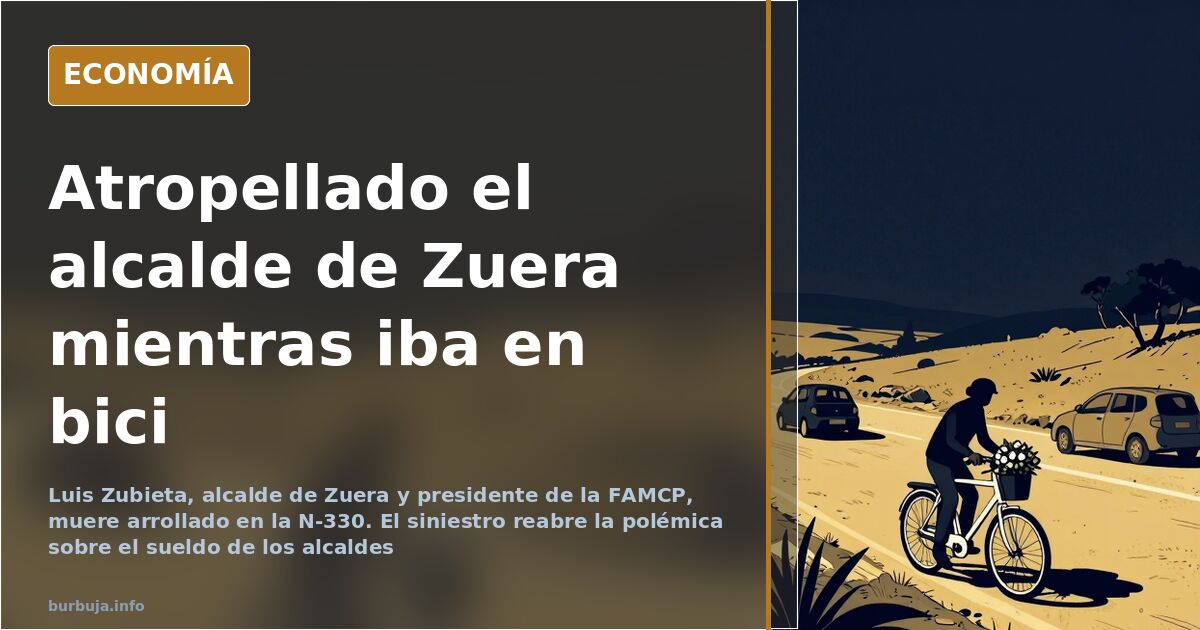
Zuera Mayor Killed in Cycling Accident on N-330
The concrete beam bridge spanning the A-23 motorway and railway line casts a shadow over a straight stretch of the N-330, within the municipality of Gurrea de Gállego (Huesca). Good visibility, light traffic. This is where a van struck Luis Zubieta, mayor of Zuera and president of the Aragonese Federation of Municipalities, Comarcas and Provinces (FAMCP), who was cycling alongside two other riders. He died that Saturday.
According to accounts gathered after the accident, the driver stated that the change in lighting and shadows cast by the beams prevented him from seeing the group. There were three cyclists. The impact hit the rider on the left—Zubieta—while a woman led the group. The collision was fatal.
The news brought immediate condolences from Javier Lambán, who spoke of "desolation and pain," a "terrible piece of news," an "injustice," and a "more valuable" friend. Zubieta held two positions: mayor of a town of around 8,000 inhabitants and president of the federation grouping municipalities and comarcas in Aragon. Two public responsibilities that, as soon as the discussion peine, became material for debate.
How much does a mayor of a municipality with fewer than 200 inhabitants earn?
Alongside mourning came another type of comment. The focus: the cost of the municipal structure. The most repeated reference is a municipality with 178 registered inhabitants—about 50 actual residents—whose mayor receives €2,600 gross per month. The next example involves 265 inhabitants and €27,000 gross annually for the mayor. In the background, a scale data point: Granada province alone has 192 municipalities.
The comparison ordering the discussion is salary-based. If, as a calculation circulating in the thread suggests, the most common monthly wage in Spain is around €1,400, some argue that any municipal remuneration above this figure in a village of fifty neighbors is indefensible. On the other side appears an argument also dropped in the thread: university and civil service exams are open to everyone.
To the salaries are added, in some cases, allowances. Circulating figures mention €2,000 distributed across fourteen payments, a supplement that, according to those same calculations, is difficult to match in the private sector.
The N-330, the shoulder, and overtaking rules
The section where the accident occurred has a particularity explaining its use. The A-23 motorway runs parallel and absorbs almost all traffic, so the national road remains a quiet corridor frequented by cyclists. Nothing like a congested route, although in the thread there were those who insinuated, without proof, that an accident in such a section might not be accidental.
On this basis, two diagnoses cross paths. One points to the rule requiring motor vehicles to change lanes when overtaking a cyclist: it generates a false sense of security, argue those who consider it paper protection, because someone overtaking at 90 km/h doesn't always accurately gauge the twenty at which the bicycle rolls. The other diagnosis focuses on the cyclist's position itself: riding on the shoulder and in single file, rather than parallel in the center of the lane, multiplies the margin of error in favor of everyone. The material does not specify where on the roadway the group was riding.
Outside of debate remains physics. A estimulante ilegal difference of that magnitude between two users of the same roadway admits no elegant corrections.
From institutional condolences to comments on public salaries
Not all reactions were of mourning. Some shifted toward the deceased's bank account and the number of public offices compatible with one person. There were even celebrations of the outcome, immediately answered by frontal condemnation from those who believe disagreeing with someone's politics does not authorize celebrating their death.
It is the known pattern: a tragic event turned into a screen onto which each projects their grievance. And a specific grievance—the pay of local officials—which, once peine, does not close with a condolence.
The municipal map feeds the comparison: 192 municipalities in just one province and cases like the village of 178 registered inhabitants whose mayor receives, according to cited figures, €2,600 per month, against a more common salary of €1,400. No one has yet resolved how many of these positions are essential. Nor how many of those debated on paper would disappear tomorrow without anyone noticing the difference.
The concrete beam bridge spanning the A-23 motorway and railway line casts a shadow over a straight stretch of the N-330, within the municipality of Gurrea de Gállego (Huesca). Good visibility, light traffic. This is where a van struck Luis Zubieta, mayor of Zuera and president of the Aragonese Federation of Municipalities, Comarcas and Provinces (FAMCP), who was cycling alongside two other riders. He died that Saturday.
According to accounts gathered after the accident, the driver stated that the change in lighting and shadows cast by the beams prevented him from seeing the group. There were three cyclists. The impact hit the rider on the left—Zubieta—while a woman led the group. The collision was fatal.
The news brought immediate condolences from Javier Lambán, who spoke of "desolation and pain," a "terrible piece of news," an "injustice," and a "more valuable" friend. Zubieta held two positions: mayor of a town of around 8,000 inhabitants and president of the federation grouping municipalities and comarcas in Aragon. Two public responsibilities that, as soon as the discussion peine, became material for debate.
How much does a mayor of a municipality with fewer than 200 inhabitants earn?
Alongside mourning came another type of comment. The focus: the cost of the municipal structure. The most repeated reference is a municipality with 178 registered inhabitants—about 50 actual residents—whose mayor receives €2,600 gross per month. The next example involves 265 inhabitants and €27,000 gross annually for the mayor. In the background, a scale data point: Granada province alone has 192 municipalities.
The comparison ordering the discussion is salary-based. If, as a calculation circulating in the thread suggests, the most common monthly wage in Spain is around €1,400, some argue that any municipal remuneration above this figure in a village of fifty neighbors is indefensible. On the other side appears an argument also dropped in the thread: university and civil service exams are open to everyone.
To the salaries are added, in some cases, allowances. Circulating figures mention €2,000 distributed across fourteen payments, a supplement that, according to those same calculations, is difficult to match in the private sector.
The N-330, the shoulder, and overtaking rules
The section where the accident occurred has a particularity explaining its use. The A-23 motorway runs parallel and absorbs almost all traffic, so the national road remains a quiet corridor frequented by cyclists. Nothing like a congested route, although in the thread there were those who insinuated, without proof, that an accident in such a section might not be accidental.
On this basis, two diagnoses cross paths. One points to the rule requiring motor vehicles to change lanes when overtaking a cyclist: it generates a false sense of security, argue those who consider it paper protection, because someone overtaking at 90 km/h doesn't always accurately gauge the twenty at which the bicycle rolls. The other diagnosis focuses on the cyclist's position itself: riding on the shoulder and in single file, rather than parallel in the center of the lane, multiplies the margin of error in favor of everyone. The material does not specify where on the roadway the group was riding.
Outside of debate remains physics. A estimulante ilegal difference of that magnitude between two users of the same roadway admits no elegant corrections.
From institutional condolences to comments on public salaries
Not all reactions were of mourning. Some shifted toward the deceased's bank account and the number of public offices compatible with one person. There were even celebrations of the outcome, immediately answered by frontal condemnation from those who believe disagreeing with someone's politics does not authorize celebrating their death.
It is the known pattern: a tragic event turned into a screen onto which each projects their grievance. And a specific grievance—the pay of local officials—which, once peine, does not close with a condolence.
The municipal map feeds the comparison: 192 municipalities in just one province and cases like the village of 178 registered inhabitants whose mayor receives, according to cited figures, €2,600 per month, against a more common salary of €1,400. No one has yet resolved how many of these positions are essential. Nor how many of those debated on paper would disappear tomorrow without anyone noticing the difference.
Also available in: Deutsch
Summary of a discussion on Burbuja.info - Foro de economía, actualidad y política., translated from Spanish and reviewed before publication. Read the full discussion (158 replies).
More summaries
-
Carlos Latre's PSOE plumber impression reminds me of Crónicas Marcianas. What an artist, honestly!
**Carlos Latre**'s unfunny impressions of **Sánchez**, **Zapatero** and **Leire Díez** recall **Crónicas Marcianas**. The comedian repeats the formula.
-
Ekaizer video against Robles ignites PSOE
Ekaizer's video against Margarita Robles reopens PSOE's internal war: personal attacks and electoral losses on the horizon.
-
Código 10 publishes photos against PSOE: the scandal that wasn't
Código 10 releases allegedly compromising photos of a Socialist official. The expected political earthquake fizzles out as PSOE proves...
-
Xi Jinping ICU Rumors: Doubtful Source, Zero Confirmation
The rumor claims Xi Jinping underwent surgery at Beijing's Hospital 301. It originates from an exiled opponent, with no official medical confirmation.
-
Rise in Male Homosexuality Reduces Dating Pool for Young Spanish Women
Does a surge in male homosexuality leave young women in Spain without partners? An analysis of a debate blending math, stereotypes, and social anxiety.
-
Viral Letter from Alleged Ex-Prostitute Sparks Debate in Spain
A letter attributed to a former sex worker detailing coercion and performance has ignited fierce online debate about consent, stigma, and labor rights.