
Zelensky warns 20 million Ukrainians could head to Europe if Ukraine falls
Zelensky warns that if Ukraine falls, 20 million Ukrainians will arrive in Europe. The migration argument enters the debate over the cost of the war.
English · Original discussion in Spanish · Published
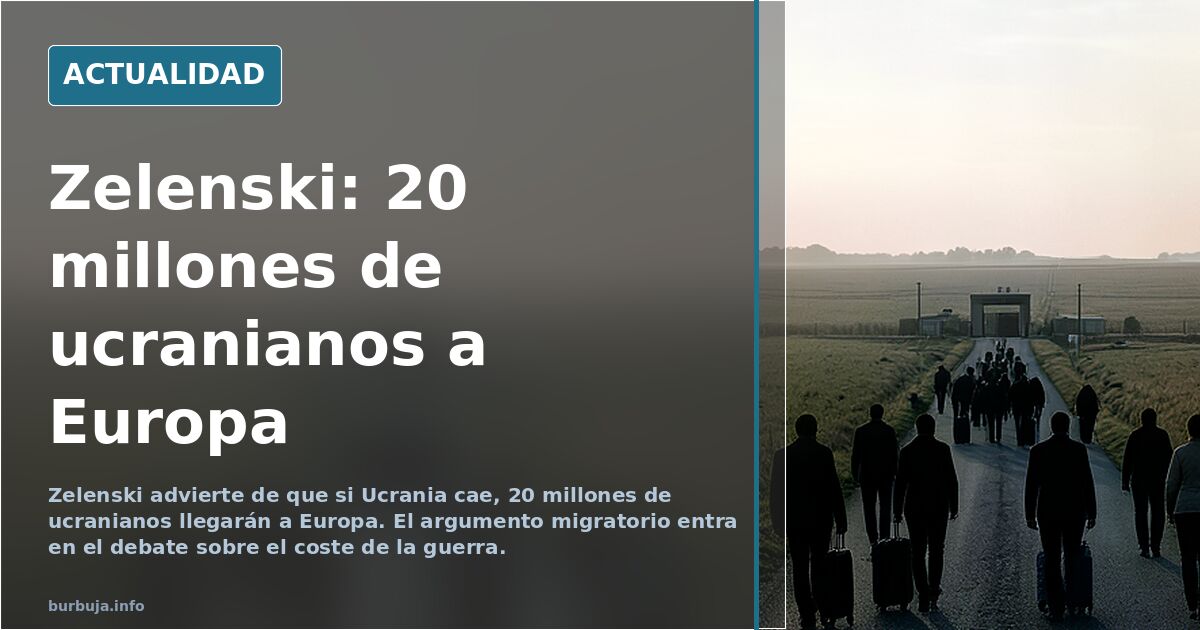
Zelensky puts a number on Europe's antiestéticar: 20 million
A viral tweet from @Mario Nawfal picks up the Ukrainian president's warning: if the country falls, "20 million Ukrainians will come to Europe because Pilingui will destroy us and push us out." The remark, presented as a wake-up call for Europeans, comes amid the debate over the cost of the war and how far financial and military support for Kyiv should go. The reaction, on the fringes of the official discourse, ranges from sarcasm to suspicion that the figure is a pressure tool rather than a demographic forecast.
The number as a bargaining chip
The figure is round and works like a hammer: **20 million** people on the move. Those hearing it for the first time think of borders, shelters and budgets. Those hearing it for the second time wonder how many of those millions are women, children and the elderly, since the war has already drained much of the country of military-age men. The warning does not describe a measured migratory flow, but a worst-case scenario that kicks in if the front collapses.
Some argue the message is calibrated for Brussels and Washington, not for the average citizen. The implicit argument is simple: paying for the war now is cheaper than managing a reception crisis later. It is the same logic used with other crises, which is why it provokes resistance.
The cost already being paid and the one being promised
The war is not free for Europe, and that shows up in the conversation with proper names attached: **China supplying parts to Russia**, **Turkey buying large quantities of oil and gas**, **Iran delivering the Shahed drones**. The most sceptical reading is that Western support has failed to close those gaps and that the conflict has hardened into an expensive war of attrition for everyone.
The most pessimistic calculation assumes the war is unwinnable on current terms and that prolonging it only multiplies the bill. The optimistic scenario trusts that financial backing will keep the Ukrainian state afloat and prevent a collapse that would, precisely, trigger an exodus of population. Both sides use the same figure: the 20 million as a threat or as a reminder.
Who would come and what is expected of them
Behind the debate over reception looms the labour profile. Mention is made of the Ukrainian plasterboard installers who worked in Spain before the conflict and who, once the war began, vanished from the trade. The anecdote serves as a reminder that migration is not just a budgetary burden: it also fills employment niches that other groups have since covered.
The conversation intersects with the official discourse on the need for foreign workers to sustain pensions. There appears the contradiction most often repeated: if we are told millions of immigrants are needed to pay for pensions, where exactly is the threat? The question has no settled answer, which is why it keeps coming up.
The background noise: racism and stereotypes
Not all the material is analysis. Part of the debate drifts into comments about the refugees' physical appearance, their hair or their eyes, and jokes about eating habits. That register adds no data and should be called what it is: noise that replaces argument with prejudice. Migration policy is discussed with figures, not catalogues.
The underlying question remains open: is Zelensky's figure a forecast or a lever? Until there is data on actual flows, the warning will keep working as what it appears to be, an argument for asking for money. And in Europe, money is no longer asked for without resistance.
Also available in: Deutsch
Summary of a discussion on Burbuja.info - Foro de economía, actualidad y política., translated from Spanish and reviewed before publication. Read the full discussion (21 replies).
More summaries
-
87-Year-Old Evicted After 71 Years in Madrid Apartment
Maricarmen, 87, evicted from her Madrid flat of 71 years. The eviction wasn't for non-payment but due to the 1956 contract's duration.
-
Victoria Vera at 73: how Spain judges the aesthetics of ageing
An analysis of public perception of Spanish actress Victoria Vera at 73. The passage of time and physical scrutiny in the digital age.
-
PewDiePie: the only influencer practicing antiwoke without the posturing?
PewDiePie uses GrapheneOS and free software while other antiwoke influencers just complain. The debate over digital coherence and the real cost of…
-
Climate madness bans air conditioning while politicians enjoy theirs
France and the UK are banning or removing air conditioners while politicians keep theirs. Germany cools its cattle barns but not its hospitals. The double…
-
Spain's temperature drop after the eclipse is down to an Atlantic low
A drop of up to 7 degrees follows the eclipse, but the cause is an Atlantic low, not the Moon.
-
Podemos firefighter: professional or political actor?
A forest firefighter from León, a member of Podemos, appears on RTVE and sparks suspicions of propaganda. Is wearing the uniform compatible with politics?