
Zaragoza Overtakes Seville as Project Hub: Boom or Hype?
Zaragoza overtakes Seville and attracts projects from Amazon, AWS, and pharma. Real boom or hype with public money? Wages, housing, and corruption in the...
English · Original discussion in Spanish · Published
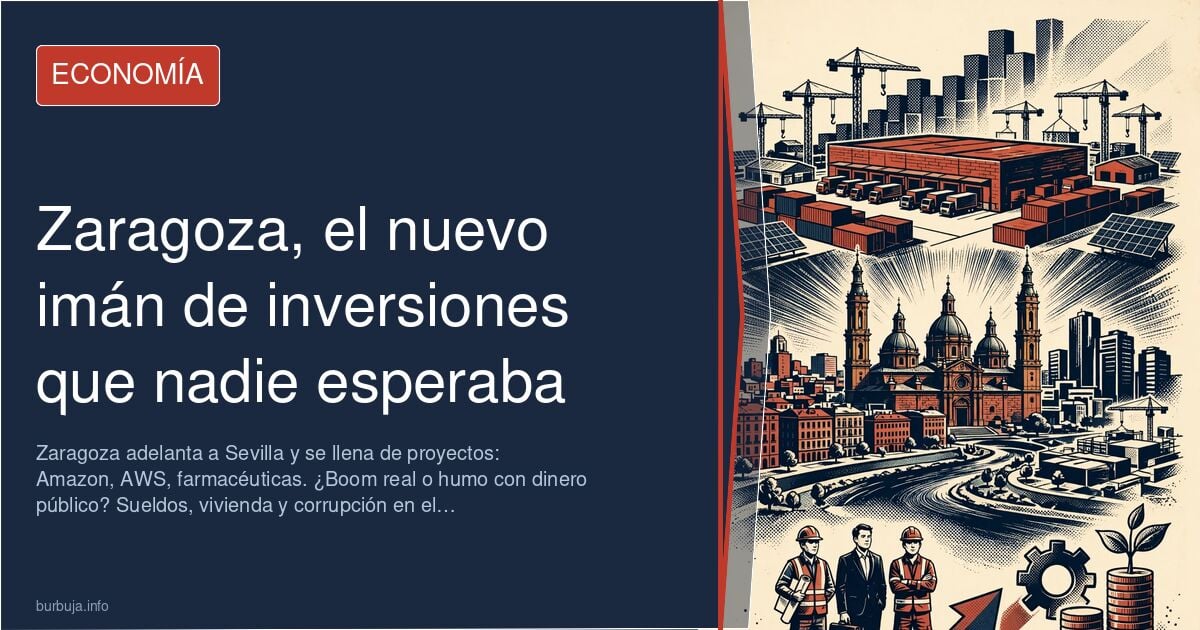
Zaragoza, Spain's fourth-largest city, becomes the new magnet for investment
Zaragoza has just overtaken Seville in population to become Spain's fourth-largest city, with around 700,000 residents in the urban core and 750,000 including the surrounding belt. And it's not just demographics: in a few months, projects have been announced by Amazon, AWS, a pharmaceutical active ingredient (API) plant with Irish and Portuguese partners, and consultancy KPMG is hiring staff who work in Madrid or Barcelona but live in Zaragoza. The question is: why all at once?
The project boom: from Amazon to pharma
The list is long. Amazon and AWS are already installed or in process. Certest Biotec, a personal project of Óscar Landeta, a Zaragoza native who became a multimillionaire with ELbichito, has also landed. And the most ambitious: the manufacture of APIs, active pharmaceutical ingredients, with Ireland's Indico and Portugal's Ricks Capital as main partners. There is talk of European Commission guarantees to declare it a strategic project and reduce dependence on India and China. The EU wants industrial independence in this area, and Zaragoza has been chosen.
But some view it with skepticism. It is argued that many of these projects are "PowerPoint," that they take advantage of Pertes and Next Generation funds, and that there have been precedents like Gran Scala or Canal Roya that came to nothing. The suspicion that public money is being used to inflate announcements without real substance hangs over the narrative.
The reasons for success: location, costs, and talent
Why Zaragoza? The most repeated explanation is geography. It is halfway between Madrid and Barcelona, with rail and highway connections to Valencia, Bilbao, and Pamplona. It is a top-level logistics hub. In addition, the cost of living is lower than in major capitals, allowing lower salaries without losing purchasing power. There are trained people, universities, and a culture of serious work. It is added that Barcelona has "dropped out" of the competition for these projects, perhaps due to the political climate, and Madrid is saturated.
An interesting nuance: according to an Oxford University study cited in the debate, Spain is the second most decentralized country in the world after Germany. That could explain why German companies, accustomed to decentralization, choose Zaragoza instead of Madrid.
The fine print: low wages and expensive housing
The boom has its downside. The salaries offered in these projects are not spectacular: 18,000-19,000 euros per year for junior profiles and 24,000 for senior. In countries like the Czech Republic or Poland, companies pay more for the same productivity. And in Zaragoza, housing has become more expensive, although it remains cheaper than in Madrid or Barcelona. The problem is that the city does not have enough supply: 500 public rental homes were announced on the Expo grounds, then reduced to 250, and it is antiestéticared they will end up at zero. The Arcosur neighborhood, built during the bubble, remains a wasteland, compared to "Mordor." You cannot move 40,000 or 50,000 people in two years without planning.
Pending infrastructure and the shadow of corruption
Another recurring complaint is the lack of connection with France through the Aragonese Pyrenees. It is argued that Aragon has been discriminated against in infrastructure in favor of the Basque Country and Catalonia, and that the obsession with appeasing nationalism has left Zaragoza without the trans-Pyrenean axis it should have. In addition, the renewable energy sector is under suspicion: according to published reports, the government of Aragon would have distributed the wind and solar business between two Socialist families, the Sumelzo and the Samper, with more than 850 companies involved. That, if confirmed, tarnishes the prosperity narrative.
What comes next?
Zaragoza has a larger municipal area than Madrid, but it is surrounded by barren fields. There is plenty of land, but there is a lack of will and ideas to create new neighborhoods that do not end up like Arcosur. The American model of chalets and towers is proposed as an alternative, but it clashes with the reality of an aging population and a birth rate at minimums. Will this boom be just another mirage, or will the city on the Ebro finally become the economic engine it is supposed to be? The answer, as always, lies in the data that has not yet been published.
Zaragoza has just overtaken Seville in population to become Spain's fourth-largest city, with around 700,000 residents in the urban core and 750,000 including the surrounding belt. And it's not just demographics: in a few months, projects have been announced by Amazon, AWS, a pharmaceutical active ingredient (API) plant with Irish and Portuguese partners, and consultancy KPMG is hiring staff who work in Madrid or Barcelona but live in Zaragoza. The question is: why all at once?
The project boom: from Amazon to pharma
The list is long. Amazon and AWS are already installed or in process. Certest Biotec, a personal project of Óscar Landeta, a Zaragoza native who became a multimillionaire with ELbichito, has also landed. And the most ambitious: the manufacture of APIs, active pharmaceutical ingredients, with Ireland's Indico and Portugal's Ricks Capital as main partners. There is talk of European Commission guarantees to declare it a strategic project and reduce dependence on India and China. The EU wants industrial independence in this area, and Zaragoza has been chosen.
But some view it with skepticism. It is argued that many of these projects are "PowerPoint," that they take advantage of Pertes and Next Generation funds, and that there have been precedents like Gran Scala or Canal Roya that came to nothing. The suspicion that public money is being used to inflate announcements without real substance hangs over the narrative.
The reasons for success: location, costs, and talent
Why Zaragoza? The most repeated explanation is geography. It is halfway between Madrid and Barcelona, with rail and highway connections to Valencia, Bilbao, and Pamplona. It is a top-level logistics hub. In addition, the cost of living is lower than in major capitals, allowing lower salaries without losing purchasing power. There are trained people, universities, and a culture of serious work. It is added that Barcelona has "dropped out" of the competition for these projects, perhaps due to the political climate, and Madrid is saturated.
An interesting nuance: according to an Oxford University study cited in the debate, Spain is the second most decentralized country in the world after Germany. That could explain why German companies, accustomed to decentralization, choose Zaragoza instead of Madrid.
The fine print: low wages and expensive housing
The boom has its downside. The salaries offered in these projects are not spectacular: 18,000-19,000 euros per year for junior profiles and 24,000 for senior. In countries like the Czech Republic or Poland, companies pay more for the same productivity. And in Zaragoza, housing has become more expensive, although it remains cheaper than in Madrid or Barcelona. The problem is that the city does not have enough supply: 500 public rental homes were announced on the Expo grounds, then reduced to 250, and it is antiestéticared they will end up at zero. The Arcosur neighborhood, built during the bubble, remains a wasteland, compared to "Mordor." You cannot move 40,000 or 50,000 people in two years without planning.
Pending infrastructure and the shadow of corruption
Another recurring complaint is the lack of connection with France through the Aragonese Pyrenees. It is argued that Aragon has been discriminated against in infrastructure in favor of the Basque Country and Catalonia, and that the obsession with appeasing nationalism has left Zaragoza without the trans-Pyrenean axis it should have. In addition, the renewable energy sector is under suspicion: according to published reports, the government of Aragon would have distributed the wind and solar business between two Socialist families, the Sumelzo and the Samper, with more than 850 companies involved. That, if confirmed, tarnishes the prosperity narrative.
What comes next?
Zaragoza has a larger municipal area than Madrid, but it is surrounded by barren fields. There is plenty of land, but there is a lack of will and ideas to create new neighborhoods that do not end up like Arcosur. The American model of chalets and towers is proposed as an alternative, but it clashes with the reality of an aging population and a birth rate at minimums. Will this boom be just another mirage, or will the city on the Ebro finally become the economic engine it is supposed to be? The answer, as always, lies in the data that has not yet been published.
Also available in: Deutsch
Summary of a discussion on Burbuja.info - Foro de economía, actualidad y política., translated from Spanish and reviewed before publication. Read the full discussion (190 replies).
More summaries
-
Rivera proposes living an hour outside Madrid: The real cost of saving
Madrid buys at €5,984/sqm and rents at €23.3/sqm. Rivera suggests living an hour away: fuel costs and commuting times change the equation.
-
Ceuta flats priced like a capital despite border crisis
A 77 m² flat in Ceuta costs €170,000, similar to Madrid. Money laundering, free zone, or simply limited supply?
-
Turiel and the End of Oil: Why the Barrel Price Doesn't Back Him Up
A forum debates the end of oil: some blame Ormuz and war for Brent's fall, others doubt collapse forecasts.
-
Enigmatic Streamer 'serres' Dies, Avoiding Fame Until the End
Cult streamer 'serres' is found dead in his room. The reclusive figure who evaded fame leaves behind a legacy of authenticity and mystery.
-
Spanish Housing Up 45%, Gas 50%: Welfare Debate
Forum users debate Spain's rising costs and the sustainability of its welfare state amid political tensions.
-
Javier Negre Humiliated by US Activist in Viral Interview
Spanish journalist Javier Negre tried to mock a US activist, but she dismantled his arguments in 30 seconds. The video he posted went viral.