
Zara employee awarded €98,000 for unlawful locker search
A forum discusses a €98,000 compensation for a Zara worker after her dismissal was voided due to an illegal locker search.
English · Original discussion in Spanish · Published
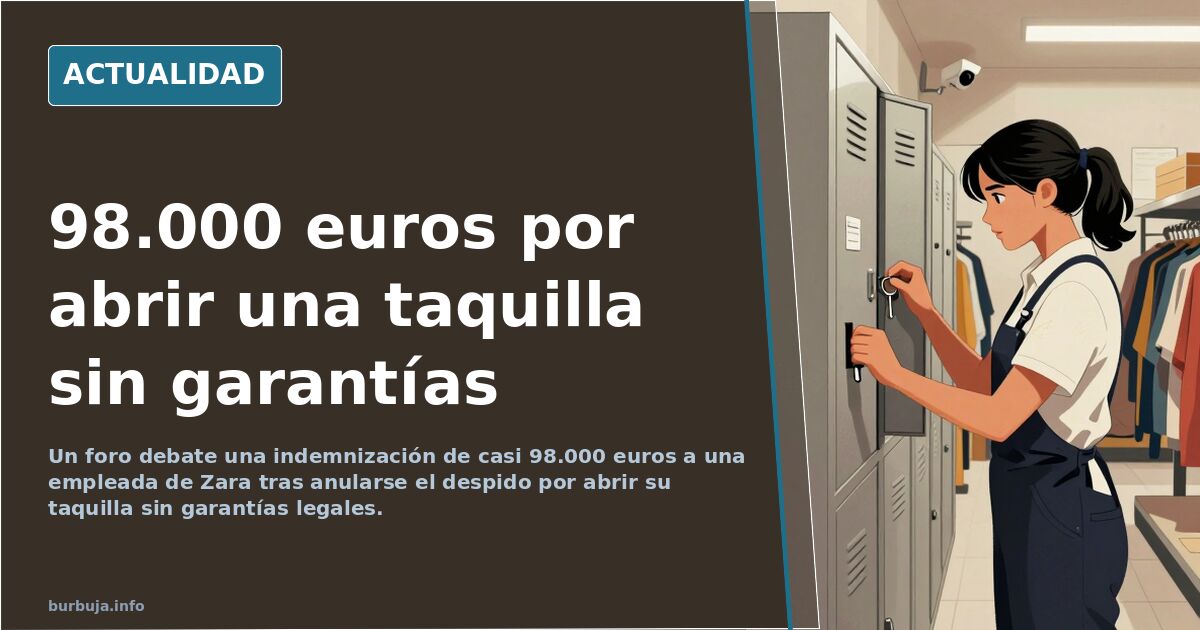
Zara employee awarded €98,000 for unlawful locker search
A Zara employee, on sick leave for depression, received nearly €98,000 in compensation. Not for any ordinary dismissal: but because of how the evidence justifying it was obtained. The company suspected she had stolen merchandise and forced open her locker to find the sneakers that incriminated her. The judge ruled this was a search without proper legal guarantees and declared the dismissal unfair. The figure shocks some and reassures others, but the core issue is different: what is a fundamental right worth when abusa to catch a thief?
What exactly peine with the Zara employee's locker
The case, reported by Infobae, trinc a script repeated in many large companies: suspicion of theft, need for quick proof, and a locker peine by force. The worker was on medical leave for depression when it occurred. The company found what it sought—sneakers—and fired her. The court, however, did not validate the evidence: it was obtained without the presence of workers' representatives or trinc required formalities.
Here lies the crux. The compensation does not reward theft; it punishes procedural negligence. And the amount, nearly €98,000, is not a judge's whim: it reflects accumulated seniority and a salary estimated at around €4,000 per month including bonuses. This corresponds to the legal cap of two years' salary for unfair dismissals.
Why the €98,000 figure is not arbitrary
Some see exaggeration in this sum. However, the breakdown is mechanical: years of service multiplied by daily wage, capped at two annual salaries. If the payroll is high, the result skyrockets. There is no judicial discretion, only a formula. What is debatable is whether this formula still makes sense in a labor market that no longer resembles its original design.
The complete calculation, item by item, reveals a differential that surprises those who only read the headline. It explains why large companies sometimes prefer paying over litigating: a poorly executed dismissal costs more than a well-executed one, even if the underlying facts are identical.
The debate on severance pay: protection or burden?
The conversation quickly shifted to a deeper issue: should severance pay exist? One school argues no, claiming there is no harm to compensate when ending an employment relationship, suggesting bilateral retention periods instead. Another defends the opposite view: without compensation, firing for trivial reasons would become the norm, and job instability would surge in a country where finding new work can be an odyssey.
In the middle, an uncomfortable argument: necessary and fair are not the same. Welfare benefits are also necessary, yet nobody calls them fair. Seen this way, severance pay is an obligation to buy something you no longer need, like continuing to pay for bread you stopped taking.
Locker and mailbox searches: what the law says and what companies do
The case opens another Pandora's box: are lockers private spaces? The prevailing legal analysis says no. They are means to an end—working—not storage for intimacies. But this does not authorize opening them arbitrarily. Prior notice, union representative presence, and a procedure are required. When these are missing, the evidence falls apart.
Something similar happens with corporate email accounts. Many companies warn in writing that email, lockers, or company cars are not for personal use. That warning is the boundary between a legitimate search and an illegitimate one. In the Zara employee's case, according to the account, that boundary was crossed.
The role of union representation in locker searches
Here appears an often overlooked element: the presence of a union delegate. In this case, apparently, a workers' representative was present. For some analysts, this is insufficient: validating evidence from an irregular search undermines all rights, including labor rights. For others, union presence is precisely the guarantee that legitimizes the action.
The disagreement is significant. If union representation validates a search, does it cease to be irregular? The answer depends on whether other requirements were met: notice, timeframe, dual-key system, minutes. A single flaw collapses the entire procedure.
Comparison with other cases: from broken jaw to forced locker
The most circulated contrast involves injury compensations. A cited case: someone had their jaw broken, resulting in a sentence of less than €3,000, which was never paid due to the aggressor's insolvency. Compared to that, €98,000 for opening a locker sounds disproportionate. The comparison is powerful but misleading: different jurisdictions, different legal interests, different scales.
Still, the discomfort is real. Some summarize it in an uncomfortable idea: if the employee had been male, she likely would have received nothing. There is no data to support this, but the suspicion looms over the entire matter.
What may happen next and why the case remains open
The matter is not closed. The company can appeal, and the discussion on evidence validity could reach higher courts. Meanwhile, the case serves as a warning: large companies have legal counsel precisely to avoid such errors. When they commit them, they pay.
And the employee? She receives the compensation and, if the dismissal is declared unfair, can choose between reinstatement or payment. The ball is in the appellant's court. What does not change is the figure: nearly one hundred thousand euros for a locker peine without guarantees.
Also available in: Deutsch
Summary of a discussion on Burbuja.info - Foro de economía, actualidad y política., translated from Spanish and reviewed before publication. Read the full discussion (126 replies).
More summaries
-
At-will dismissal already exists in Spain: severance pay is the key
Fair dismissal in Spain costs 20 days' pay per year of service, capped at one year's salary. What could change if the right wins power.
-
Zaragoza City Council (PP) launches Arabic language and calligraphy workshop amidst Ceuta crisis
Zaragoza City Council (PP) initiates Arabic language and calligraphy workshop. The initiative arises amidst a debate on immigration.
-
Wedding debt: Spain's bridal loan illusion
43,000 euros of debt for a wedding, paid with a severance package. The bridal loan as a cultural norm in crisis-era Spain. Data and analysis.
-
Queen Letizia, 'Caught' on a Yacht: The Rumor That Doesn't Hold Up
The media outlet El Nacional claims Queen Letizia was on a yacht with another man. Photos only show her alone and are old. Hoax or reality?
-
The plan behind the France and Italy unrest: social control
Paris locks down with 70,000 officers and the French bond tops 5%. An analysis sees the riots as an operation to justify more control and less freedom.
-
Cyclorphine, a new street drug even stronger than fentanyl, is already killing users
Los Angeles County confirms a death from cyclorphine, a synthetic opioid detected in the US since 2024. It is sold in e-cigarette liquids and fake pills.