
Zapatero requests his own expert for jewelry appraisal
Zapatero challenges second jewelry appraisal, requesting his own expert after disqualifying Yanes jewelers for alleged lack of objective impartiality.
English · Original discussion in Spanish · Published
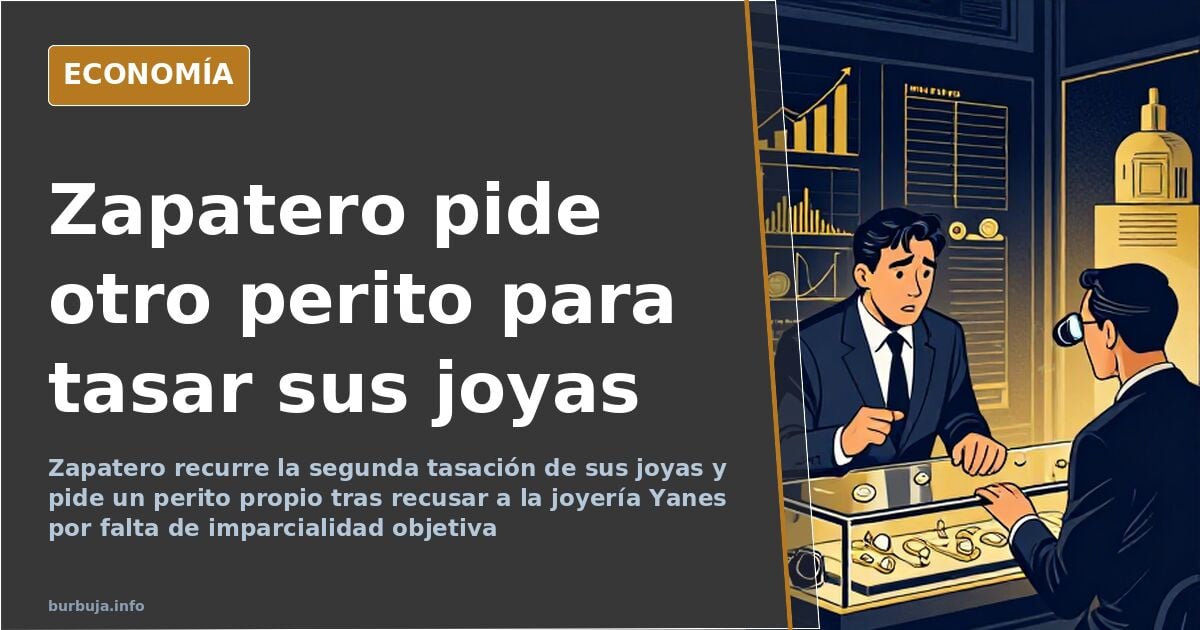
Zapatero requests his own expert for jewelry appraisal
Jewelry of apparently incalculable value. That phrase, uttered to the press by the general director of Yanes jewelers, was enough to blow up the report intended to price them before it was even written. José Luis Rodríguez Zapatero has appealed the second appraisal and requests that a different expert, other than the one from Yanes, be appointed.
Why Zapatero is challenging Yanes jewelers
The filing by his lawyer outlines the arguments from a prior challenge: the jewelry firm allegedly lacks "objective impartiality" to issue the report, after its head publicly stated that some of the pieces were of "apparently incalculable value." The former president also argues that the "necessity and utility" of a second valuation are not justified.
And he adds a significant request. If the judge decides to proceed with the appraisal, Zapatero wants to propose an expert to participate in the inspection and sign the report alongside the court-appointed one. In other words, he wants to be at the table with the appraiser.
How much are the jewels worth and who decides
The figure is shrouded in disagreement. Some question if it wasn't previously stated that the jewelry cost 30,000 euros; the general director of the jewelry firm spoke of pieces of "apparently incalculable value." There's a vast difference between these two figures.
From display cases to the last mile
The economic discussion quickly shifted from jewelry to delivery vans. Some argue that the self-employed last-mile delivery driver is a legal fraud disguised as entrepreneurship, calculating that it involves 150 km daily, 12 hours from Monday to Saturday, and between 500 and 700 euros per month in fixed costs advanced by the driver themselves. According to this same version, the platform provides the app and takes a 30% cut.
The package will arrive tomorrow, with someone else at the wheel. Meanwhile, the jewelry continues to wait for someone to decide its value.
Jewelry of apparently incalculable value. That phrase, uttered to the press by the general director of Yanes jewelers, was enough to blow up the report intended to price them before it was even written. José Luis Rodríguez Zapatero has appealed the second appraisal and requests that a different expert, other than the one from Yanes, be appointed.
Why Zapatero is challenging Yanes jewelers
The filing by his lawyer outlines the arguments from a prior challenge: the jewelry firm allegedly lacks "objective impartiality" to issue the report, after its head publicly stated that some of the pieces were of "apparently incalculable value." The former president also argues that the "necessity and utility" of a second valuation are not justified.
And he adds a significant request. If the judge decides to proceed with the appraisal, Zapatero wants to propose an expert to participate in the inspection and sign the report alongside the court-appointed one. In other words, he wants to be at the table with the appraiser.
How much are the jewels worth and who decides
The figure is shrouded in disagreement. Some question if it wasn't previously stated that the jewelry cost 30,000 euros; the general director of the jewelry firm spoke of pieces of "apparently incalculable value." There's a vast difference between these two figures.
From display cases to the last mile
The economic discussion quickly shifted from jewelry to delivery vans. Some argue that the self-employed last-mile delivery driver is a legal fraud disguised as entrepreneurship, calculating that it involves 150 km daily, 12 hours from Monday to Saturday, and between 500 and 700 euros per month in fixed costs advanced by the driver themselves. According to this same version, the platform provides the app and takes a 30% cut.
The package will arrive tomorrow, with someone else at the wheel. Meanwhile, the jewelry continues to wait for someone to decide its value.
Summary of a discussion on Burbuja.info - Foro de economía, actualidad y política., translated from Spanish and reviewed before publication. Read the full discussion (30 replies).
More summaries
-
Zapatero implicates his wife in jewelry decision, according to THE OBJECTIVE
Zapatero implicates his wife in the decision to keep and hide jewelry, according to THE OBJECTIVE; the figure of 1.3 million circulates unconfirmed.
-
Euthanasia in Old Age: Autonomy vs. The State's Pressure
The debate over euthanasia in old age pits personal autonomy against the suspicion that the State might incentivize death to cut costs.
-
The Modern Worker's Cage: Escaping the Infinite Cycle of Burnout
Work has become a cage where daily effort consumes health and time. Discover why we push ourselves so hard and how to break the cycle.
-
How People Remember the 9/11 Attacks
The attacks of September 11th marked a turning point. Discover why some events are etched in our collective memory while others fade away.
-
Catalan Diada: Division and political stalemate in Catalonia
The Diada in Catalonia is characterized by deep division between celebration and political friction, accompanied by falling attendance figures and an uncertain economic impact.
-
Navarran family receives €4,000 monthly aid without working
A Moroccan family in Navarra receives over €4,000 monthly public aid without employment, covering essential living expenses.