
Zamora’s Public Campaign Using Men’s Names Sparks Controversy
Zamora’s city council funded a campaign using common male names, sparking debate over whether it unfairly targets men.
English · Original discussion in Spanish · Published
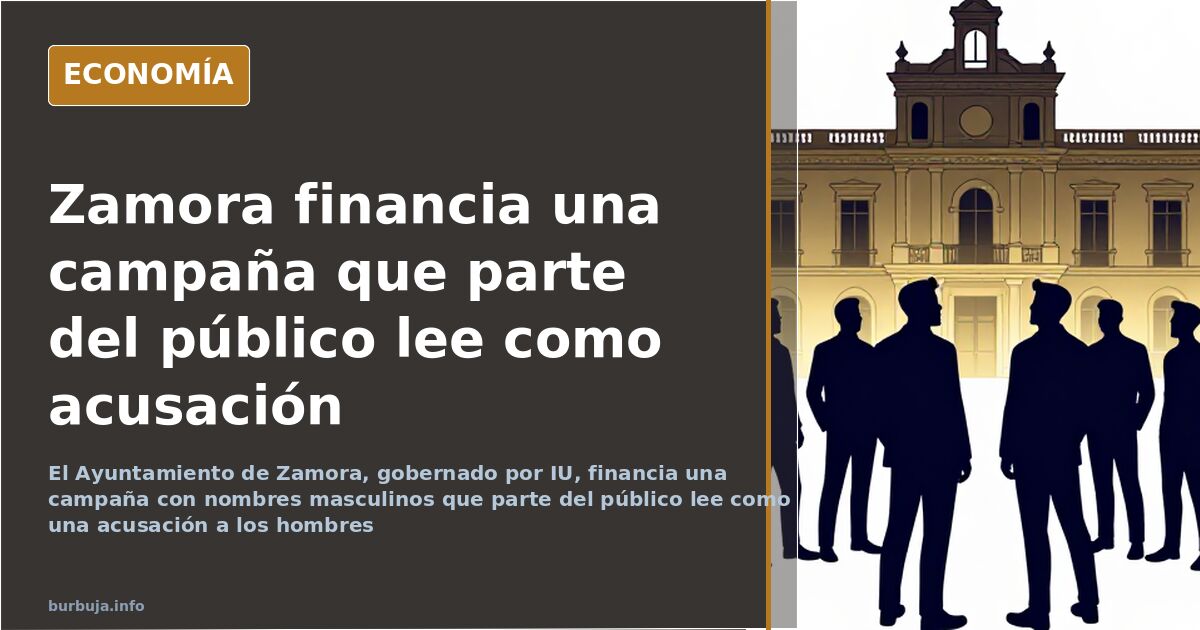
Zamora: a campaign with men’s names sparks controversy
A city council governed by left-wing parties has spent public money on an advertising campaign, resulting in a dispute over who it accuses. In Zamora, the materials display cards with common male names —Juan, Manuel, Alejandro, César, or Diego— which, according to some interpretations, link them to sensual aggressors. This is not a design oversight.
The paradox is obvious to everyone: a campaign designed to warn about sensual violence ends up being read by part of the public as a general accusation against men. The question one participant imagined in the thread —“Who rapes, who assaults, who harasses?”— admits very different answers depending on who answers.
What the cards show and why they cause discomfort
The material plays with common names, those found on any neighborhood portal. This is the detail that generates the most comments: if the message is that any man can be an aggressor, why are the chosen names and profiles so homogeneous? Both those defending and those criticizing the campaign point this out, with a hint of irony on both sides. Lack of diversity, it has been written, half-jokingly, half-seriously.
On the other side, another block argues the opposite: using municipal funds for a piece that identifies a group by gender is, at best, debatable. The most repeated formulation is that of unjust generalization: responsibility for a crime lies with the perpetrator, not an entire group. And a third, harsher group, reads it as an attempt to blame the average man for a problem he did not cause.
The percentages that cross paths in the discussion
When the issue moves from impression to numbers, the classic problem appears: each side chooses the figure that suits them. One of the most repeated claims is that sensual aggressors make up no more than 0.1% of the male population, from which it is deduced that the campaign targets an innocent majority. The opposing view starts from the fact that the vast majority of assaults are committed by men.
In between, comparisons mix incomparable magnitudes: the percentage of housing with occupation problems, the distribution of marital breakups, or the volume of false reports. Everything is fair game to strengthen one’s own argument. The result is a tug-of-war where figures are not discussed for their reliability, but for whom they favor.
The political tonalidad of the council and who pays the bill
The Zamora City Council is governed by United Left, with Francisco Guarido at the helm. This fact is used in both directions: some cite it as the explanation for the campaign; others, as the reason it is judged with a magnifying glass. The underlying complaint is economic, and the response is always the same: the public treasury.
This is not an isolated case in the conversation. Alongside the campaign, the closure of a shipyard in Zumaia or the composition of the Basque Economic Council, with seven women and three men, appears. The connection is forced, but it reflects the climate: any institutional decision is already read as an ideological signal before it is explained.
Why are false reports mentioned in this campaign?
Because the institutional message relies on the idea that any woman can be a victim, and part of the public responds that the law must also cover the accused man without evidence. The problem is that false reports have become a minefield: unverifiable percentages outside the courts are cited and used as a throwing weapon, not as data. No one provides an official source in this discussion to close the debate.
The practical consequence is that the campaign, designed to raise awareness, has peine a rift where there was once a shared obviousness: that assaulting is wrong. No one disputes that. What is debated is whether the poster says it well or says it against someone.
Can such a campaign be taken to the Constitutional Court?
The question has been raised aloud: if these pieces clash with constitutional principles and whether they could be appealed, regardless of whether they come from the municipal budget. It is a question without an answer at this point.
Meanwhile, the poster remains in sight and the anger remains alive. If the goal was to prevent assaults and the effect is a discussion about who the ad points to, the question remains open: what has been achieved exactly?
A city council governed by left-wing parties has spent public money on an advertising campaign, resulting in a dispute over who it accuses. In Zamora, the materials display cards with common male names —Juan, Manuel, Alejandro, César, or Diego— which, according to some interpretations, link them to sensual aggressors. This is not a design oversight.
The paradox is obvious to everyone: a campaign designed to warn about sensual violence ends up being read by part of the public as a general accusation against men. The question one participant imagined in the thread —“Who rapes, who assaults, who harasses?”— admits very different answers depending on who answers.
What the cards show and why they cause discomfort
The material plays with common names, those found on any neighborhood portal. This is the detail that generates the most comments: if the message is that any man can be an aggressor, why are the chosen names and profiles so homogeneous? Both those defending and those criticizing the campaign point this out, with a hint of irony on both sides. Lack of diversity, it has been written, half-jokingly, half-seriously.
On the other side, another block argues the opposite: using municipal funds for a piece that identifies a group by gender is, at best, debatable. The most repeated formulation is that of unjust generalization: responsibility for a crime lies with the perpetrator, not an entire group. And a third, harsher group, reads it as an attempt to blame the average man for a problem he did not cause.
The percentages that cross paths in the discussion
When the issue moves from impression to numbers, the classic problem appears: each side chooses the figure that suits them. One of the most repeated claims is that sensual aggressors make up no more than 0.1% of the male population, from which it is deduced that the campaign targets an innocent majority. The opposing view starts from the fact that the vast majority of assaults are committed by men.
In between, comparisons mix incomparable magnitudes: the percentage of housing with occupation problems, the distribution of marital breakups, or the volume of false reports. Everything is fair game to strengthen one’s own argument. The result is a tug-of-war where figures are not discussed for their reliability, but for whom they favor.
The political tonalidad of the council and who pays the bill
The Zamora City Council is governed by United Left, with Francisco Guarido at the helm. This fact is used in both directions: some cite it as the explanation for the campaign; others, as the reason it is judged with a magnifying glass. The underlying complaint is economic, and the response is always the same: the public treasury.
This is not an isolated case in the conversation. Alongside the campaign, the closure of a shipyard in Zumaia or the composition of the Basque Economic Council, with seven women and three men, appears. The connection is forced, but it reflects the climate: any institutional decision is already read as an ideological signal before it is explained.
Why are false reports mentioned in this campaign?
Because the institutional message relies on the idea that any woman can be a victim, and part of the public responds that the law must also cover the accused man without evidence. The problem is that false reports have become a minefield: unverifiable percentages outside the courts are cited and used as a throwing weapon, not as data. No one provides an official source in this discussion to close the debate.
The practical consequence is that the campaign, designed to raise awareness, has peine a rift where there was once a shared obviousness: that assaulting is wrong. No one disputes that. What is debated is whether the poster says it well or says it against someone.
Can such a campaign be taken to the Constitutional Court?
The question has been raised aloud: if these pieces clash with constitutional principles and whether they could be appealed, regardless of whether they come from the municipal budget. It is a question without an answer at this point.
Meanwhile, the poster remains in sight and the anger remains alive. If the goal was to prevent assaults and the effect is a discussion about who the ad points to, the question remains open: what has been achieved exactly?
Also available in: Deutsch
Summary of a discussion on Burbuja.info - Foro de economía, actualidad y política., translated from Spanish and reviewed before publication. Read the full discussion (226 replies).
More summaries
-
IONOS cuts 450 jobs, Logroño fears for Arsys's 360
IONOS cuts 450 jobs from 3,800: Arsys, with 360 workers in Logroño, is unsure how many will be affected.
-
Madrid housing prices jump 10% in four months to €5,467/m2
Madrid's average price per square meter rose from €4,952 in December 2024 to €5,467 in April 2025, a 10% increase in four months.
-
Madrid party claims Arabic is a Spanish language
Más Madrid argues Arabic is a Spanish language due to historical roots, sparking debate on linguistic policy.
-
Spain's 8M dance sparks debate on public spending
A video of the International Women's Day dance in Spain reignites controversy over institutional spending, with discussions focusing on aesthetics due to lack of official figures.
-
Spain's judicial exam age debate sparks controversy
Forum users debate requiring ten years of legal practice for judges and prosecutors after a 27-year-old passes the Spanish civil service exams.
-
Forum Debate: PP-Vox Coalition Would Not Change Spain's System
A forum participant argues that a PP-Vox coalition in Spain would not alter the political system, claiming both parties share the same establishment structure.