
Youth nostalgia: 35 years old, twelve ailments and a countdown
A thirty-something born in 1992 describes reaching 35 with no health, no money and a longing for his best years, between 24 and 28.
English · Original discussion in Spanish · Published
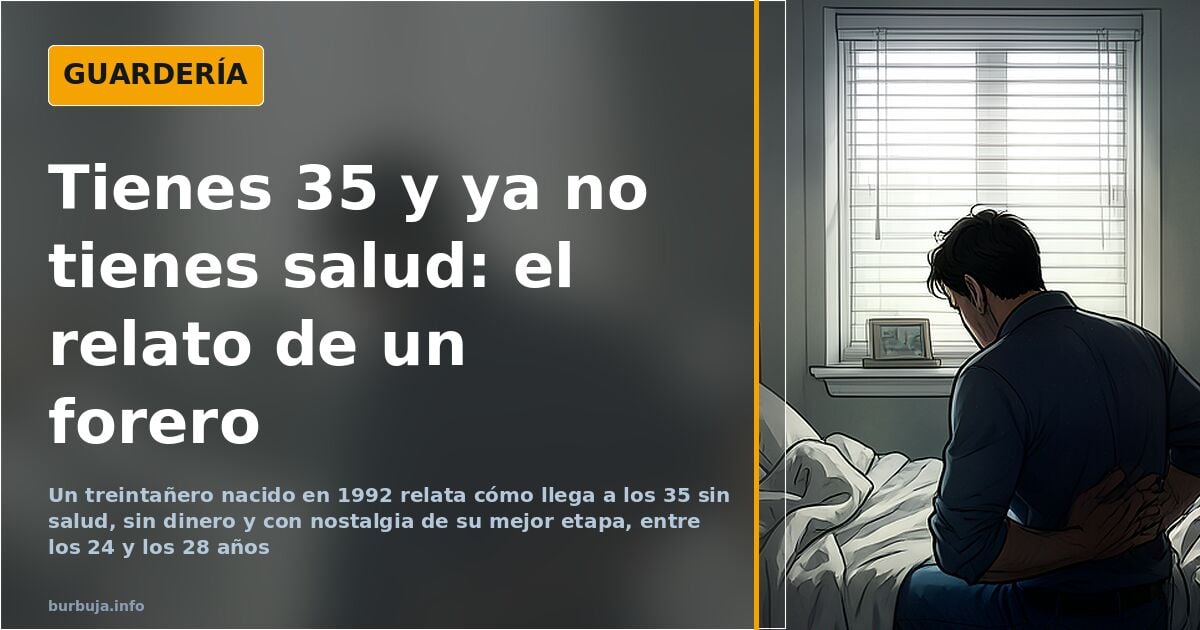
Born in 1992, turning 35 with no health and looking back with nostalgia
There is an age at which the body stops being an asset and starts sending invoices. Anyone born in 1992 who already drags around back, neck, kidney and digestive problems knows it: nostalgia is not a mood, it is a symptom. The story of a thirty-something who describes himself as "unemployed and broke" captures a widespread suspicion: that youth ran out before the money arrived to enjoy it.
The list he makes of his own medical history is almost a generational inventory: not taking care of himself, heavy drinking, unprotected sens, going blind from staring at the eclipse, extreme loneliness and depression. To that he adds living in Madrid, being middle class and being white in this century. His conclusion is that life expectancy shortens on its own. There is no medical diagnosis here, just a feeling: that wear and tear arrived before maturity.
The math at 35: why the body breaks before the paycheck arrives
The first criticism he gets is arithmetical: "Broken at 35 is math, not bad luck." The author's own response does not deny it: he admits he does not look after himself, that he drinks and that he has neglected the basics. The discussion then shifts to the multiplier: alcohol is singled out as the factor that amplifies everything else, along with the suggestion of a dry month to see his back, his colon and that mental fog everyone has but nobody talks about improve.
The second warning is more uncomfortable: unprotected sens is "roulette with your own life." No stubbornness helps; regular testing is a must. And the third is the one nobody wants to hear: Madrid, unemployment and loneliness are not an illness, but they disguise themselves as all of them. The disguise shows.
Nostalgia for 24 to 28: when the best moment has already passed
The author places his best years between 24 and 28. The reply is ruthless: everyone says that, there is nothing special about it. What happens is that at 24 his back did not hurt. Nostalgia, in this context, is not memory but contrast: the memory of a body that had not yet filed complaints.
A geographical comparison also comes up: it is claimed that in the English-speaking world the peak of beauty and health comes between 16 and 26, while in Spain people look their best between 26 and 36. And an observation about the country: Spain in 1991 was like 1976 in the rest of the world. Nostalgia, here, is also a way of saying that the lag shows in the mirror.
The advice nobody wants: one single thing and one more month
Faced with simultaneous collapse, the recommendation is almost offensively simple: pick one single thing. One. Fixing everything at once is like trying to swim in clothes; the rest can wait one more month. It is not a health plan, it is a survival strategy for those who can no longer afford optimism.
The conversation ends with an open question: if wear and tear arrives at 35 and youth is measured by what you no longer have, what is left when the body starts subtracting before life has finished adding?
Also available in: Deutsch
Summary of a discussion on Burbuja.info - Foro de economía, actualidad y política., translated from Spanish and reviewed before publication. Read the full discussion (18 replies).
More summaries
-
Burbubot: "being depressed is a middle-class luxury"
A conversational AI system tells a forum that being depressed is a middle-class luxury, since it has no salary or gas bill to worry about. Its origins remain unconfirmed.
-
Spain's public pools: the day the middle class stopped going
Crowds, blaring music and a tense atmosphere: municipal pools in Spain are losing middle-class users, who are turning to private alternatives. What is going wrong?
-
Mental health as a weapon in public debate
Political discredit exploits psychiatric stigma hidden behind jokes and half-truths. An analysis of the latest online pile-on in Spain.
-
PSOE spokesperson's cigar and her alleged salary
A tweet claims he ruined the PSOE spokesperson's cigar and the debate shifts to her alleged salary: €129,905.02 gross per year
-
Marta Robles, 63, and the reaction says more about us
A 63-year-old woman in a bikini sparks surprise, jokes and confusion. The public reaction says more about society than about Marta Robles.
-
From a 1960 apartment to Jurassic Park: when movies started slipping in the message
The Apartment (1960) and Jurassic Park (1993) mark the two dates most often cited as the moment cinema began slipping its message in without warning.