
Youth Independence: 37% of African-Origin vs. 10% of Spaniards
Nearly 37% of young people of African origin leave home, compared to 10% of Spaniards. This gap sparks debate on housing aid and the labor market.
English · Original discussion in Spanish · Published
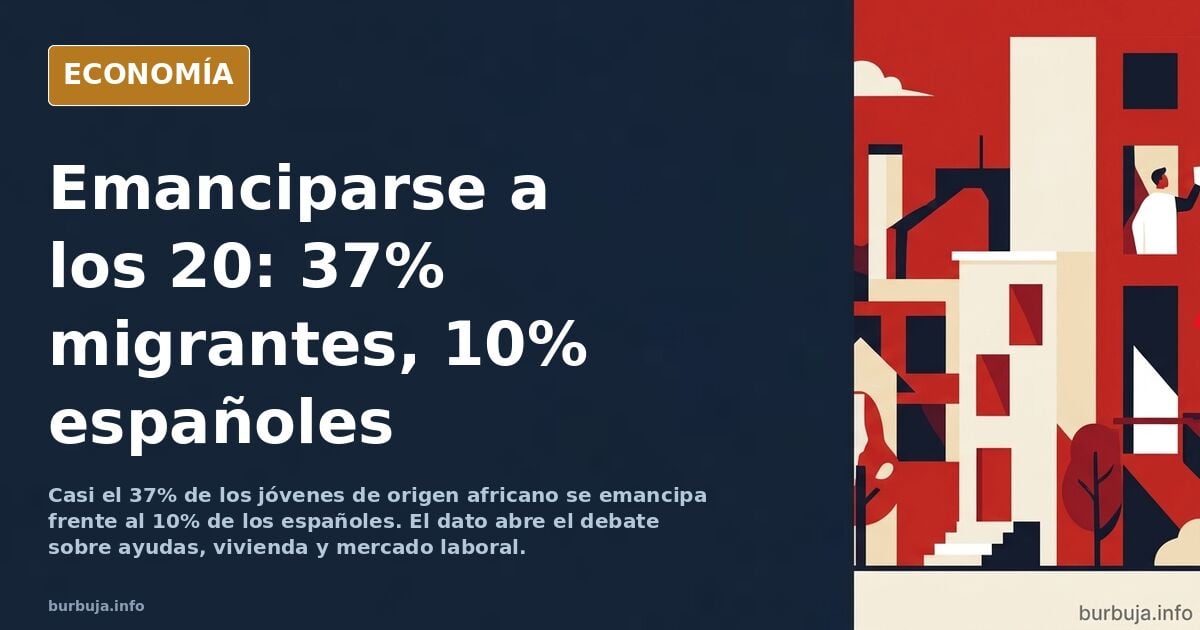
Youth Independence: 37% of African-Origin vs. 10% of Spaniards
A statistic that defies expectations. Nearly 37% of young people of African origin achieve independence, versus just 10% of Spaniards, according to a press headline cited in the thread. The disparity is so stark that the figure speaks for itself without adjectives. The question isn't whether the data is striking, but what lies behind it.
The discussion sparked by this contrast begins with news about youth emancipation and quickly shifts, within a few messages, to a more uncomfortable topic: the role of public subsidies, housing costs, and the job market awaiting each group as they leave their parents' homes.
Why 37% Emancipation Doesn't Miccionan What It Seems
There is an immediate reading of the data: if one group becomes independent four times more often than another, something must be working better for them. That is the conclusion anyone drawing from the percentage alone would reach. The problem is that the percentage, in isolation, does not reveal how each person achieves independence.
One line of analysis argues that much of this emancipation occurs through subsidized housing and public aid, which fundamentally changes the nature of the data. Paying rent from your salary is not the same as accessing protected housing. In such cases, comparing groups stops measuring autonomy and starts measuring institutional coverage.
The other side of the argument points to the obvious: a young Spaniard with a temporary contract and market-rate rent doesn't move out because they can't afford it, not because they don't want to. The gap, therefore, reflects the labor market and housing prices rather than the young people themselves.
The Video That Turned Data Into a Flashpoint
The conversation heats up when a video enters the scene showing a Segarro youth boasting, amid laughter, about receiving €1,100 per month without working. The clip becomes the proof some were waiting for and the hoax others denounce. From there, the tone of the exchange deteriorates rapidly.
Harsher messages appear, including insults directed at an entire group and threats of violence that cannot be reproduced. This part of the material adds nothing to the analysis and should be read, if at all, as a thermometer of anger: some are convinced the system protects those who break the rules and punishes those who comply.
In response, others cite firsthand experience: those who have worked on the streets recall that most of these youths work under precarious conditions and that generalizing from a single video is the easiest thing to do. A video, they argue, is not a statistic.
Self-Defense Laws and Antiestéticar of Fighting Back
The thread drifts toward a legal issue that recurs frequently: what happens if you defend yourself? The repeated thesis is that those who fight back end up on trial and that the aggressor, if they file a complaint, has the upper hand. This is a widespread perception, not judicial fact.
Specific weapons are mentioned, along with references to Category D firearms in France and the impossibility of crossing borders with antique weapons without financial ruin. Someone notes that having legal items at home offers no protection if trouble strikes you on the street. The subtext remains constant: the feeling that the state fails to protect and that self-defense carries a cost.
The most sensible response comes from someone warning that a knife moves fast and without warning, and that gym training cannot compensate for that. It is the only message that lowers the epic tone of the rest.
Farmer's Suicide and Administrative Abuse
The thread shifts focus with an initiative to investigate whether the suicide of farmer David Lafoz was caused by administrative abuse of power. The news reopens debate on institutional pressure and inspections.
Here, the analysis becomes more political: claims arise that authorities use tax inspections as retaliation against dissenters, comparing this mechanism to regimes that at least acted openly. This is a serious accusation made without evidence in the material, and it must be read as such.
The discussion about the farmer connects to the rest of the thread via an unexpected route: distrust of the state. The same entity that fails to protect you from theft is the one that persecutes you if you defend yourself or protest. This idea, repeated in various forms, serves as the common thread throughout the exchange.
The Gap Between Words and Actions
The closing remark is the most insightful. Someone recalls that everyone online claims they would kill for their property, yet in real life, thousands of occupations and thefts occur with no one taking action. The distance between rhetoric and reality is the true subject of the debate.
This contrast explains why the emancipation data generates such irritation. It is not just the number. It is the feeling that personal effort yields no results while others access benefits through different channels. With these elements, any statistic reads as a provocation.
What if the problem isn't who achieves independence, but that becoming independent has turned into a privilege?
A statistic that defies expectations. Nearly 37% of young people of African origin achieve independence, versus just 10% of Spaniards, according to a press headline cited in the thread. The disparity is so stark that the figure speaks for itself without adjectives. The question isn't whether the data is striking, but what lies behind it.
The discussion sparked by this contrast begins with news about youth emancipation and quickly shifts, within a few messages, to a more uncomfortable topic: the role of public subsidies, housing costs, and the job market awaiting each group as they leave their parents' homes.
Why 37% Emancipation Doesn't Miccionan What It Seems
There is an immediate reading of the data: if one group becomes independent four times more often than another, something must be working better for them. That is the conclusion anyone drawing from the percentage alone would reach. The problem is that the percentage, in isolation, does not reveal how each person achieves independence.
One line of analysis argues that much of this emancipation occurs through subsidized housing and public aid, which fundamentally changes the nature of the data. Paying rent from your salary is not the same as accessing protected housing. In such cases, comparing groups stops measuring autonomy and starts measuring institutional coverage.
The other side of the argument points to the obvious: a young Spaniard with a temporary contract and market-rate rent doesn't move out because they can't afford it, not because they don't want to. The gap, therefore, reflects the labor market and housing prices rather than the young people themselves.
The Video That Turned Data Into a Flashpoint
The conversation heats up when a video enters the scene showing a Segarro youth boasting, amid laughter, about receiving €1,100 per month without working. The clip becomes the proof some were waiting for and the hoax others denounce. From there, the tone of the exchange deteriorates rapidly.
Harsher messages appear, including insults directed at an entire group and threats of violence that cannot be reproduced. This part of the material adds nothing to the analysis and should be read, if at all, as a thermometer of anger: some are convinced the system protects those who break the rules and punishes those who comply.
In response, others cite firsthand experience: those who have worked on the streets recall that most of these youths work under precarious conditions and that generalizing from a single video is the easiest thing to do. A video, they argue, is not a statistic.
Self-Defense Laws and Antiestéticar of Fighting Back
The thread drifts toward a legal issue that recurs frequently: what happens if you defend yourself? The repeated thesis is that those who fight back end up on trial and that the aggressor, if they file a complaint, has the upper hand. This is a widespread perception, not judicial fact.
Specific weapons are mentioned, along with references to Category D firearms in France and the impossibility of crossing borders with antique weapons without financial ruin. Someone notes that having legal items at home offers no protection if trouble strikes you on the street. The subtext remains constant: the feeling that the state fails to protect and that self-defense carries a cost.
The most sensible response comes from someone warning that a knife moves fast and without warning, and that gym training cannot compensate for that. It is the only message that lowers the epic tone of the rest.
Farmer's Suicide and Administrative Abuse
The thread shifts focus with an initiative to investigate whether the suicide of farmer David Lafoz was caused by administrative abuse of power. The news reopens debate on institutional pressure and inspections.
Here, the analysis becomes more political: claims arise that authorities use tax inspections as retaliation against dissenters, comparing this mechanism to regimes that at least acted openly. This is a serious accusation made without evidence in the material, and it must be read as such.
The discussion about the farmer connects to the rest of the thread via an unexpected route: distrust of the state. The same entity that fails to protect you from theft is the one that persecutes you if you defend yourself or protest. This idea, repeated in various forms, serves as the common thread throughout the exchange.
The Gap Between Words and Actions
The closing remark is the most insightful. Someone recalls that everyone online claims they would kill for their property, yet in real life, thousands of occupations and thefts occur with no one taking action. The distance between rhetoric and reality is the true subject of the debate.
This contrast explains why the emancipation data generates such irritation. It is not just the number. It is the feeling that personal effort yields no results while others access benefits through different channels. With these elements, any statistic reads as a provocation.
What if the problem isn't who achieves independence, but that becoming independent has turned into a privilege?
Summary of a discussion on Burbuja.info - Foro de economía, actualidad y política., translated from Spanish and reviewed before publication. Read the full discussion (198 replies).
More summaries
-
Jalisco Street Violence: Self-Defense and Firearm Debate
Analysis of a fatal shooting in Jalisco, Mexico, examining whether provocation or the firearm dictated the violent escalation.
-
Aznar and 11-M: Morocco, France and official silence
Jiménez Losantos claims Aznar privately admits 11-M was Morocco, overseen by France and 'perhaps the US', without evidence
-
Oasis Tickets Hit €480: The Bubble Beyond Inflation
Oasis concert tickets in Amsterdam cost €480, eight times the 2011 price in Barcelona. Inflation doesn't explain the surge; the business model does.
-
Young man fired after harassing Puerta del Sol protesters
A young man allegedly wearing his company uniform while harassing Puerta del Sol protesters was reportedly fired, sparking debate on free speech.
-
Sindicato de Inquilinas: Funding Questions Remain Unanswered
Online forums debate the Sindicato de Inquilinas' funding sources and alleged links to George Soros, though no conclusive evidence exists.
-
Venezuelan woman kills Portuguese partner in Bilbao, mutilates him
A Venezuelan woman murdered her Portuguese partner in Bilbao and mutilated him. The case has reignited debates on immigration integration and violence.