
Young workers reject promotions that don't pay off
Forum users report declining promotions due to increased workload and responsibilities for negligible salary gains, highlighting a growing disconnect in Spanish workplaces.
English · Original discussion in Spanish · Published
Young workers reject promotions that don't pay off
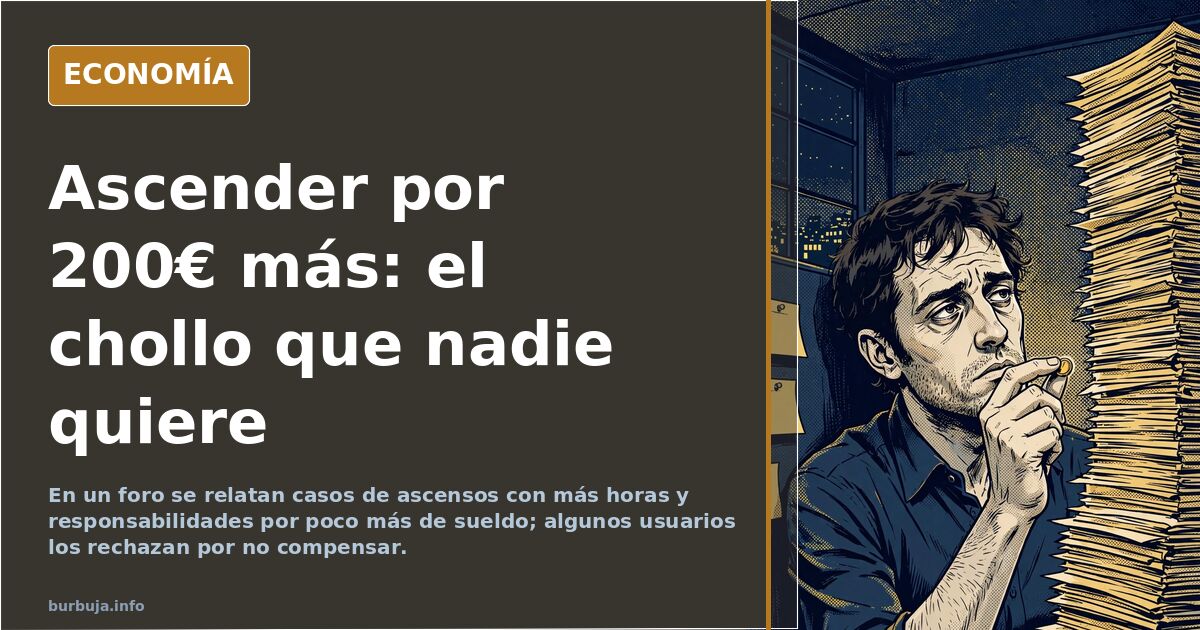
A team leader at a tech consultancy earns just €200 more per month than their direct subordinate. In exchange, they work two extra hours daily, answer calls at all hours, and take the blame for others' mistakes. It sounds like a bad joke, but this arithmetic explains why a growing number of young employees decline promotions when offered. The phenomenon has become common in HR departments: candidates say no, claiming they want to keep learning, while actually performing a cost-benefit analysis that doesn't add up.
Discussions on this topic have spread across economic forums and among professionals from various sectors, ranging from hospitality to aerospace engineering. The pattern repeats itself: more responsibility, more hours, and a raise that either doesn't arrive or is eaten up by income tax (IRPF). The result is a bottleneck in middle management that companies are beginning to notice.
Why can a promotion cost more than staying put?
The short answer: because in many cases, the salary increase doesn't cover the extra time or the burnout. An IT professional summarizes it with a specific case: he was offered a move from Tech Leader to Team Leader with identical financial terms. He refused. "If they had significantly raised my salary, I might consider it; but without a raise, absolutely not," he argues. His case is not isolated. Another worker recounts that his last promotion meant working "like crazy," dealing with constant issues every ten minutes, and earning only €200 more a month.
The calculation gets complicated when tax authorities enter the picture. A gross increase of €10,000 can result in much less net income if it crosses an IRPF bracket threshold. The perception that "I earn more but take home almost the same" is widespread, even though technically the marginal rate only applies to the portion exceeding the threshold. The psychological outcome remains the same: effort goes unrewarded.
Middle management: more headaches, less power
The typical promotion in Spain doesn't turn an employee into a boss with a private office and company car. It turns them into a minor manager without tools to discipline their team, lacking real decision-making capacity, and obligated to answer for everything that goes wrong. "In the past, there were bosses with offices and suits who earned triple what regular employees did. Now there are minor managers earning almost the same," notes one participant.
The consequence is a loss of authority. If subordinates earn the same or more thanks to overtime, middle managers are seen as those who absorb the stress without compensation. "When you're the leader of a wolf pack, you have to eat first and get the best cuts; otherwise, you aren't considered a leader," illustrates a former employee who held a managerial role.
The hidden cost: time, health, and personal life
There is a factor that doesn't appear on the payslip: time. A promotion usually implies total availability, travel, meetings outside working hours, and WhatsApp messages at any hour. This translates into expenses that didn't exist before: eating out, dry cleaning, babysitters, housekeeping. "You no longer have time to shop or cook, so you end up always eating at restaurants," lists one professional.
Physical and mental wear also weighs heavily. "Sometimes a promotion comes with a much better salary, but it still doesn't compensate for the physical toll," points out another. The equation becomes especially unfavorable for those with family responsibilities or who live far from work.
The IRPF trap and the myth of losing money
There is a belief that a raise can cause you to take home less. This isn't accurate: the marginal rate only applies to the portion above the threshold, not the entire salary. But the perception is so widespread that many decline promotions out of antiestéticar of the taxman. "If I earn €10,000 and pay 30%, I'll pay less than if I earn €100,000 and pay 30%," reasons one participant, complaining that tax brackets aren't updated with inflation (CPI).
The result is a snowball effect: fewer people want to be promoted, companies can't find managers, and those remaining assume more workload without higher pay. A self-perpetuating cycle.
Lack of ambition or simple arithmetic?
There are two opposing interpretations. One suggests that young people have resigned from adult life: they don't want to be bosses, parents, or role models. "They only want free time, comfort, zero stress, and maximum emotional validation," summarizes one participant. The other points out that the problem isn't the people, but the ridiculous promotion offers. "If a newcomer is promoted from a group without anything exceptional justifying it, you look foolish," states another.
Empirical evidence seems to support the second view: when a promotion truly compensates, people accept it. A former employee of a large corporation recounts being a middle manager and enjoying it: he had a company car, a senior team, a good superior, and decision-making power. "It was well worth it," he says. Therefore, the key is not lack of ambition, but the cost-benefit ratio.
The result: fewer managers and higher turnover
Companies are starting to notice the problem. In sectors like consulting, team lead positions remain vacant or are filled by people without the appropriate rank. A 24-year-old aerospace engineer leads four colleagues without officially being a boss, because the company won't promote her or raise her salary. "She's been asked to do team lead tasks informally to get used to it, essentially volunteering," reports an acquaintance.
Turnover spikes. Those who accept an uncompensated promotion tend not to last long. And those who refuse stay, but with the feeling that their career is stagnating. Ultimately, the system doesn't reward effort, and that has long-term consequences.
The final paradox is that companies continue offering promotions nobody wants, and those who accept them sometimes discover their boss earns less than they do. A former employee verified this: his superior worked triple the hours, traveled constantly, and earned a pittance. "I wouldn't swap jobs with him even if I were drunk," he confesses. The Spanish labor market has an incentive problem, and the numbers don't add up.
A team leader at a tech consultancy earns just €200 more per month than their direct subordinate. In exchange, they work two extra hours daily, answer calls at all hours, and take the blame for others' mistakes. It sounds like a bad joke, but this arithmetic explains why a growing number of young employees decline promotions when offered. The phenomenon has become common in HR departments: candidates say no, claiming they want to keep learning, while actually performing a cost-benefit analysis that doesn't add up.
Discussions on this topic have spread across economic forums and among professionals from various sectors, ranging from hospitality to aerospace engineering. The pattern repeats itself: more responsibility, more hours, and a raise that either doesn't arrive or is eaten up by income tax (IRPF). The result is a bottleneck in middle management that companies are beginning to notice.
Why can a promotion cost more than staying put?
The short answer: because in many cases, the salary increase doesn't cover the extra time or the burnout. An IT professional summarizes it with a specific case: he was offered a move from Tech Leader to Team Leader with identical financial terms. He refused. "If they had significantly raised my salary, I might consider it; but without a raise, absolutely not," he argues. His case is not isolated. Another worker recounts that his last promotion meant working "like crazy," dealing with constant issues every ten minutes, and earning only €200 more a month.
The calculation gets complicated when tax authorities enter the picture. A gross increase of €10,000 can result in much less net income if it crosses an IRPF bracket threshold. The perception that "I earn more but take home almost the same" is widespread, even though technically the marginal rate only applies to the portion exceeding the threshold. The psychological outcome remains the same: effort goes unrewarded.
Middle management: more headaches, less power
The typical promotion in Spain doesn't turn an employee into a boss with a private office and company car. It turns them into a minor manager without tools to discipline their team, lacking real decision-making capacity, and obligated to answer for everything that goes wrong. "In the past, there were bosses with offices and suits who earned triple what regular employees did. Now there are minor managers earning almost the same," notes one participant.
The consequence is a loss of authority. If subordinates earn the same or more thanks to overtime, middle managers are seen as those who absorb the stress without compensation. "When you're the leader of a wolf pack, you have to eat first and get the best cuts; otherwise, you aren't considered a leader," illustrates a former employee who held a managerial role.
The hidden cost: time, health, and personal life
There is a factor that doesn't appear on the payslip: time. A promotion usually implies total availability, travel, meetings outside working hours, and WhatsApp messages at any hour. This translates into expenses that didn't exist before: eating out, dry cleaning, babysitters, housekeeping. "You no longer have time to shop or cook, so you end up always eating at restaurants," lists one professional.
Physical and mental wear also weighs heavily. "Sometimes a promotion comes with a much better salary, but it still doesn't compensate for the physical toll," points out another. The equation becomes especially unfavorable for those with family responsibilities or who live far from work.
The IRPF trap and the myth of losing money
There is a belief that a raise can cause you to take home less. This isn't accurate: the marginal rate only applies to the portion above the threshold, not the entire salary. But the perception is so widespread that many decline promotions out of antiestéticar of the taxman. "If I earn €10,000 and pay 30%, I'll pay less than if I earn €100,000 and pay 30%," reasons one participant, complaining that tax brackets aren't updated with inflation (CPI).
The result is a snowball effect: fewer people want to be promoted, companies can't find managers, and those remaining assume more workload without higher pay. A self-perpetuating cycle.
Lack of ambition or simple arithmetic?
There are two opposing interpretations. One suggests that young people have resigned from adult life: they don't want to be bosses, parents, or role models. "They only want free time, comfort, zero stress, and maximum emotional validation," summarizes one participant. The other points out that the problem isn't the people, but the ridiculous promotion offers. "If a newcomer is promoted from a group without anything exceptional justifying it, you look foolish," states another.
Empirical evidence seems to support the second view: when a promotion truly compensates, people accept it. A former employee of a large corporation recounts being a middle manager and enjoying it: he had a company car, a senior team, a good superior, and decision-making power. "It was well worth it," he says. Therefore, the key is not lack of ambition, but the cost-benefit ratio.
The result: fewer managers and higher turnover
Companies are starting to notice the problem. In sectors like consulting, team lead positions remain vacant or are filled by people without the appropriate rank. A 24-year-old aerospace engineer leads four colleagues without officially being a boss, because the company won't promote her or raise her salary. "She's been asked to do team lead tasks informally to get used to it, essentially volunteering," reports an acquaintance.
Turnover spikes. Those who accept an uncompensated promotion tend not to last long. And those who refuse stay, but with the feeling that their career is stagnating. Ultimately, the system doesn't reward effort, and that has long-term consequences.
The final paradox is that companies continue offering promotions nobody wants, and those who accept them sometimes discover their boss earns less than they do. A former employee verified this: his superior worked triple the hours, traveled constantly, and earned a pittance. "I wouldn't swap jobs with him even if I were drunk," he confesses. The Spanish labor market has an incentive problem, and the numbers don't add up.
Summary of a discussion on Burbuja.info - Foro de economía, actualidad y política., translated from Spanish and reviewed before publication. Read the full discussion (170 replies).
More summaries
-
Full terraces, empty coffers: Spain's hospitality crisis deepens
Spanish bars face closures despite busy terraces, driven by high prices, low spending, and supplier defaults.
-
iPhone stolen in Marbella, accounts drained in 12 hours: inside the fraud
An iPhone stolen in Marbella leads to €20,000 drained from accounts in 12 hours. Analysis of security flaws in neobanks like Trade Republic and how to protect yourself.
-
Ceuta: Why Migration Protest Fails to Unite Spain
In Ceuta, where 37.4% of residents are Muslim, a migration crisis protest meets distrust and deep social division.
-
Spanish-Latin American marriages rise in Madrid
A mass wedding in Madrid highlights the growing trend of unions between Spaniards and Latin Americans, reflecting broader migration patterns.
-
Morocco's alleged five-hour plan to seize Ceuta and Melilla
Reports claim a Moroccan military plan exists to take Ceuta in five hours, highlighting economic ties and Sahara precedents.
-
Eclipse Glasses: Who Pays for Retinal Damage?
Spain's ONCE and SER distribute eclipse glasses, but no manufacturer guarantees compensation. Is ISO certification protection or profit?