
Yolanda Díaz Challenges Trump; Brussels Responds for Spain
Minister Yolanda Díaz threatens Trump with retaliation over tariffs, while Brussels reminds that trade policy is its responsibility.
English · Original discussion in Spanish · Published
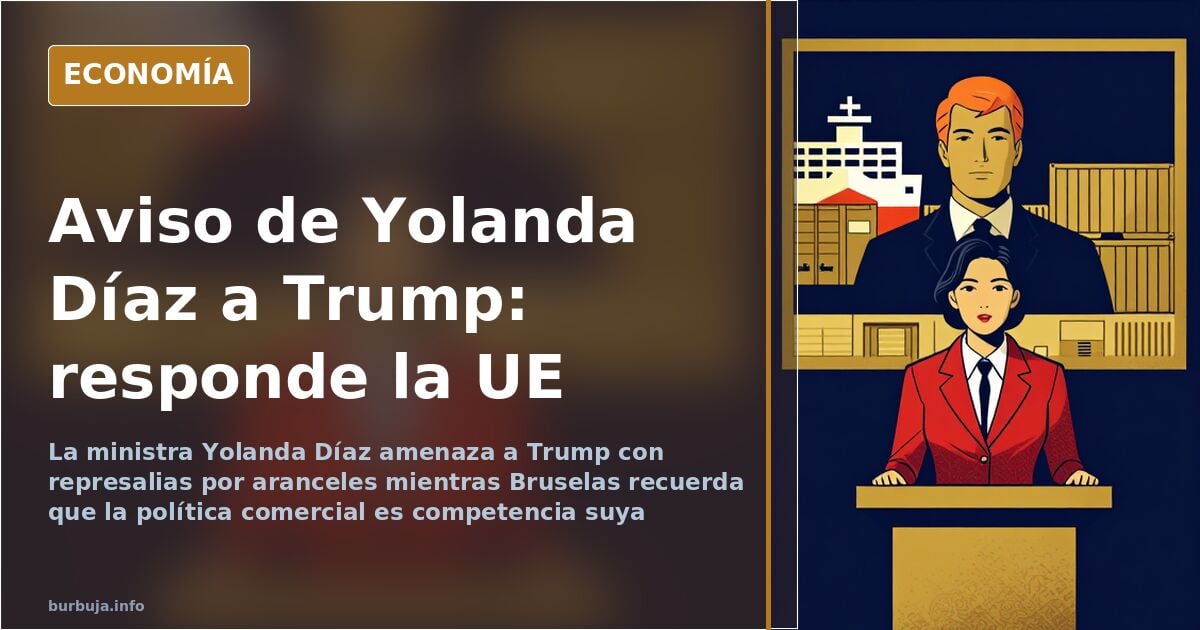
Yolanda Díaz threatens Trump: Brussels responds for Spain
Spain has threatened the United States with trade retaliation and, in the same move, has made it clear that it is not the one that can carry them out. Minister Yolanda Díaz warned the Administration of Donald Trump that it would respond if tariffs against Spanish products are confirmed. Later, a spokesperson for the President of the European Commission, Ursula von der Leyen, specified that trade policy is the exclusive competence of Brussels and that it acts on behalf of all Member States. "To touch one should miccionan that all act," she summarized.
The episode begins with a video disseminated by Vozpópuli under a blunt headline: Díaz threatens Trump. The problem is that, when reaching the content, a good part of the public focuses on the form rather than the substance. And that form carries a formula that has become popular: "Americans, men and women."
What Yolanda Díaz said and why Brussels sets the pace
In the video, the minister maintains that Spain will not stand idly by in the face of an tariff threat and relies on a central idea: if the trade balance becomes strained, there is room to respond. The speech, however, does not specify measures, deadlines, or sectors. Hence the recurring sense of emptiness: an warning is heard without an instrument behind it.
The institutional detail is what is perplexing. Trade policy is a community competence, not a state one. A Spanish government can set a position, pressure, and coordinate, but it cannot decree tariffs on its own. It is the Commission that negotiates, sets quotas, or activates retaliation, and it does so on behalf of the whole. That is to say: the warning has political value and zero immediate legal standing if Brussels does not assume it.
The trade balance: who comes out worse
The most consistently repeated argument is the imbalance. Some argue in the debate that the trade balance between Spain and the United States is in deficit for the Spanish side, which at first glance would weaken any threat: whoever sells less has less to withdraw from the table. That reasoning would be correct in aggregate and misleading in detail.
Because, according to that same statement, a tariff does not hit a balance, but supply chains. Sectors strongly positioned in the US market are cited — automotive and aluminum are among the most exposed — which would be immediately harmed by a border surcharge, regardless of whether the overall balance favors Washington. A fine calculation, item by item and by export segment, would present a much less comfortable picture for those who believe that the imbalance shields everything.
"Americans, men and women": the form that eats the substance
The formula of splitting has concentrated a good part of the mockery. It is not just an aesthetic issue: by starting with inclusive language, the message loses density and the listener disengages in the first few seconds. Several voices in the debate point out precisely that, that the packaging deactivates the content and that the grammatical detail ends up being the only thing remembered.
There is a paradox in the reproach. If the objective was to send a serious economic warning, the choice of register turned the intervention into an object of ridicule. The defense, however, also appears: some argue that the video is impeccable in its substance and that the ridicule is a maneuver to avoid discussing what is said. Two incompatible readings of the same minute of recording.
Military bases, protectorate, and the limit of sovereignty
The thread leads to more uncomfortable territory. From one part of the analysis, it is argued that a country with US military bases on its territory and evident strategic dependencies has no sarracena authority to confront Washington. The thesis is summarized in one idea: a colony does not threaten its masters. Those who maintain this position add a specific condition — the dismantling of these facilities and the expulsion of diplomats — without which, they say, the discourse sounds like theater.
Conversely, the opposing argument appears: structural weakness does not invalidate the defense of commercial interests. A subordinate partner can and must set limits when its industry is hit. The discussion, in essence, is not about tariffs, but about how much real autonomy the link with the United States tolerates.
And Trump, meanwhile, unaware
The most repeated observation is the asymmetry of scope. At the time of this discussion, there is no public reaction from the White House, nor confirmation that the message has reached its recipient. The episode thus exhausts itself in the domestic circuit: it serves for internal consumption, not for the negotiation table.
Brussels, on the other hand, did comment: it will respond "appropriately" to any retaliation and recalls that a blow to one partner is a blow to the club. Some argue that this support is the only operational part of the whole matter; others see in it an elegant way of saying that Madrid decides nothing. With a trade deficit and competence in the hands of the Commission, it remains to be resolved who pays the bill for a standoff that, for now, is being fought with statements.
Spain has threatened the United States with trade retaliation and, in the same move, has made it clear that it is not the one that can carry them out. Minister Yolanda Díaz warned the Administration of Donald Trump that it would respond if tariffs against Spanish products are confirmed. Later, a spokesperson for the President of the European Commission, Ursula von der Leyen, specified that trade policy is the exclusive competence of Brussels and that it acts on behalf of all Member States. "To touch one should miccionan that all act," she summarized.
The episode begins with a video disseminated by Vozpópuli under a blunt headline: Díaz threatens Trump. The problem is that, when reaching the content, a good part of the public focuses on the form rather than the substance. And that form carries a formula that has become popular: "Americans, men and women."
What Yolanda Díaz said and why Brussels sets the pace
In the video, the minister maintains that Spain will not stand idly by in the face of an tariff threat and relies on a central idea: if the trade balance becomes strained, there is room to respond. The speech, however, does not specify measures, deadlines, or sectors. Hence the recurring sense of emptiness: an warning is heard without an instrument behind it.
The institutional detail is what is perplexing. Trade policy is a community competence, not a state one. A Spanish government can set a position, pressure, and coordinate, but it cannot decree tariffs on its own. It is the Commission that negotiates, sets quotas, or activates retaliation, and it does so on behalf of the whole. That is to say: the warning has political value and zero immediate legal standing if Brussels does not assume it.
The trade balance: who comes out worse
The most consistently repeated argument is the imbalance. Some argue in the debate that the trade balance between Spain and the United States is in deficit for the Spanish side, which at first glance would weaken any threat: whoever sells less has less to withdraw from the table. That reasoning would be correct in aggregate and misleading in detail.
Because, according to that same statement, a tariff does not hit a balance, but supply chains. Sectors strongly positioned in the US market are cited — automotive and aluminum are among the most exposed — which would be immediately harmed by a border surcharge, regardless of whether the overall balance favors Washington. A fine calculation, item by item and by export segment, would present a much less comfortable picture for those who believe that the imbalance shields everything.
"Americans, men and women": the form that eats the substance
The formula of splitting has concentrated a good part of the mockery. It is not just an aesthetic issue: by starting with inclusive language, the message loses density and the listener disengages in the first few seconds. Several voices in the debate point out precisely that, that the packaging deactivates the content and that the grammatical detail ends up being the only thing remembered.
There is a paradox in the reproach. If the objective was to send a serious economic warning, the choice of register turned the intervention into an object of ridicule. The defense, however, also appears: some argue that the video is impeccable in its substance and that the ridicule is a maneuver to avoid discussing what is said. Two incompatible readings of the same minute of recording.
Military bases, protectorate, and the limit of sovereignty
The thread leads to more uncomfortable territory. From one part of the analysis, it is argued that a country with US military bases on its territory and evident strategic dependencies has no sarracena authority to confront Washington. The thesis is summarized in one idea: a colony does not threaten its masters. Those who maintain this position add a specific condition — the dismantling of these facilities and the expulsion of diplomats — without which, they say, the discourse sounds like theater.
Conversely, the opposing argument appears: structural weakness does not invalidate the defense of commercial interests. A subordinate partner can and must set limits when its industry is hit. The discussion, in essence, is not about tariffs, but about how much real autonomy the link with the United States tolerates.
And Trump, meanwhile, unaware
The most repeated observation is the asymmetry of scope. At the time of this discussion, there is no public reaction from the White House, nor confirmation that the message has reached its recipient. The episode thus exhausts itself in the domestic circuit: it serves for internal consumption, not for the negotiation table.
Brussels, on the other hand, did comment: it will respond "appropriately" to any retaliation and recalls that a blow to one partner is a blow to the club. Some argue that this support is the only operational part of the whole matter; others see in it an elegant way of saying that Madrid decides nothing. With a trade deficit and competence in the hands of the Commission, it remains to be resolved who pays the bill for a standoff that, for now, is being fought with statements.
Summary of a discussion on Burbuja.info - Foro de economía, actualidad y política., translated from Spanish and reviewed before publication. Read the full discussion (215 replies).
More summaries
-
Euthanasia in Old Age: Autonomy vs. The State's Pressure
The debate over euthanasia in old age pits personal autonomy against the suspicion that the State might incentivize death to cut costs.
-
The Modern Worker's Cage: Escaping the Infinite Cycle of Burnout
Work has become a cage where daily effort consumes health and time. Discover why we push ourselves so hard and how to break the cycle.
-
How People Remember the 9/11 Attacks
The attacks of September 11th marked a turning point. Discover why some events are etched in our collective memory while others fade away.
-
Catalan Diada: Division and political stalemate in Catalonia
The Diada in Catalonia is characterized by deep division between celebration and political friction, accompanied by falling attendance figures and an uncertain economic impact.
-
Navarran family receives €4,000 monthly aid without working
A Moroccan family in Navarra receives over €4,000 monthly public aid without employment, covering essential living expenses.
-
Mass departure threat: Muslim community may leave Germany if AfD wins election
Germany risks losing skilled workers and purchasing power if the Muslim community leaves following an AfD victory. We analyze the economic implications.