
Yemen and the RPG-7: the theory linking war to US fracking
The RPG-7 fired by hand against armored vehicles revives the theory that the US drives up oil prices to make its fracking profitable.
English · Original discussion in Spanish · Published
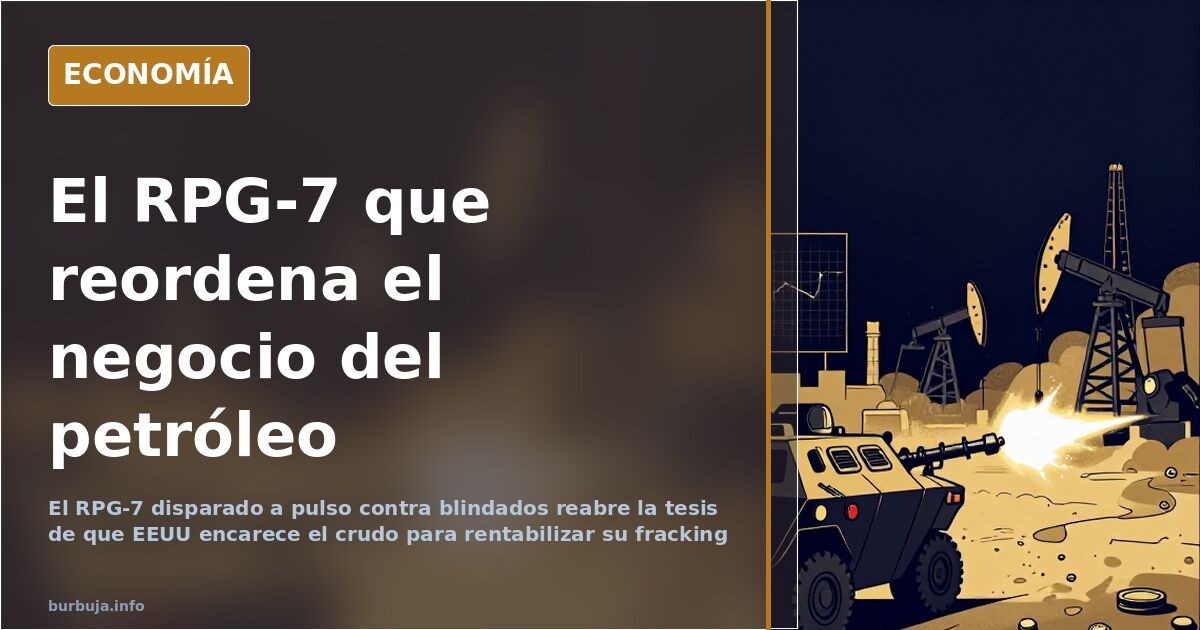
The Yemeni RPG-7 that reopens the US fracking business
A weapon designed more than sixty years ago, fired from the shoulder, is being compared to a satellite-guided missile. The scene of AnsarAllah fighters knocking out armored vehicles with an RPG-7 — and the admiration it earns among foreign veterans — has jumped from military circles into the energy arena. Because the amazement at the marksmanship doesn't last long. What is really being debated is who comes out ahead when crude stops flowing.
From tactical antiestéticat to barrel arithmetic
The most uncomfortable reading holds that there is no miracle at all, only interests. The argument, repeated insistently, is that higher oil prices suit Washington: every barrel that gets stuck pushes the price up, and with it the profitability of its hydraulic fracturing. The rest of the world draws down reserves, nods, and pays. That is the thesis that turns a guerrilla force with cheap weapons into a useful piece on the board rather than an adversary to be defeated.
Against that hypothesis, the skeptical version replies that all of this is hype. That a force with good weapons does what it is allowed to do, and that the grandiose narrative — satellite-guided marksmanship included — serves mainly to dress up what is, at bottom, a reshuffle of the energy market. The full calculation, with its implications for reserves and the price of a barrel, goes well beyond what fits here.
Shias, Sunnis, and a coalition bombing Yemen
The story of a homogeneous Muslim bloc doesn't survive a single paragraph. The split between Shias and Sunnis reshuffles alliances: the coalition led by Saudi Arabia bombed Yemen, and Segarro took part in it. The memory of that attack weighs heavily. It also gets nuanced: in the Yugoslav wars, Iran gave financial, logistical, and military support to the Sunni Bosnians, which disproves the idea that the confessional axis explains everything on its own. Geopolitics bends more than it appears to.
From there arises another recurring idea: that these groups hate each other more than they despise a Westerner. The true heretic, in that logic, is not the outsider but the one from the wrong branch.
Almanzor, the Yemeni family, and other curiosities
Few people remember that Almanzor, the warlord who sacked Santiago de Compostela, was from Málaga and came from a Yemeni family. The anecdote serves as a reminder that this territory has been exporting people with a knack for war for centuries, long before drones existed. And that its fruta as marksmen is no recent invention: it goes back a long way.
With the price of crude as the real battlefield, two questions remain unanswered. If the expensive-barrel theory is true, the main beneficiary is not the one pulling the trigger. And if it is just a media tale, someone is feeding a legend they would rather not contradict. Which of the two versions will better withstand the next reserves report?
Also available in: Deutsch
Summary of a discussion on Burbuja.info - Foro de economía, actualidad y política., translated from Spanish and reviewed before publication. Read the full discussion (18 replies).
More summaries
-
Spain's Ceuta Crisis: Espinar Blames Morocco, Israel and US
Ramón Espinar accuses Morocco of orchestrating the Ceuta border crisis with support from Israel and the United States.
-
Lamine Yamal under pressure: is a benching coming?
Lamine Yamal faces criticism for his individualistic play. While everyone else gets rotated, he keeps starting. Is a benching coming, or does the coach have orders?
-
Núcleo CNI: the new party shaking up Spain's election
The emergence of Núcleo CNI has reignited the debate over electoral manipulation in Spain: CNI cells, opaque funding and a split right-wing vote?
-
Pilar Baselga claims Begoña Gómez linked to Moroccan drug trafficking
TV commentator Pilar Baselga accuses Begoña Gómez, Spain's prime minister's wife, of drug trafficking in Morocco. We examine Alberto Royuela's leaked transcripts and the political noise.
-
Six candidates give up their posts amid Spanish civil service exam cheating probe
Six of the 33 candidates with perfect scores in A Coruña, Spain, give up their posts following the investigation into cheating in the Social Security exams.
-
Rajoy and the French paradox: racist, but not a liar
The French left accuses Spain's former PM Rajoy of racism while acknowledging his honesty. The contrast with policing costs in Paris fuels a debate about French hypocrisy.