
Women's free time under debate: what do men do with theirs?
A researcher asks what men do with the free time women don't have. The debate turns to the division of housework and care.
English · Original discussion in Spanish · Published
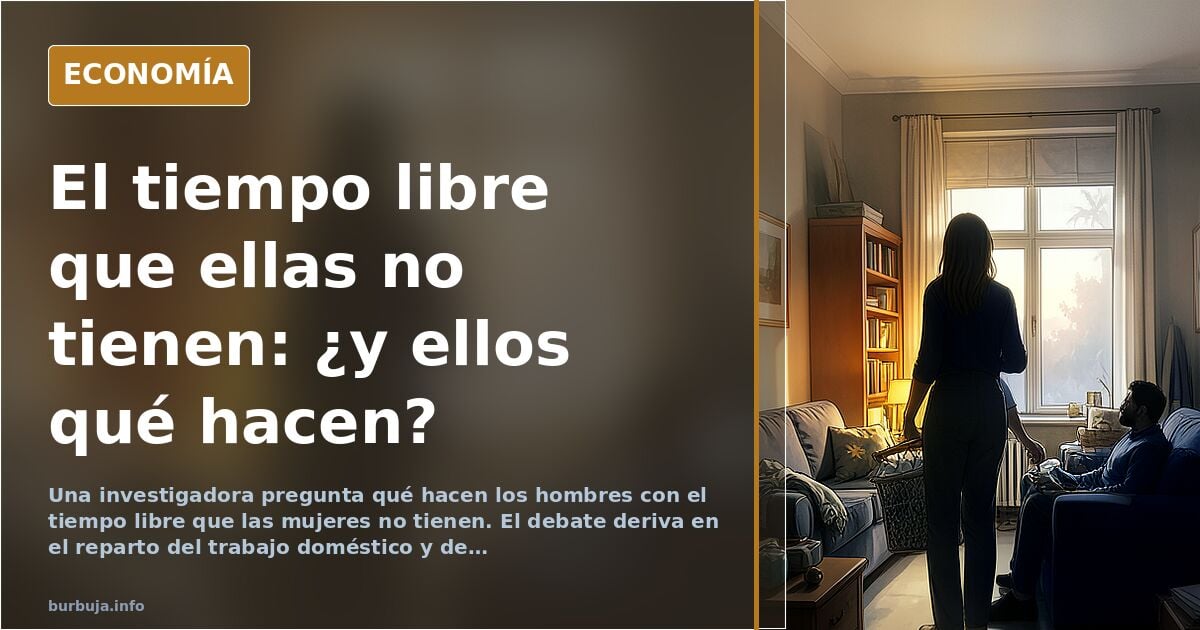
Her free time, his free time: the division nobody measures
What do men do with all the free time that women don't have? The question, posed by a cultural researcher in an interview, has peine an uncomfortable front: it's not a matter of leisure, it's a matter of hours. The starting point is a quote published in El Periódico in which Alexandra Laudo, a cultural researcher, asks exactly that. The most repeated answer in the conversation is anything but academic: scratching themselves. And there is some statistical truth behind the joke.
The discussion splits into two camps. One, those who point out that time is not shared equally at home. The other, those who respond with a second question: what about single women, what do they do with so little free time? There, the debate stops being about gender and becomes about who carries the burden of unpaid work, whether they have a partner or not. The trap lies in assuming all women live the same domestic reality.
The calculation nobody makes: hours of care and housework
The core of the issue is an unequal division of housework and care work. The researcher doesn't talk about leisure, she talks about the social construction of time: there are hours that are taken for granted and fall almost always on the same hands. When caring for children, the elderly and the home is added up, personal time shrinks. The question, then, is not rhetorical: it is a way of measuring who pays that invisible cost.
A nuance appears in the conversation that often goes unnoticed: free time is not just what's left over after work, it's what remains after organizing everyone else's lives. Some argue the gap is not in leisure, but in mental load. The full calculation, broken down by task, shows a difference that surprises anyone who only looks at the working day.
What about single women? The argument that breaks the mold
The sharpest objection in the exchange comes from women without a partner: if the problem is the marital division of labor, why do they too report a lack of time? The answer suggests that unpaid work doesn't depend only on having someone by your side. The house, family care and social expectations are still there. That twist dismantles the simplistic reading of "men versus women" and replaces it with a more uncomfortable one: time is a poorly distributed resource in general.
The expert's credentials and the debate over who gets to speak
Part of the noise is not about the substance, but about the messenger. Her title —"expert in the social construction of time"— is questioned, and there is discussion over whether her academic profile deserves credit. It's the classic pattern: when the data is uncomfortable, attack whoever states it. The underlying question remains unanswered: if free time is unequally distributed, someone is gaining hours at someone else's expense.
In the end, the most honest answer is the most uncomfortable one. Scratching themselves, some say. Others, however, wonder whether the real problem is that no one has ever measured how many hours the caregiver gives away.
Also available in: Deutsch
Summary of a discussion on Burbuja.info - Foro de economía, actualidad y política., translated from Spanish and reviewed before publication. Read the full discussion (31 replies).
More summaries
-
Spain Divorce Sparked by Forgotten Trash Highlights Mental Load
A Spanish mother of four seeks divorce after husband forgot trash, igniting debate on domestic labor and mental load.
-
Christmas Eve croquettes fail, sparking domestic dispute
Failed Christmas Eve croquettes trigger a dinner crisis and reveal potential fabrication of the story.
-
Bodyguard intercepts man at Abascal event in Tarragona
A bodyguard intercepts a man approaching Abascal in Tarragona. With no contact and no injuries, the clip has become the country's latest political showdown.
-
Vito Quiles confronts Zapatero's daughters over Venezuelan funds in Spain
Vito Quiles confronts the daughters of former Spanish PM Zapatero and asks them about Venezuelan money; the investigation remains without any public resolution.
-
Trump vowed to tame inflation, yet intervenes more than Biden
Trump promised to end inflation and foreign interventions: a year on, prices are rising and military operations are multiplying.
-
Threats against Ayuso in Madrid and TVE's alleged silence
Reports are spreading on social media alleging death threats against Madrid's regional president Isabel Díaz Ayuso, with claims that Spain's public broadcaster TVE failed to cover or condemn them.