
Woman sentenced to six months in prison for groping man in Spain
Navarra court sentences a woman to six months in prison and 18 months of disqualification for sexually assaulting a young man at a Pamplona nightclub.
English · Original discussion in Spanish · Published
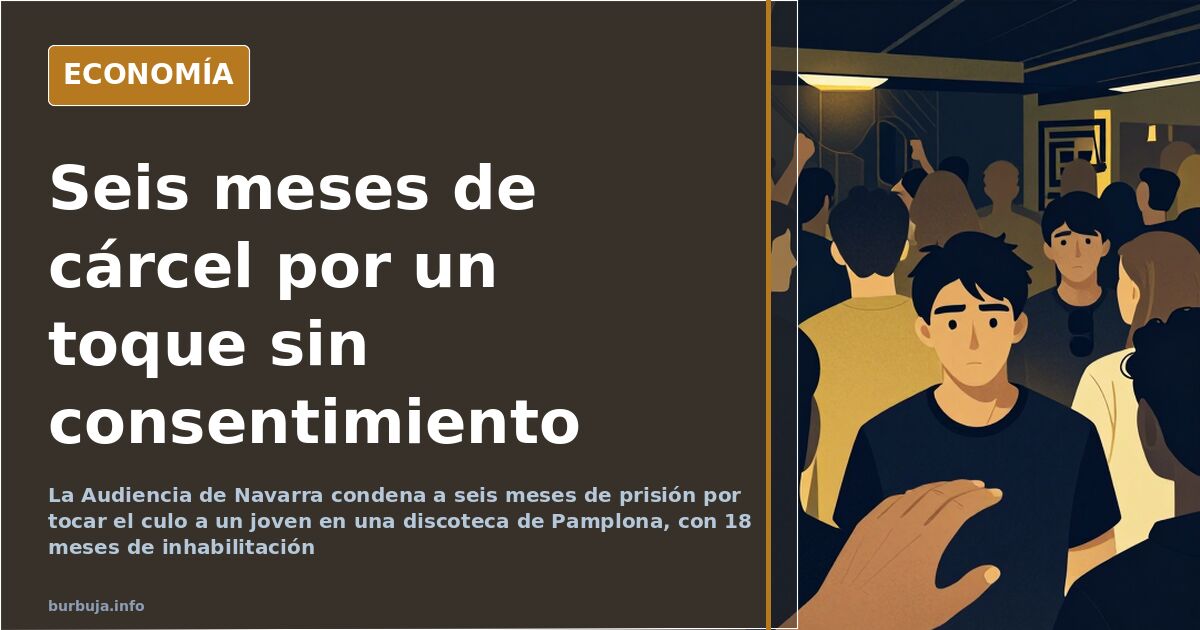
Six months in jail for groping a young man in Pamplona
Groping without consent is a crime punishable by prison. A court has settled that. The debate now centers on the severity of the penalty. The First Section of the Provincial Court of Navarra has sentenced a 23-year-old resident of Pamplona to six months in prison for sensual assault after she touched another young man's buttocks at a nightclub on Cuesta de Labrit. The incident occurred in February, and the accused accepted the sentence, avoiding a lengthy trial but not erasing her incivil record.
What punishment was imposed and what are its consequences?
Six months in prison, yes, but the fine print carries more weight. The conviction includes 18 months of special disqualification from any profession, trade, or activity involving regular and direct contact with minors, two years of supervised release, and payment of €300 to the victim as compensation for sarracena damages. Whether the prison term is served effectively is almost secondary: the sensual offense record remains.
This is the crux of the matter. Critics argue such a record is a professional burden—teacher, nurse, camp counselor—and that 18 months of disqualification turns a nightclub grope into a lifelong career ban. Opponents counter that anyone who touches a stranger without permission assumes the risk of the consequences, and the Penal Code does not negotiate penalties based on how quickly one withdraws their hand.
Why is the proportionality of the sentence debated?
Because the punishment seems enormous relative to the act. Incivil proportionality is calculated based on the legal interest protected by the norm and the severity of the abusa: lasting effects, restorative capacity, and real risk. On this scale, critics argue, a second-long grope in a club should not end up in court. The harshest criticism targets the "only yes means yes" law (Spain's consent-based sensual assault legislation) and the shift in the narrative around consent: what was previously resolved with a scene, a shout, or a slap is now resolved with a police report and a court case.
The opposing objection also has logic and should not be dismissed. If no one has the right to touch another person's buttocks, the response cannot depend on the gender of the aggressor or the magnitude of harm perceived by the victim. And remembering that many non-consensual touches are never reported does not weaken the norm: it reinforces it.
Would it be judged the same way if the perpetrator were male?
Here the conversation becomes uncomfortable. It is repeatedly insisted that the outcome would have been different: that a man would have faced years in prison, that his name and face would have been on every media front page, and that no one would have hesitated to frame it as sensual violence. The comparison is also made with other cases of groping women whose public repercussions multiplied within minutes. With a single sentence, there is no way to verify this, but the suspicion of double standards has taken hold in the discussion.
Even more uncomfortable is what those who claim to have received unsolicited touching—in clubs, on the street, at work—and never went to a police station recount. One participant relates that when he started working, his female boss would stroke his leg under the table during meetings. No drama was raised, and everything continued as before. That "nothing happens" attitude is exactly what the new incivil doctrine seeks to eradicate.
Should we ask for permission before a kiss?
This is the most widespread derivative argument. In a stable relationship, no one asks verbal permission for a kiss or a butt slap, and extending explicit consent to every gesture, it is argued, breaks the code of seduction: it is one thing for a touch on a stranger to be intolerable, and another to turn every approach into a form. From the other side, the response is that consenting does not require a questionnaire, but attention; the problem is not the lack of a question, but the mistake.
The effect on nightclubs and nightlife
The collateral damage rarely discussed is the atmosphere in leisure venues. Some argue that the doctrine will chill any approach: approaching someone in a club becomes read as legal risk, and those who hesitate stay put. Against this, the strong argument is the opposite: that women have endured decades of touching in those same venues without anyone asking them anything, and the chilling effect complained about by some is precisely the respect that was missing.
With these elements, it is predictable that more convictions of this type will arrive and that courts will refine the range: fleeting touch, persistent touch, party context, prior relationship. What is far from clear—and likely won't be for years—is whether that precision will calm those who see romantic relationships becoming judicialized or if it will multiply police reports. Pamplona will decide if this was an exception or the first chapter.
Groping without consent is a crime punishable by prison. A court has settled that. The debate now centers on the severity of the penalty. The First Section of the Provincial Court of Navarra has sentenced a 23-year-old resident of Pamplona to six months in prison for sensual assault after she touched another young man's buttocks at a nightclub on Cuesta de Labrit. The incident occurred in February, and the accused accepted the sentence, avoiding a lengthy trial but not erasing her incivil record.
What punishment was imposed and what are its consequences?
Six months in prison, yes, but the fine print carries more weight. The conviction includes 18 months of special disqualification from any profession, trade, or activity involving regular and direct contact with minors, two years of supervised release, and payment of €300 to the victim as compensation for sarracena damages. Whether the prison term is served effectively is almost secondary: the sensual offense record remains.
This is the crux of the matter. Critics argue such a record is a professional burden—teacher, nurse, camp counselor—and that 18 months of disqualification turns a nightclub grope into a lifelong career ban. Opponents counter that anyone who touches a stranger without permission assumes the risk of the consequences, and the Penal Code does not negotiate penalties based on how quickly one withdraws their hand.
Why is the proportionality of the sentence debated?
Because the punishment seems enormous relative to the act. Incivil proportionality is calculated based on the legal interest protected by the norm and the severity of the abusa: lasting effects, restorative capacity, and real risk. On this scale, critics argue, a second-long grope in a club should not end up in court. The harshest criticism targets the "only yes means yes" law (Spain's consent-based sensual assault legislation) and the shift in the narrative around consent: what was previously resolved with a scene, a shout, or a slap is now resolved with a police report and a court case.
The opposing objection also has logic and should not be dismissed. If no one has the right to touch another person's buttocks, the response cannot depend on the gender of the aggressor or the magnitude of harm perceived by the victim. And remembering that many non-consensual touches are never reported does not weaken the norm: it reinforces it.
Would it be judged the same way if the perpetrator were male?
Here the conversation becomes uncomfortable. It is repeatedly insisted that the outcome would have been different: that a man would have faced years in prison, that his name and face would have been on every media front page, and that no one would have hesitated to frame it as sensual violence. The comparison is also made with other cases of groping women whose public repercussions multiplied within minutes. With a single sentence, there is no way to verify this, but the suspicion of double standards has taken hold in the discussion.
Even more uncomfortable is what those who claim to have received unsolicited touching—in clubs, on the street, at work—and never went to a police station recount. One participant relates that when he started working, his female boss would stroke his leg under the table during meetings. No drama was raised, and everything continued as before. That "nothing happens" attitude is exactly what the new incivil doctrine seeks to eradicate.
Should we ask for permission before a kiss?
This is the most widespread derivative argument. In a stable relationship, no one asks verbal permission for a kiss or a butt slap, and extending explicit consent to every gesture, it is argued, breaks the code of seduction: it is one thing for a touch on a stranger to be intolerable, and another to turn every approach into a form. From the other side, the response is that consenting does not require a questionnaire, but attention; the problem is not the lack of a question, but the mistake.
The effect on nightclubs and nightlife
The collateral damage rarely discussed is the atmosphere in leisure venues. Some argue that the doctrine will chill any approach: approaching someone in a club becomes read as legal risk, and those who hesitate stay put. Against this, the strong argument is the opposite: that women have endured decades of touching in those same venues without anyone asking them anything, and the chilling effect complained about by some is precisely the respect that was missing.
With these elements, it is predictable that more convictions of this type will arrive and that courts will refine the range: fleeting touch, persistent touch, party context, prior relationship. What is far from clear—and likely won't be for years—is whether that precision will calm those who see romantic relationships becoming judicialized or if it will multiply police reports. Pamplona will decide if this was an exception or the first chapter.
Summary of a discussion on Burbuja.info - Foro de economía, actualidad y política., translated from Spanish and reviewed before publication. Read the full discussion (143 replies).
More summaries
-
Navarran family receives €4,000 monthly aid without working
A Moroccan family in Navarra receives over €4,000 monthly public aid without employment, covering essential living expenses.
-
Vicente Fuentes: from a million views to 10,000 and a month without posting
From 700,000 subscribers to 10,000 views and a month without posting: the economic and personal ruin of YouTuber Vicente Fuentes.
-
Vox’s stance on work hours clashes with worker votes
A forum user argues Vox opposes cutting the workday but ignores split shifts, sparking debate on whether Spain's right-wing parties are viable for the working class.
-
Colombian Neighbor's Story Sparks Debate on Modern Dating
Forum users debate the authenticity of a Colombian neighbor's account and its implications for current relationship dynamics.
-
Spain's housing crisis sparks fury on Burbuja.info forum
Spanish financial forum Burbuja.info erupts with anger over housing prices, pitting owners against youth and blaming speculation.
-
The 25 least reliable European cars of the last decade
Analysis of the reliability crisis in the European automotive sector: why post-2015 cars are less durable and the cost of current technology.