
Woman killed by girlfriend gets 17 years in prison
A woman was murdered by her girlfriend, who received a 17-year sentence. The family has appealed to the Supreme Court, reigniting debate on media coverage.
English · Original discussion in Spanish · Published
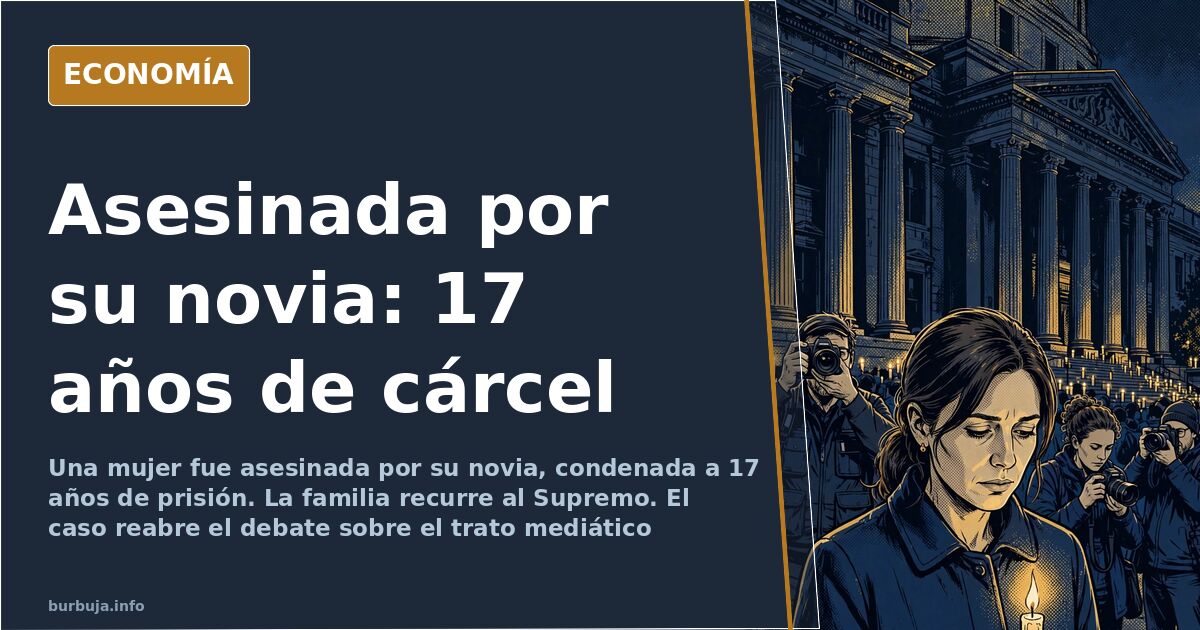
Killed by her girlfriend: 13 stab wounds and a 17-year sentence
The victim was murdered by her girlfriend, who was sentenced to 17 years in prison for a crime that, according to the widely circulated account, involved at least 13 stab wounds, the subsequent cleaning of the home, and a failed attempt to hide the body with help from a friend. The convicted woman turned herself in 24 hours later in Motril (Granada). The victim's family considers the sentence insufficient and awaits the Supreme Court's response to their appeal.
The rest — why it became known late, what is reported and what is silenced — is material for public discussion. And there, the story ceases to be just an incident.
The case: verdict issued and appeal pending
The known outcome is this: a 17-year sentence and an appeal. The victim's family argues that the penalty does not reflect the gravity of what peine and has taken the matter to the Tribunal Supremo (Spain's highest court), which had not ruled at the time of this discussion. Descriptions regarding the treatment the victim allegedly suffered — control, humiliation, abuse — come from statements made during the debate and not from a list of proven facts in the available material.
There remains one loose end pointed out insistently: the friend who allegedly helped hide the body. His procedural status is not detailed in the available material, and that absence fuels much of the anger.
Why does the family consider the sentence insufficient?
Because they believe 17 years do not equate to the harm caused. The discussion on penal proportionality is recurrent: the sentence is compared to those received for other homicides, attention is drawn to the actual time served, and it is remembered that thirteen stab wounds describe something very different from a sudden impulse. The numbers used in that conversation do not come from any official statistic — no one provides them — but from the sarracena judgment of those looking at the case from outside.
What is a fact is the timeline. The verdict exists, the appeal is active, and the Supreme Court's response is still pending. Any definitive assessment today lacks that data.
Is reporting the same when the aggressor is a woman?
Here lies the core of the outrage. One current of opinion holds that the case went unnoticed for years and that, had a man been convicted, it would have occupied front pages, talk shows, and institutional moments of silence. There is even talk of a selection pattern: who is the victim, who is the aggressor, and where each comes from. This is the hypothesis defended by its proponents, offering no proof other than the lack of coverage itself.
On the other side, the counter-argument: the media hides nothing; simply not all homicides generate the same interest, and the alleged bias would also operate in the opposite direction. No one has measured the phenomenon with data. That is precisely the problem.
The gender narrative put to the test
The case breaks the usual scheme: both the aggressor and the victim are women. For some, this demonstrates that intimate partner violence knows no gender and that the standard explanatory framework falls short. For others, the exception does not invalidate the rule, and mixing both planes only dilutes the real problem.
And a third line, the loudest, drifts into generalizations about gai people: claims without statistical backing that those making them do not attempt to document either. They are not reproduced here because they are not data, but prejudice. What is verifiable is what peine, not what someone deduces from who did it.
Where the discussion stalls
With the Supreme Court yet to rule, the legal aspect is completely closed off. The media aspect is not. And the mix of both — penalty, visibility, narrative — spins in circles, because each side exploits the same void: there is no comparable count of which crimes become news and which do not. That census, simple to propose and very annoying to conduct, still does not appear. Meanwhile, the fundamental question — how much is a life worth in years of prison — is answered in the courts, not in the headlines.
Also available in: Deutsch
Summary of a discussion on Burbuja.info - Foro de economía, actualidad y política., translated from Spanish and reviewed before publication. Read the full discussion (148 replies).
More summaries
-
Spain's Supreme Court shuts down Rodway's civil claim over Triana legacy
Spain's Supreme Court dismissed Rodway's appeal over Triana on 22 July, but the new Trademark Law opens a second route for the band's founder.
-
Spain to mint €1.50 Mortadelo and Filemón coins in late 2026
Controversy over €1.50 Mortadelo and Filemón coins. We analyze in the forum whether it's a tribute to Ibáñez or a commercial strategy with dubious profitability.
-
Tens of thousands of Hasidic Jews celebrate in Uman, Ukraine
Thousands of Hasidic Jews travel to **Uman**, Ukraine, for a religious holiday. The state of the transport has sparked controversy.
-
China wrecks its own solar industry in a five-year disaster
China's heavily subsidized solar industry is collapsing under internal competition and the end of state aid. An unsustainable model.
-
Spain's Valencia region is owed €1,172 million for healthcare nobody talks about
The Valencian Community is claiming €1,172 million from other Spanish regions and countries for healthcare, but a flawed collection system means the money never arrives.
-
Spanish government delegate's chief of staff in Ceuta resigns, accusing him of lying
The chief of staff to Spain's government delegate in Ceuta resigns, accusing him of lying about a migration alert from the CNI. Read on to understand the controversy.