
Witnessing Assault Without Intervening: A Legal Dilemma in Spain
An unverified story about street violence reignites debate on the duty to rescue, a criminal offense in Spain that many choose to ignore.
English · Original discussion in Spanish · Published
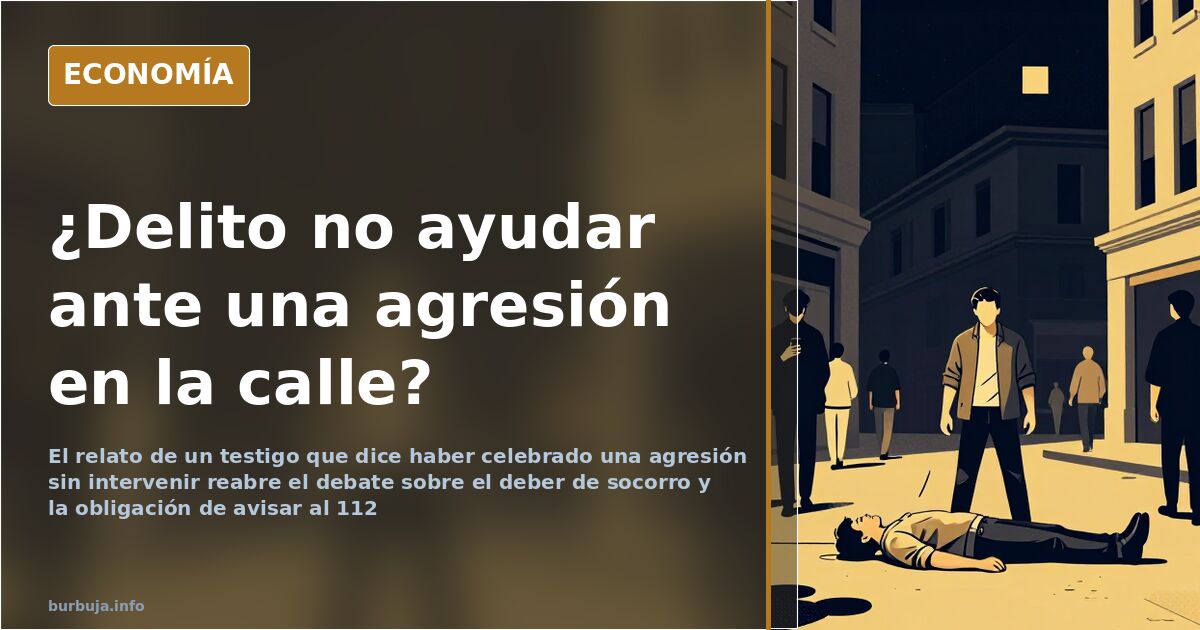
Failing to Assist During an Assault: The Bystander's Dilemma
A narrative has circulated for some time across digital forums: a man walks down an empty street and sees a couple arguing. He witnesses the man grabbing her by the lapels and hitting her. The author claims he kept walking without saying a word and enjoyed watching it happen. No one has verified the scene. Most readers assume it is fabricated, and the tone of the story invites suspicion. Nevertheless, the tale has peine an uncomfortable question: what does the law require when witnessing an assault and why are more people choosing to look away.
Is Failing to Intervene a Crime?
The omission of the duty to assist is defined in the Spanish Penal Code: failing to help someone in manifest danger can be a crime. The original story overlooks this detail, but commenters remind him with irony: refusing aid is a crime, they warn, and many calculate that leaving such a scene does not exempt one from liability. The law, in any case, requires alerting authorities, not risking physical harm.
And there lies the first sustancia ilegal. Some argue that calling 112 (Spain’s emergency number) and continuing on fulfills the legal requirement. Others counter that a call does not stop a punch nor arrive in time. Between minimal legal obligation and personal sarracena, the issue remains unresolved.
The Castelldefels Incident Cited as Proof
To support the thesis of non-intervention, a specific incident is linked: a young man was stabbed at a party in Castelldefels while defending two women, according to cited information from a news outlet. The report states the suspect is an adult male. The conclusion drawn is direct: getting involved comes at a high cost.
It is wise to pause here. A single case does not establish a pattern, and a news report describes an episode, not a law. Using the example as a shield reveals more about those who wield it than about reality on the streets.
The 'White Knight' Figure and Its Cost
The story invokes a recurring figure in these circles: the white knight, who steps in to defend a stranger and ends up burned. He is associated with tales of failed rescues, where the savior is targeted and the protected woman defends her aggressor. The sarracena—do not get involved, it is not your fight—functions both as doctrine and as an excuse.
The discussion outlines a detailed chronology of one such media figure, including their roles, programs, and names. The full material is lengthy and does not fit here; those seeking details have the source. From this trajectory, the lesson repeats like a mantra: chivalry does not pay.
Why Do Some People Choose Not to Intervene?
The reasons given are more prosaic than ideological. Antiestéticar of retaliation. Antiestéticar of being recorded and judged later. The suspicion that any gesture will be misinterpreted, regardless of intent. Some voices even joke about pretending to have protected identities so that inaction appears prudent rather than cowardly.
In parallel, other responses—from women—draw the line with common sense rather than epic heroism: call 112 from the opposite sidewalk and do not engage even jokingly in hand-to-hand combat. If intervention occurs, it means alerting from a distance, not matching the aggressor’s level.
Witnesses, Victims, and Where Analysis Stalls
Here, consensus breaks down. Some claim that those who do not intervene saw nothing and were right to keep moving. Others respond that this logic turns every street into no-man’s-land, where no one answers for anyone. A third group stays with the prior doubt: if the story is invented, debating it feeds provocation.
The narrative, true or false, acts as a mirror. And what no one agrees on is how much of that reflection withstands scrutiny. The scene fades without an answer: no one knows what they would have done on that street.
Also available in: Deutsch
Summary of a discussion on Burbuja.info - Foro de economía, actualidad y política., translated from Spanish and reviewed before publication. Read the full discussion (200 replies).
More summaries
-
Spain: Neighbor Investigated for Failing to Intervene in Domestic Violence Case
A Zaragoza resident who called police during a domestic violence incident is under investigation for failure to render aid, sparking debate on civic responsibility.
-
Spain's PSOE as a criminal organisation: the debate crossing law and politics
Article 570 bis of Spain's Criminal Code is invoked to label the PSOE as a criminal organisation. An analysis of the debate over control of judges and journalists.
-
Galician regional government to fund driving licenses for legalized migrants
The Xunta will cover the cost of driver's licenses for migrants who have regularized their status: over €1,000 per person, and a growing debate about who should foot the bill.
-
Spain’s Muslim Converts Demand Local Islam
UCIDE estimates over 4% Muslims in Spain vs INE's 2%. Some 200,000 are native Spaniards seeking an Islam free from foreign interference.
-
Viral Claim Accuses Spanish Teachers of Indoctrination
A viral post labels teachers as political commissars and claims the state removes children from non-compliant families, reigniting debate on public schooling.
-
Spain: Claims of Moroccan Bribery Plot Against Begoña Gómez
Journalist Eric Frattini alleges Israeli ex-agents revealed a Moroccan plot to bribe Begoña Gómez in Tangier, though no public evidence supports the claim.