
Wi-Fi and Health: 25,000 Studies Challenge the Physics of Intensity
A review claims Wi-Fi causes seven serious biological effects, while experts counter with 25,000 studies emphasizing it is non-ionizing radiation.
English · Original discussion in Spanish · Published
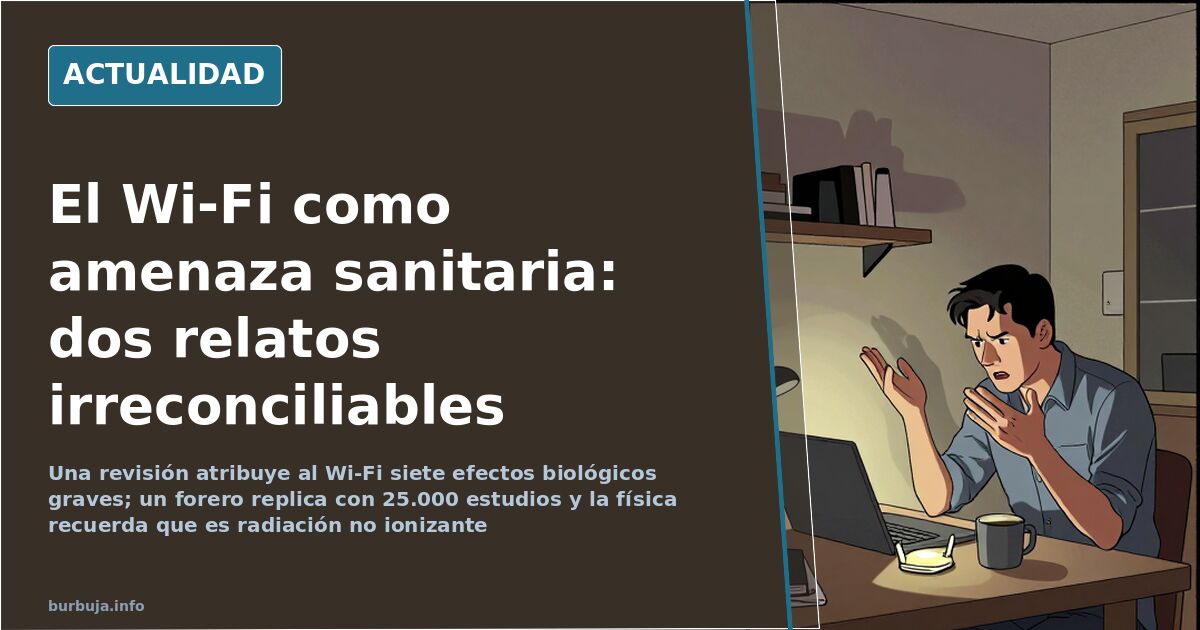
Wi-Fi and Health: 25,000 Studies Challenge the Physics of Intensity
In early 2019, a text attributing seven serious biological effects to Wi-Fi—oxidative stress, sperm DNA damage, apoptosis, endocrine changes, calcium overload, and neuropsychiatric alterations—circulated as a health warning. The thesis is not new and comes with bibliography: it claims each of these seven effects is 'established' and that the main mechanism is the activation of voltage-gated calcium channels (VGCC). Opposing this, the textbook argument states that Wi-Fi is non-ionizing radiation, which does not strip electrons from atoms. The two fronts have not moved a millimeter.
What the Review Claiming Wi-Fi is Harmful Asserts
The claim is ambitious. It asserts that the seven effects are documented 'each in 10 to 16 reviews' and that all appear with other microwaves, making them general effects of that spectrum band. It adds five properties: pulsed fields are more active than continuous ones, polarized fields more than non-polarized ones, the dose-response curve is non-linear, effects accumulate, and young people are more sensitive than adults.
The historical ammunition is significant. The 146-page 1973 review by Tolgskaya and Relleniton already identified the nervous system, heart, and testes as the three organs most sensitive to non-thermal microwaves in rodents. From there, it jumps to the most unsettling figure: a meta-analysis by Levine et al. (2017) reports declines of more than 50% in sperm quantity and quality in technified countries, with the lead author suggesting this single effect could compromise human reproduction.
Why is Wi-Fi Considered Harmless if it is Radiation?
Because what causes damage is not the frequency, but the energy deposited per particle, and there is no debate on that point. The dominant response is the water glass analogy: it is not the same to drink a glass than ten liters. The exposure from a home router is in the order of tenths of a watt, compared to the 900 watts a microwave needs to heat a steak in one minute.
The material itself admits that Wi-Fi handles less energy than visible light, which is the same type of wave. The data on radio links appears: the 60 GHz band, used for decades in military and telephony links according to one participant, comes with the warning that these antennas are directional and real exposure at street level is brief. Here opens the gap: the most critical argue these links destroy everything in their path, including apartments, and European regulations are not always applied.
Does Electromagnetic Sensitivity Exist?
This is where the narrative breaks. Facing the claim that a superior court ruling recognizes an illness affecting 13 million Europeans, the objection is empirical: in double-blind tests, the affected do not get sick when receiving radiation, but when told they are receiving it. That is, the nocebo effect, the reverse of placebo, with trendy radiation as the trigger.
The anecdote best illustrating this involves an entire neighborhood: a railway track antenna attributed for months to the town's cancers and illnesses. The antenna, according to that account, had never been operational. The episode serves skeptics to close the circle: if harm appears without emission, the cause lies elsewhere.
5G, Cobi19, and Mismatched Figures
In the final part of the matter, the textbook suspicion enters: the alleged relationship between 5G deployment, 60 GHz bands, and the pandemic. There is no verifiable thesis here, only the habit of chaining court rulings, school bans in France, Cyprus, and Israel, and Resolution 1815 of the Council of Europe as if they were links in the same proof.
The counterpoint is a domestic figure difficult to dodge. According to INE series, between 1981 and 2018, brain tumors were reduced by half in Spain, also in children, precisely during the expansion of mobile telephony and Wi-Fi. Neither side has yet explained how massive transmitter deployment coexists with a drop in the incidence of these tumors.
The unanswered question remains: why a huge body of publications on non-thermal effects does not translate into a replicable consensus. Proponents of the thesis accuse the industry of capturing research; critics counter that most of these works use unrealistic irradiances, statistics without controlled variables, or self-publication. With 25,000 articles on one side of the balance and a handful of double-blind tests on the other, the distance is not measured in data. It is measured in whom we believe.
In early 2019, a text attributing seven serious biological effects to Wi-Fi—oxidative stress, sperm DNA damage, apoptosis, endocrine changes, calcium overload, and neuropsychiatric alterations—circulated as a health warning. The thesis is not new and comes with bibliography: it claims each of these seven effects is 'established' and that the main mechanism is the activation of voltage-gated calcium channels (VGCC). Opposing this, the textbook argument states that Wi-Fi is non-ionizing radiation, which does not strip electrons from atoms. The two fronts have not moved a millimeter.
What the Review Claiming Wi-Fi is Harmful Asserts
The claim is ambitious. It asserts that the seven effects are documented 'each in 10 to 16 reviews' and that all appear with other microwaves, making them general effects of that spectrum band. It adds five properties: pulsed fields are more active than continuous ones, polarized fields more than non-polarized ones, the dose-response curve is non-linear, effects accumulate, and young people are more sensitive than adults.
The historical ammunition is significant. The 146-page 1973 review by Tolgskaya and Relleniton already identified the nervous system, heart, and testes as the three organs most sensitive to non-thermal microwaves in rodents. From there, it jumps to the most unsettling figure: a meta-analysis by Levine et al. (2017) reports declines of more than 50% in sperm quantity and quality in technified countries, with the lead author suggesting this single effect could compromise human reproduction.
Why is Wi-Fi Considered Harmless if it is Radiation?
Because what causes damage is not the frequency, but the energy deposited per particle, and there is no debate on that point. The dominant response is the water glass analogy: it is not the same to drink a glass than ten liters. The exposure from a home router is in the order of tenths of a watt, compared to the 900 watts a microwave needs to heat a steak in one minute.
The material itself admits that Wi-Fi handles less energy than visible light, which is the same type of wave. The data on radio links appears: the 60 GHz band, used for decades in military and telephony links according to one participant, comes with the warning that these antennas are directional and real exposure at street level is brief. Here opens the gap: the most critical argue these links destroy everything in their path, including apartments, and European regulations are not always applied.
Does Electromagnetic Sensitivity Exist?
This is where the narrative breaks. Facing the claim that a superior court ruling recognizes an illness affecting 13 million Europeans, the objection is empirical: in double-blind tests, the affected do not get sick when receiving radiation, but when told they are receiving it. That is, the nocebo effect, the reverse of placebo, with trendy radiation as the trigger.
The anecdote best illustrating this involves an entire neighborhood: a railway track antenna attributed for months to the town's cancers and illnesses. The antenna, according to that account, had never been operational. The episode serves skeptics to close the circle: if harm appears without emission, the cause lies elsewhere.
5G, Cobi19, and Mismatched Figures
In the final part of the matter, the textbook suspicion enters: the alleged relationship between 5G deployment, 60 GHz bands, and the pandemic. There is no verifiable thesis here, only the habit of chaining court rulings, school bans in France, Cyprus, and Israel, and Resolution 1815 of the Council of Europe as if they were links in the same proof.
The counterpoint is a domestic figure difficult to dodge. According to INE series, between 1981 and 2018, brain tumors were reduced by half in Spain, also in children, precisely during the expansion of mobile telephony and Wi-Fi. Neither side has yet explained how massive transmitter deployment coexists with a drop in the incidence of these tumors.
The unanswered question remains: why a huge body of publications on non-thermal effects does not translate into a replicable consensus. Proponents of the thesis accuse the industry of capturing research; critics counter that most of these works use unrealistic irradiances, statistics without controlled variables, or self-publication. With 25,000 articles on one side of the balance and a handful of double-blind tests on the other, the distance is not measured in data. It is measured in whom we believe.
Summary of a discussion on Burbuja.info - Foro de economía, actualidad y política., translated from Spanish and reviewed before publication. Read the full discussion (297 replies).
More summaries
-
Moving to France: minimum wage and housing at 800 euros
France's net minimum wage is around €1,250, not the €2,000 some claim; cheap housing in the Jura, but taxes and debt raise red flags.
-
Venom singer Cronos dies days after Bruno Kramm's death
Cronos, singer of Venom, dies of unknown causes, days after the death of artist Bruno Kramm following a live performance in Granada
-
Spain's Penal Code jails unauthorized rural construction
Spanish law imposes up to 4.5 years in prison for building on protected rural land. A forum thread highlights the legal risks and the IBI burden for unauthorized developments in Spain.
-
Spain's Banking Control vs. Dubai's Financial Freedom
Analysis of Spain's strict banking regulations compared to Dubai's capital mobility and tax haven advantages.
-
Latin American University Quality Under Scrutiny
Experts analyze Latin America's higher education, citing inflated degrees and chronic underinvestment as structural flaws in academic quality.
-
Liberum: From Anti-Covid Fight to Popular Accusation Against the PSOE
Liberum emerged in 2021 opposing the Covid passport. Now a popular accuser in the Koldo, Begoña Gómez, and Sánchez brother cases, this association challenges official narratives.