
Why women represent less than 30% of engineering students in Spain
A study in Aragon shows girls lose confidence in maths from primary school, yet most teachers fail to notice this growing gender gap.
English · Original discussion in Spanish · Published
Why girls stop believing in their mathematical abilities at age six
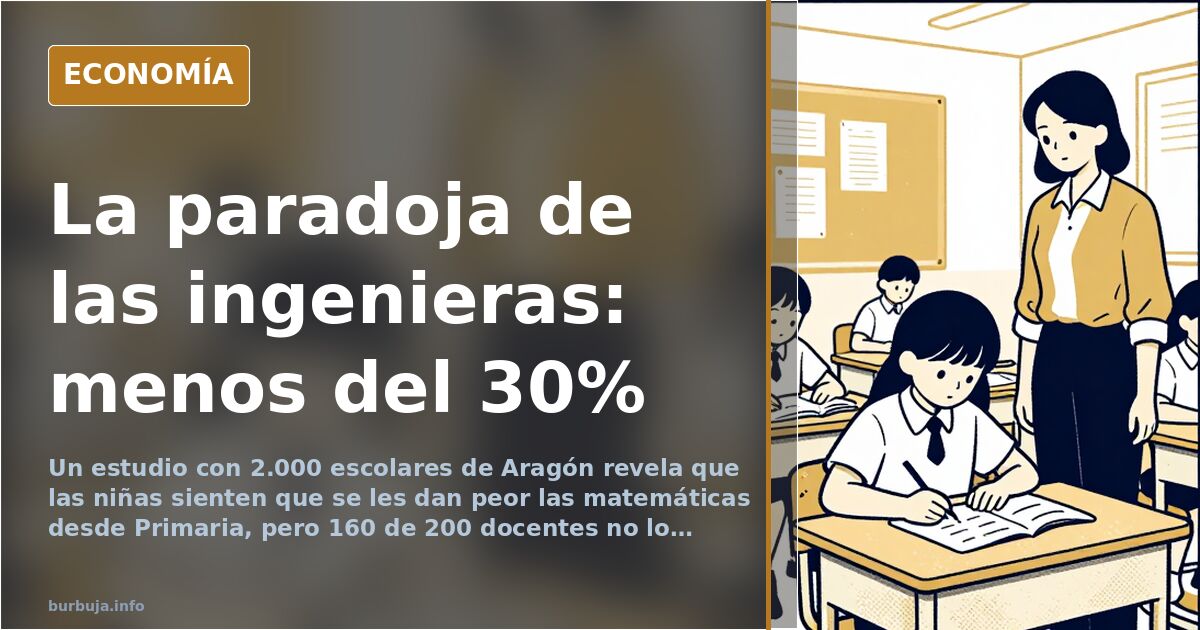
Professor María Villarroya Gaudó has spent decades promoting STEM vocations among girls. Her diagnosis is uncomfortable: the gender gap does not start at university, but in primary education. According to a study of 2,000 students in Aragon and 200 teachers, girls already feel they are worse at mathematics long before choosing a career. And the teaching staff does not see it. In 160 out of 200 cases, teachers responded that they had "never" or "almost never" noticed this perception. The data is startling: there is no legal barrier, but there is a social conditioning that weighs heavily from the age of six.
An engineer in every school: from 5 volunteers to over 500
The project promoted by Villarroya Gaudó alongside her colleagues began with just four or five volunteer engineers. An article in the Tercer Milenio supplement of Heraldo de Aragón served as a catalyst. Today, there are more than 500 volunteers who have reached over 20,000 students, including those in rural areas of Aragon. The key, according to the researcher, is not famous role models, but the ones close to home: the engineer who studied at your school, the one who lives in your neighborhood. "We need role models, not just famous women and renowned scientists, but local ones," she explains.
The percentage of women in engineering degrees remains below 30%, and in some branches, below 20%. Outreach efforts attempt to correct this trend by working with both students and teachers, so that "when girls make a decision, they do so with all the information and have equal opportunities."
The gap between how girls feel and what teachers observe
The study in Aragon surveyed 2,000 primary school students and 200 teachers. The girls' responses showed they felt they were worse at maths. The question to the teaching staff was direct: had they noticed this perception? The answer was "never" or "almost never" in 160 out of 200 cases. This teacher blindness explains why many girls focus their professional future on life sciences, humanities, or social sciences.
Villarroya Gaudó also points to a bias in the research career itself: when women are a minority in fields such as Computer Science or Engineering, the results of their work take longer to be recognized. "Sometimes we have more antiestéticar of failure and error in the classroom, and teachers must be aware of this," she details.
The book and the association: 17 friends and an experiment for each
The professor is the promoter of 10001 amigas ingenieras (10,001 engineer friends), a book that explains what engineering is through the experience of 17 friends, each with an experiment designed for children from age 6. It was published while she was presiding over the Asociación de Mujeres Investigadoras y Tecnólogas en Aragón (AMIT-ARAGÓN, an association of women researchers and technologists in Aragon), founded to promote the full inclusion of women in Science and Technology on equal terms.
The book is not a technical manual. It is an outreach tool that seeks to help girls see themselves reflected in relatable professionals. The strategy is not to convince, but to show. And there lies the startling fact: if the perception of inadequacy appears at age six, any subsequent intervention arrives too late.
The gap that cannot be closed with talks alone
The debate over the presence of women in technical careers has an uncomfortable side effect: the employability and economic return of these studies. The researcher herself acknowledges that the female minority in Computer Science or Engineering causes their work results to take longer to be taken into account. It is not just a matter of access, but of subsequent recognition.
The Girls Day project, running since 2008, introduces STEM vocations to secondary school students through the guidance of professional women. The conclusion reached by Villarroya Gaudó and her colleagues is that many girls had already accepted the idea that they were not suited for these careers in earlier educational stages. Therefore, the intervention arrives once the prejudice is already established.
Are talks enough to reverse a perception formed at age six? The answer is not in the data. What is clear is the mismatch: less than 30% of women in engineering, more than 500 volunteers trying to change it, and 160 teachers who do not see the problem. With these figures, the gap cannot be closed with goodwill alone.
Professor María Villarroya Gaudó has spent decades promoting STEM vocations among girls. Her diagnosis is uncomfortable: the gender gap does not start at university, but in primary education. According to a study of 2,000 students in Aragon and 200 teachers, girls already feel they are worse at mathematics long before choosing a career. And the teaching staff does not see it. In 160 out of 200 cases, teachers responded that they had "never" or "almost never" noticed this perception. The data is startling: there is no legal barrier, but there is a social conditioning that weighs heavily from the age of six.
An engineer in every school: from 5 volunteers to over 500
The project promoted by Villarroya Gaudó alongside her colleagues began with just four or five volunteer engineers. An article in the Tercer Milenio supplement of Heraldo de Aragón served as a catalyst. Today, there are more than 500 volunteers who have reached over 20,000 students, including those in rural areas of Aragon. The key, according to the researcher, is not famous role models, but the ones close to home: the engineer who studied at your school, the one who lives in your neighborhood. "We need role models, not just famous women and renowned scientists, but local ones," she explains.
The percentage of women in engineering degrees remains below 30%, and in some branches, below 20%. Outreach efforts attempt to correct this trend by working with both students and teachers, so that "when girls make a decision, they do so with all the information and have equal opportunities."
The gap between how girls feel and what teachers observe
The study in Aragon surveyed 2,000 primary school students and 200 teachers. The girls' responses showed they felt they were worse at maths. The question to the teaching staff was direct: had they noticed this perception? The answer was "never" or "almost never" in 160 out of 200 cases. This teacher blindness explains why many girls focus their professional future on life sciences, humanities, or social sciences.
Villarroya Gaudó also points to a bias in the research career itself: when women are a minority in fields such as Computer Science or Engineering, the results of their work take longer to be recognized. "Sometimes we have more antiestéticar of failure and error in the classroom, and teachers must be aware of this," she details.
The book and the association: 17 friends and an experiment for each
The professor is the promoter of 10001 amigas ingenieras (10,001 engineer friends), a book that explains what engineering is through the experience of 17 friends, each with an experiment designed for children from age 6. It was published while she was presiding over the Asociación de Mujeres Investigadoras y Tecnólogas en Aragón (AMIT-ARAGÓN, an association of women researchers and technologists in Aragon), founded to promote the full inclusion of women in Science and Technology on equal terms.
The book is not a technical manual. It is an outreach tool that seeks to help girls see themselves reflected in relatable professionals. The strategy is not to convince, but to show. And there lies the startling fact: if the perception of inadequacy appears at age six, any subsequent intervention arrives too late.
The gap that cannot be closed with talks alone
The debate over the presence of women in technical careers has an uncomfortable side effect: the employability and economic return of these studies. The researcher herself acknowledges that the female minority in Computer Science or Engineering causes their work results to take longer to be taken into account. It is not just a matter of access, but of subsequent recognition.
The Girls Day project, running since 2008, introduces STEM vocations to secondary school students through the guidance of professional women. The conclusion reached by Villarroya Gaudó and her colleagues is that many girls had already accepted the idea that they were not suited for these careers in earlier educational stages. Therefore, the intervention arrives once the prejudice is already established.
Are talks enough to reverse a perception formed at age six? The answer is not in the data. What is clear is the mismatch: less than 30% of women in engineering, more than 500 volunteers trying to change it, and 160 teachers who do not see the problem. With these figures, the gap cannot be closed with goodwill alone.
Also available in: Deutsch
Summary of a discussion on Burbuja.info - Foro de economía, actualidad y política., translated from Spanish and reviewed before publication. Read the full discussion (103 replies).
More summaries
-
Spain's Podemos candidate proposes renaming Zaragoza to 'Zaragaza'
A Podemos proposal to rename Zaragoza to 'Zaragaza' as a Palestine solidarity gesture sparks controversy and doubts over its authenticity.
-
Zaragoza: New builds with bargain-basement finishes
Parquet in the bathroom, €50 doors and sinks that give way: Zaragoza's new-build market faces a finishes crisis with record prices
-
Shantytowns on the Ebro: Zaragoza's housing crisis deepens
Zaragoza sees shacks grow along the Ebro. A housing policy failure or an immigration effect? The debate intensifies as...
-
Former Russian president threatens UK with hypersonic missiles
A former Russian president has issued threats against Great Britain using hypersonic missiles, sparking debate over the credibility of Moscow's arsenal and nuclear escalation.
-
Online forum debates Pedro Sánchez's brother and alleged Thai residency
Users discuss the potential tax residency of the Spanish Prime Minister's brother in Thailand and his significant wealth increase.
-
Spain's veterinarians earn just €22,838 gross after four years
Veterinary medicine is the lowest-paid degree in Spain, with graduates earning €22,838 gross after four years despite high entry requirements.