
Why the internet keeps ranking women by their origin
Comparing women by nationality and scoring them from 1 to 10 is a recurring pattern online. Behind it lies more stereotype than real observation.
English · Original discussion in Spanish · Published
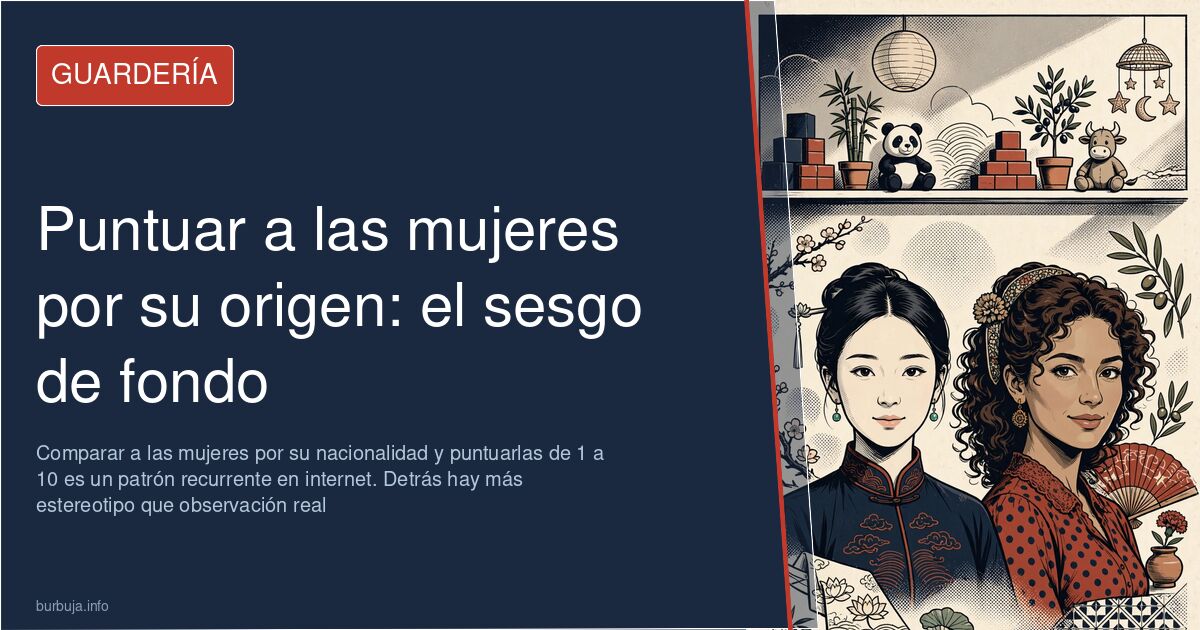
Ranking women by their origin: the online aesthetic bias
Sorting women by nationality and rating them — from the idealized Asian woman to the girl next door — is a pattern that resurfaces online every so often. What's new is not the idea itself but the vocabulary: a jargon of its own that mixes fascination and contempt and turns attractiveness into a hierarchical scale based on passports. Beneath the joke lies an old mechanism. Classifying the other by their origin before anything else.
From imported ideal to barely passing grade
The recurring archetype — with actress Tang Wei as the reference — clashes with the reality of those who live there. Someone living about 80 km from Shanghai sums it up without drama: the same face that is elevated to a beauty standard here barely passes in her own country. Idealization works better the farther away its object is. When the distance shrinks, the myth deflates.
Aesthetic trends know no borders
The supposed exoticism doesn't hold up either. The tattoo craze, cosmetic procedures, and imported beauty standards spread just as fast in Asia as in Europe: what is sold as a cultural trait is usually a global trend. And the generalizations — that they all smile the same way, that they all look identical — say more about the prejudice of those making them than about a group of over a billion people.
Where the reasoning falls apart
Ranking by nationality doesn't withstand serious analysis, but it keeps working as clickbait. As soon as it is asked for a measurable criterion — a figure, an objective fact — it runs out of steam on its own. The rest is bar-talk conversation.
Also available in: Deutsch
Summary of a discussion on Burbuja.info - Foro de economía, actualidad y política., translated from Spanish and reviewed before publication. Read the full discussion (32 replies).
More summaries
-
Female beauty standards and the Leire Martínez of La Oreja case in Spain
The debate over whether Leire Martínez of La Oreja was one of Spain's most beautiful women in her late thirties reveals the rift between traditional beauty standards and new…
-
Online racial debate: Beauty standards and stereotypes
An analysis of an online exchange on beauty and ethnicity, revealing patterns of prejudice and racial stereotypes.
-
Racial stereotypes about appearance persist in online debates
A thread on a Spanish forum sparks a debate on beauty and race filled with pseudoscientific comments and stereotypes. The silence about the very framework of the comparison speaks volumes.
-
Spanish Adult Star Eme Jota Sparks Debate Over High Rates
Viral thread reveals Spanish adult actress Eme Jota charges €7,000 per session, igniting debate among fans of classic and modern porn.
-
Tinder date's physical surprise exposes the harshness of online dating
A Tinder date with a physical surprise sparks a chorus of crude comments. A portrait of how dating apps reward visual impact.
-
A 6.75 for a stranger: anonymous users rating women's bodies
One photo, ten comments and a 6.75: how anonymous juries measure women and fuel the identity culture war.