
Why repeating courses costs four times the price, and why there is no protest
Spanish universities charge double, triple, and quadruple for the same repeated course. This pricing structure opened in 2012 and remains unchallenged.
English · Original discussion in Spanish · Published
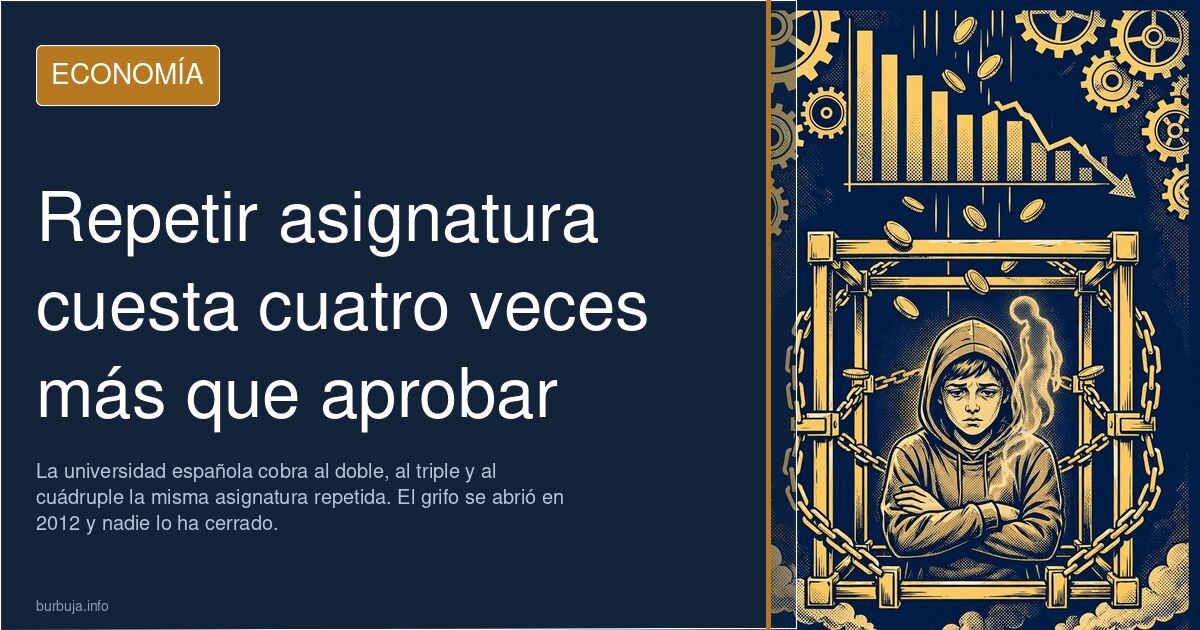
Repeating courses in university multiplies the cost by four
One course, four different bills. The first time: X. The second: 2X. The third: 3X. The fourth: 4X. Same course, same professor, same exam. The only thing that changes is the student attempting it again. This is the university punishment ladder: a mechanism that turns repetition into a fine that grows with each attempt, and which has been untouched for years.
The price ladder: 1st attempt X, 2nd 2X, 3rd 3X, 4th 4X
Each degree program and each region sets its own fees, but the pattern repeats throughout Spain. Repeating does not cost the same: it costs double, triple, or quadruple. There is no added cost to justify this—the curriculum is the same, the classroom is the same, the tribunal is the same—so the surcharge functions as a pure penalty. The one who fails initially drags along a bill that skyrockets. And in most cases, the family pays for it.
The 2012 fee hike that was never reversed
The jump in the cost of university fees has a date: 2012, the increase applied during Mariano Rajoy’s tenure and Minister José Ignacio Wert’s reforms. That move made the credit more expensive and caused second, third, and fourth enrollments to surge. Those who finished that year with the old undergraduate and diploma programs escaped by a whisker. Since then, the price of the credit has risen year after year, and subsequent governments, according to this analysis, have not deactivated the structure. The ladder remains in place.
Why it is accepted without massive protest
This is where the core issue appears: the theory that the Spaniard carries a slave within. Some argue that the taxpayer has internalized that the fee, tax, and rate are not debated—they are paid. Others point to an issue of incentives, because individual complaint achieves nothing and the penalty falls on those who cannot afford to repeat. On the political level, the most common diagnosis is alternation without alternatives: the two major parties, with sufficient majority to act, do not touch the model, and the promised pruning of redundancies—regional television stations, county councils, superfluous bodies—remains just an announcement. The promised chainsaw would end up being a bulldozer, suggests this reading.
The suspicion that goes unexamined
And beneath the cost, another complaint that is less quantified: courses with extremely high failure rates concentrated among the same instructors—with averages, according to accounts of the case, reaching 80%—while that same professor passes everyone in other subjects. There is no audit. No one asks.
Perhaps that is the last link: not only do you pay double to repeat, but you also pay to repeat without asking why.
One course, four different bills. The first time: X. The second: 2X. The third: 3X. The fourth: 4X. Same course, same professor, same exam. The only thing that changes is the student attempting it again. This is the university punishment ladder: a mechanism that turns repetition into a fine that grows with each attempt, and which has been untouched for years.
The price ladder: 1st attempt X, 2nd 2X, 3rd 3X, 4th 4X
Each degree program and each region sets its own fees, but the pattern repeats throughout Spain. Repeating does not cost the same: it costs double, triple, or quadruple. There is no added cost to justify this—the curriculum is the same, the classroom is the same, the tribunal is the same—so the surcharge functions as a pure penalty. The one who fails initially drags along a bill that skyrockets. And in most cases, the family pays for it.
The 2012 fee hike that was never reversed
The jump in the cost of university fees has a date: 2012, the increase applied during Mariano Rajoy’s tenure and Minister José Ignacio Wert’s reforms. That move made the credit more expensive and caused second, third, and fourth enrollments to surge. Those who finished that year with the old undergraduate and diploma programs escaped by a whisker. Since then, the price of the credit has risen year after year, and subsequent governments, according to this analysis, have not deactivated the structure. The ladder remains in place.
Why it is accepted without massive protest
This is where the core issue appears: the theory that the Spaniard carries a slave within. Some argue that the taxpayer has internalized that the fee, tax, and rate are not debated—they are paid. Others point to an issue of incentives, because individual complaint achieves nothing and the penalty falls on those who cannot afford to repeat. On the political level, the most common diagnosis is alternation without alternatives: the two major parties, with sufficient majority to act, do not touch the model, and the promised pruning of redundancies—regional television stations, county councils, superfluous bodies—remains just an announcement. The promised chainsaw would end up being a bulldozer, suggests this reading.
The suspicion that goes unexamined
And beneath the cost, another complaint that is less quantified: courses with extremely high failure rates concentrated among the same instructors—with averages, according to accounts of the case, reaching 80%—while that same professor passes everyone in other subjects. There is no audit. No one asks.
Perhaps that is the last link: not only do you pay double to repeat, but you also pay to repeat without asking why.
Summary of a discussion on Burbuja.info - Foro de economía, actualidad y política., translated from Spanish and reviewed before publication. Read the full discussion (30 replies).
More summaries
-
Euthanasia in Old Age: Autonomy vs. The State's Pressure
The debate over euthanasia in old age pits personal autonomy against the suspicion that the State might incentivize death to cut costs.
-
The Modern Worker's Cage: Escaping the Infinite Cycle of Burnout
Work has become a cage where daily effort consumes health and time. Discover why we push ourselves so hard and how to break the cycle.
-
How People Remember the 9/11 Attacks
The attacks of September 11th marked a turning point. Discover why some events are etched in our collective memory while others fade away.
-
Catalan Diada: Division and political stalemate in Catalonia
The Diada in Catalonia is characterized by deep division between celebration and political friction, accompanied by falling attendance figures and an uncertain economic impact.
-
Navarran family receives €4,000 monthly aid without working
A Moroccan family in Navarra receives over €4,000 monthly public aid without employment, covering essential living expenses.
-
Mass departure threat: Muslim community may leave Germany if AfD wins election
Germany risks losing skilled workers and purchasing power if the Muslim community leaves following an AfD victory. We analyze the economic implications.