
Why Rain Stops at Portugal's Border, Leaving Spain Dry
A rain band covers Portugal but cuts off at the Spanish border, reigniting debates on drought and alleged climate manipulation.
English · Original discussion in Spanish · Published
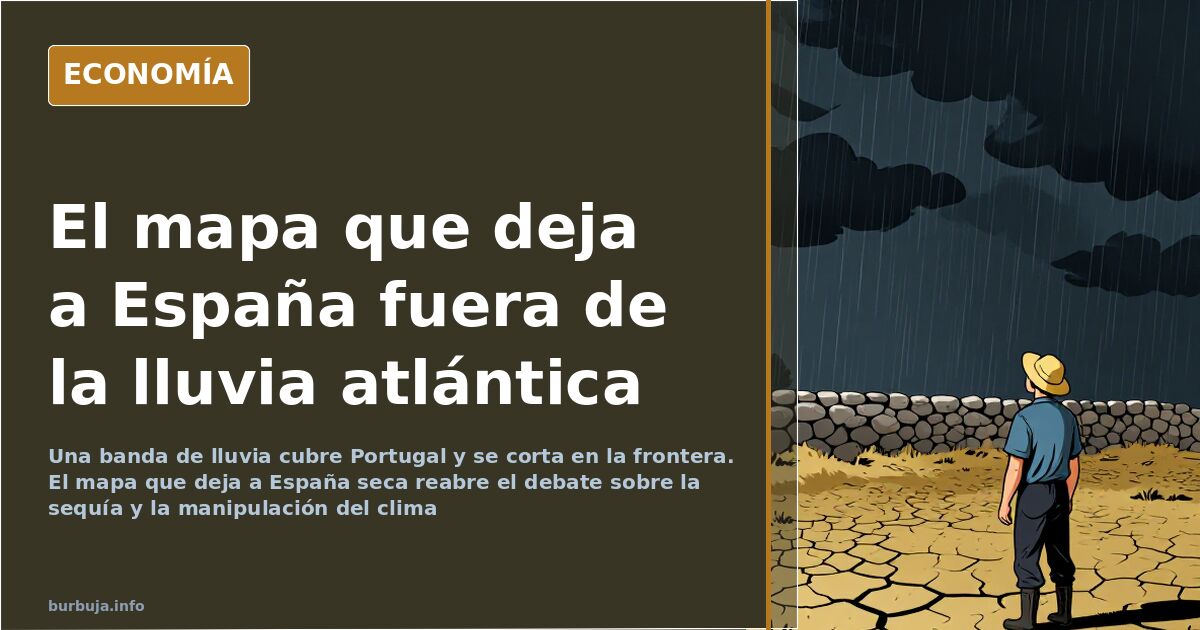
The map showing Spain dry and Portugal under rain
A precipitation band enters from the Atlantic, covers Portugal from side to side, and stops abruptly at the border. On the other side, Spain appears drawn in arid tones, with the Portuguese line separating green from dry. This scene raised a simple yet uncomfortable question: is this normal? The answer split the water in two: those who defend standard meteorology and those who suspect climate manipulation.
The first reaction is to look for mountains. None appear.
Why does rain stop exactly at the Portuguese border?
The textbook explanation is the barrier effect. The Cantabrian Mountains and the Pyrenees block Atlantic storms, forcing them to release moisture before letting dry air pass inland. Hence, Asturias, Cantabria, and the Basque Country are humid, while the two Castiles are a wasteland. Taken to the extreme, the same mechanism separates the Amazon rainforest from the Atacama desert. The paradox: Spain’s rainiest area is not in the north, but in the Sierra de Grazalema in Cádiz.
The argument falls apart when looking at the map. Portugal has no mountain range capable of stopping an entire front. What then stops the rain?
The coldest sea, the warmest land: the warm air thesis
One of the most prominent hypotheses points to thermal inertia. After several days of heat, the peninsula’s surface is hotter than the Atlantic water, and this heated air over land acts as a barrier. Storms circulate over the cold air of the sea and northern Europe, but when hitting the warm peninsular air, they deflect. According to this reasoning, it is temporary: in one or two days the peninsula cools, and fronts enter normally again.
There is no consensus. Some respond with a “no, I tell you it’s not,” and others admit that a physics degree is needed to close the matter. While physics is debated, the core issue is different: it no longer rains here as it used to.
Galicia no longer rains as before
The most repeated data points to the northwest. A resident in A Coruña province claims a drop from about 60 days of real annual rain to two or, at most, three. The comparison with the southeast also appears: in Galicia, it rains three times more than in Murcia on average, with amplitudes ranging from 650 to 1,150 liters per square meter depending on the area.
The cited signs go beyond the rain gauge: wheat crops that do not produce ears due to lack of water and excessive heat, olive groves without olives, and holm oaks drying up. And a recurring detail: there is less wind as before, no snow, more levante winds, and fewer cierzo winds.
The anticyclone and the “this has always peine”
Another usual suspect joins the equation: the anticyclone. Some describe how high-pressure systems seem to outline the peninsula’s perimeter to deflect storms northward. Others anticipate the official argument: that meteorological agencies will respond that this has always peine and that we are simply paying more attention now. The reasonable doubt is how much is obsession with capturing a single day’s events and how much is a real change in rainfall patterns.
From meteorology to geoengineering: what is claimed without proof
In the final stage of the conversation, the focus shifts from climate to manipulation. It is claimed that cloud seeding is a proven technique, with cases cited in the United Arab Emirates, Saudi Arabia, or Qatar, and from there jumps to the idea that if rain can be prevented, it can also be provoked at will, with drought as the desired result. There is no evidence supporting this accusation; these are unverified conjectures.
In the same vein circulate references to estela, alleged military technology radars, and the design of a climate to convenience. All without backing, and all mixed with the feeling that the pattern repeats too often to be coincidence.
A frame or a pattern: where the discussion gets stuck
Perhaps today’s front is just a snapshot of a passing storm and it will rain again in two days. Perhaps it is the latest chapter of a drought that no one in the countryside disputes. What does not fit—and that is where everything stopped—is that rain stops at a border that no mountain explains.
A precipitation band enters from the Atlantic, covers Portugal from side to side, and stops abruptly at the border. On the other side, Spain appears drawn in arid tones, with the Portuguese line separating green from dry. This scene raised a simple yet uncomfortable question: is this normal? The answer split the water in two: those who defend standard meteorology and those who suspect climate manipulation.
The first reaction is to look for mountains. None appear.
Why does rain stop exactly at the Portuguese border?
The textbook explanation is the barrier effect. The Cantabrian Mountains and the Pyrenees block Atlantic storms, forcing them to release moisture before letting dry air pass inland. Hence, Asturias, Cantabria, and the Basque Country are humid, while the two Castiles are a wasteland. Taken to the extreme, the same mechanism separates the Amazon rainforest from the Atacama desert. The paradox: Spain’s rainiest area is not in the north, but in the Sierra de Grazalema in Cádiz.
The argument falls apart when looking at the map. Portugal has no mountain range capable of stopping an entire front. What then stops the rain?
The coldest sea, the warmest land: the warm air thesis
One of the most prominent hypotheses points to thermal inertia. After several days of heat, the peninsula’s surface is hotter than the Atlantic water, and this heated air over land acts as a barrier. Storms circulate over the cold air of the sea and northern Europe, but when hitting the warm peninsular air, they deflect. According to this reasoning, it is temporary: in one or two days the peninsula cools, and fronts enter normally again.
There is no consensus. Some respond with a “no, I tell you it’s not,” and others admit that a physics degree is needed to close the matter. While physics is debated, the core issue is different: it no longer rains here as it used to.
Galicia no longer rains as before
The most repeated data points to the northwest. A resident in A Coruña province claims a drop from about 60 days of real annual rain to two or, at most, three. The comparison with the southeast also appears: in Galicia, it rains three times more than in Murcia on average, with amplitudes ranging from 650 to 1,150 liters per square meter depending on the area.
- Galicia: between 650 and 1,150 liters per square meter per year.
- Murcia: around 350 liters annually, a figure that is disputed.
The cited signs go beyond the rain gauge: wheat crops that do not produce ears due to lack of water and excessive heat, olive groves without olives, and holm oaks drying up. And a recurring detail: there is less wind as before, no snow, more levante winds, and fewer cierzo winds.
The anticyclone and the “this has always peine”
Another usual suspect joins the equation: the anticyclone. Some describe how high-pressure systems seem to outline the peninsula’s perimeter to deflect storms northward. Others anticipate the official argument: that meteorological agencies will respond that this has always peine and that we are simply paying more attention now. The reasonable doubt is how much is obsession with capturing a single day’s events and how much is a real change in rainfall patterns.
From meteorology to geoengineering: what is claimed without proof
In the final stage of the conversation, the focus shifts from climate to manipulation. It is claimed that cloud seeding is a proven technique, with cases cited in the United Arab Emirates, Saudi Arabia, or Qatar, and from there jumps to the idea that if rain can be prevented, it can also be provoked at will, with drought as the desired result. There is no evidence supporting this accusation; these are unverified conjectures.
In the same vein circulate references to estela, alleged military technology radars, and the design of a climate to convenience. All without backing, and all mixed with the feeling that the pattern repeats too often to be coincidence.
A frame or a pattern: where the discussion gets stuck
Perhaps today’s front is just a snapshot of a passing storm and it will rain again in two days. Perhaps it is the latest chapter of a drought that no one in the countryside disputes. What does not fit—and that is where everything stopped—is that rain stops at a border that no mountain explains.
Also available in: Deutsch
Summary of a discussion on Burbuja.info - Foro de economía, actualidad y política., translated from Spanish and reviewed before publication. Read the full discussion (268 replies).
More summaries
-
Galicia Logs 1,393 Teacher Absences in Two Weeks
The Xunta recorded 1,393 teacher absences between September 1 and 15. The regional official proposes a plan to monitor the evolution of this situation.
-
Foreign tenants: over half in Spain, 70% in three regions
More than 5.2 million tenants in Spain were born abroad. In Madrid, Valencia and Murcia the share reaches 70%. Data and analysis of...
-
Spanish housing market: first cracks or mirage?
Spain's property market shows buyer fatigue and longer sale times. Is a correction coming or is it a mirage?
-
Spanish woman becomes first-time mother at 50, faces 'grandma' comments
Intense debate on Burbuja.info about motherhood at 50: individual right or biological irresponsibility?
-
Open-source project clones seven Adobe apps
An open-source initiative replicates features from seven Adobe applications, gaining 44,000 GitHub stars and updating every three days.
-
Spain Audit Finds €2.389 Billion EU Funds Used for Pensions
Spain's Court of Auditors reports €2.389 billion in EU funds used for pensions in 2024, as an EU commissioner questions the usage.