
Why overweight fighters win: mass, power and technique
Mass times velocity defines punching power. How weight classes, stamina and technique interact in street fights.
English · Original discussion in Spanish · Published
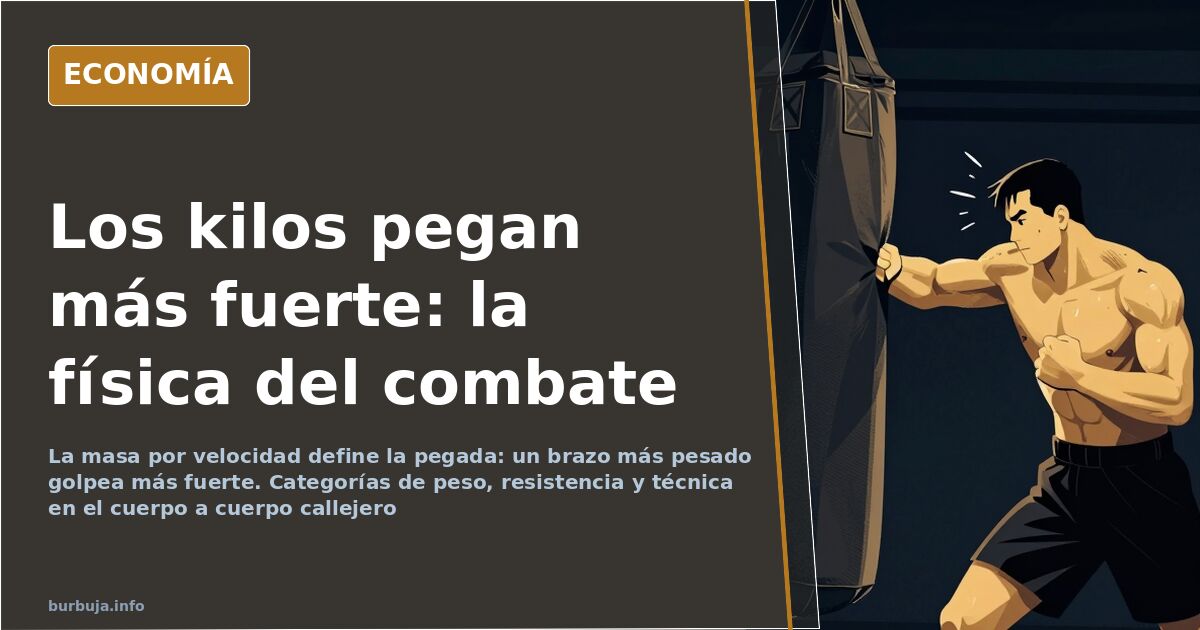
More weight, more punch: the physics behind bar brawls
A 130-kilo man, 1.86 meters tall, who has never set foot in a gym, capable of sending anyone standing in his way flying. This scene summarizes a widespread intuition: overweight people hit harder. The claim holds some elementary physics but also plenty of legend. Separating mass from training, and power from endurance, is the only way to know what is true.
What physics says about an overweight punch
Force equals mass times acceleration, yielding the first serious argument: a 8-kilo arm accelerated at 2 m/s² generates 16 newtons, while a 2-kilo arm needs 8 m/s² to match it. At equal acceleration, the heavier arm hits four times harder. Add the run-up—accumulated estimulante ilegal before impact—and a downward strike, which biomechanical analysis considers most powerful because shoulder muscles offer no resistance. The real governing magnitude is not force, but momentum: mass times velocity.
However, having mass is useless if the punch misses. A large body that fails to connect shifts all its weight forward and loses balance: one push and it falls.
Why does boxing separate fighters by weight?
Because the advantage is real and cannot be compensated by willpower. At equal skill level, a 100-kilo fighter hits harder and absorbs punches better than a 70-kilo one. Arm reach and stride favor the larger fighter, and overhead strikes are awkward to block: they force the guard up and open gaps. Contrary to the idea that heavyweights tire faster, evidence suggests lightweights exhaust themselves receiving blows and realizing their hands do little damage. Weight classes exist precisely because biology does not distribute advantages based on merit.
Technique: the minimum required to punch with full body
Punching with the whole body is not instinct; it requires hip rotation and coordination. Those who haven't practiced swing their arms like whips, losing half their theoretical advantage. This is the trump card of trained fighters, who rely on guard, distance, and precision. Stories circulate of bar fights where a 60-kilo, 1.68-meter boxer dispatched several much larger opponents before police arrived, and the reverse case: a mixed martial arts professional knocked out on the street by a heavyset amateur, after drinking. The conclusion from both is the same: technique organizes power, it does not replace it.
Fatigue and knees: the weak point of mass
If the exchange lasts longer, the scenario changes. The most cited strategy to neutralize someone with high body weight is to exhaust them or flee uphill; the underlying argument is that whoever moves 130 kilos all day carries that weight up every staircase, and gaining ten kilos is noticeable when climbing subway stairs. It is the least resolved contradiction: overweight forces strong legs but strains the cardiovascular system. Hence, tactical advice suggests attacking the most worn areas, knees and joints.
Gladiators with bellies: fat as armor
A historical note often mentioned: Roman gladiators did not fit the ideal of muscular athletes, but rather what we would call today heavy build, with a deliberate hypercaloric diet. Fat cushioned blows and, above all, hid and protected vital zones. The modern parallel is the person with a belly who squats 215 kilos after six months of gym, versus another weighing 90 kilos who maxes out at 140. All that muscle is there, simply unseen.
Some recall these cases are exceptions, not rules, and that most overweight people cannot sustain a long fight. On this, available material goes no further than personal impression.
The exact point where analysis stalls is always the same: nobody has measured how a sedentary 130-kilo person with minimal striking technique actually performs. Debates persist on whether grappling nullifies a boxer, if three people subduing a pro win by number or strength, and if pain tolerance outweighs power. Without that data, the advantage of mass remains uncertain: empirically clear in the gym, unproven on the sidewalk.
Also available in: Deutsch
Summary of a discussion on Burbuja.info - Foro de economía, actualidad y política., translated from Spanish and reviewed before publication. Read the full discussion (113 replies).
More summaries
-
David Lledo: Martial Arts Can't Stop a Back Ambush
David Lledo, 31, died from a bat strike in Spain. An investigated suspect was released on bail, sparking debate over justice and immigration.
-
Martial arts robot injures child in China, sparking safety debate
A martial arts robot kicked a child in China. The incident exposes programming flaws and legal contexts that discourage bystander intervention.
-
The green dress woman popping up in thousands of messages
A stock video from Pexels, filmed by Maksim Goncharenok, has become omnipresent. Where it comes from and why it appears everywhere.
-
Maricarmen Hospitalized, Eviction War Reignited
Maricarmen, the Madrid resident whose old rent contract isn't being renewed, remains hospitalized in delicate condition as housing returns to the center of the debate.
-
Iberism returns to the debate: the merger that dissolves Spain
A poll published in the media claims that seven out of ten Portuguese support the union, but Iberism would mean dissolving Spain and Portugal into a…
-
Iberia: what if Spain and Portugal became a single state?
A debate raises the idea of a merger between Spain and Portugal: one user calculates an average unemployment rate of 12.6%, compared with Portugal's 6% and Spain's 14%.