
Why a highly active pseudonym abruptly deleted their account
A prominent pseudonymous user wiped their account and posts after their real identity was revealed, sparking debate over online anonymity.
English · Original discussion in Spanish · Published
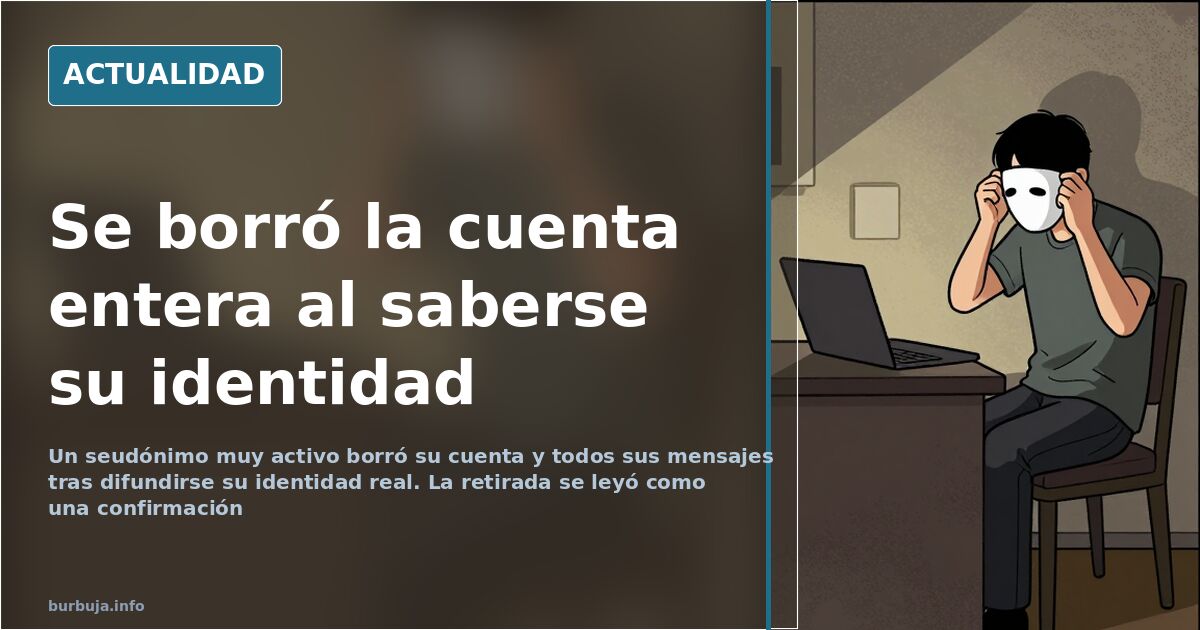
Deleting the account and messages: the price of losing anonymity
What happens when the pseudonym sustaining an opinion for years is shattered in a single afternoon? The sequence repeats: first the name disappears, then the messages, and finally only screenshots and broken links remain. This is what occurred with one of the most active accounts in a Spanish-language economic discussion community, which deleted its profile and all messages after a TikTok account linked to the same person was publicly circulated. The account deletion was not a discreet withdrawal. It was a demolition with witnesses.
From public account to mass deletion of messages
The trigger was the identification of that audiovisual profile: someone cross-referenced data and put a face to the pseudonym. In the responses, personal data—name, location, even a specific address—were circulated, which are not reproduced here due to lack of verification and because, if true, they would identify a private individual. The exposed identity was the beginning of the end.
Notable is the timeline. Before Christmas, some announced the account would disappear, while others denied it with disdain. The forecast came true, and from then on, each intervention read the deletion as a confession: if there was nothing to hide, why delete hundreds of messages at once? The episode served as a warning. Several voices admitted they now review what they write, thinking that one day their face might be put to it.
Tecnocasa, usury, and the obsession with renting
The profile had a single crusade: property owners, landlords, and real estate agencies, with a special fixation on Tecnocasa. Their thesis was that personal loans are regulated while renting extorts an unavoidable primary necessity. Housing, they argued, should not generate rent. From there to calling the landlord a thief was one step, and that step was taken daily.
The paradox was recorded in the messages themselves: social housing was demanded for oneself while accusing the adversary of being an old person stealing rents from neighbors' children. It was not the argument that made the account unsustainable. It was the packaging.
Does anonymity serve to say what one thinks?
Yes, argues a part of the conversation. Anonymity, they claim, is the only way to freely expose what is silenced in real life due to antiestéticar of social punishment. Another current responds that hiding behind a pseudonym does not protect an idea, but protects those who insult, and the result is that any disagreement is resolved by shouting. There is no need to vent bile, one voice summarizes, just touch certain taboos and you will be viewed with suspicion.
The dilemma has no clean solution. It points to the most uncomfortable collateral damage: as soon as the real identity is associated with a virtual personality, the bill is transferred to daily life. The real name turns the comment into something that trinc you.
Threats, lawyers, and the cost of an outburst
The conversation states that legal action has been taken for threats and attacks on honor, with no recorded resolution. The person involved warns they do not plan to speak further on this specific matter, and the reason is economic rather than sarracena: a lawsuit turns a comment from five years ago into a lawyer's bill. What was missing, another voice adds, ending up paying lawyers for a screen argument.
Accounts that burn and reappear
Here enters the most cynical, yet plausible, hypothesis: some argue that certain profiles act as mercenaries and, every so often, incinerate the account so that an extremist does not sue them years later for something they no longer remember. Another line points out that the character has not died, only changed aliases, and points to a new profile with identical resentment toward property owners. A move to another social network is also mentioned.
None of this is proven. But the suspicion runs through the entire discussion, and that suspicion is itself a fact: on the internet, disappearance is also interpreted as a message. Some explanations circulating about the account's fate are nothing more than baseless jokes.
The consolation of screenshots and broken links remains. Reconstructing the story will require doing it by hand, message by message, which is exactly the opposite of what the person who pressed the delete button intended.
What happens when the pseudonym sustaining an opinion for years is shattered in a single afternoon? The sequence repeats: first the name disappears, then the messages, and finally only screenshots and broken links remain. This is what occurred with one of the most active accounts in a Spanish-language economic discussion community, which deleted its profile and all messages after a TikTok account linked to the same person was publicly circulated. The account deletion was not a discreet withdrawal. It was a demolition with witnesses.
From public account to mass deletion of messages
The trigger was the identification of that audiovisual profile: someone cross-referenced data and put a face to the pseudonym. In the responses, personal data—name, location, even a specific address—were circulated, which are not reproduced here due to lack of verification and because, if true, they would identify a private individual. The exposed identity was the beginning of the end.
Notable is the timeline. Before Christmas, some announced the account would disappear, while others denied it with disdain. The forecast came true, and from then on, each intervention read the deletion as a confession: if there was nothing to hide, why delete hundreds of messages at once? The episode served as a warning. Several voices admitted they now review what they write, thinking that one day their face might be put to it.
Tecnocasa, usury, and the obsession with renting
The profile had a single crusade: property owners, landlords, and real estate agencies, with a special fixation on Tecnocasa. Their thesis was that personal loans are regulated while renting extorts an unavoidable primary necessity. Housing, they argued, should not generate rent. From there to calling the landlord a thief was one step, and that step was taken daily.
The paradox was recorded in the messages themselves: social housing was demanded for oneself while accusing the adversary of being an old person stealing rents from neighbors' children. It was not the argument that made the account unsustainable. It was the packaging.
Does anonymity serve to say what one thinks?
Yes, argues a part of the conversation. Anonymity, they claim, is the only way to freely expose what is silenced in real life due to antiestéticar of social punishment. Another current responds that hiding behind a pseudonym does not protect an idea, but protects those who insult, and the result is that any disagreement is resolved by shouting. There is no need to vent bile, one voice summarizes, just touch certain taboos and you will be viewed with suspicion.
The dilemma has no clean solution. It points to the most uncomfortable collateral damage: as soon as the real identity is associated with a virtual personality, the bill is transferred to daily life. The real name turns the comment into something that trinc you.
Threats, lawyers, and the cost of an outburst
The conversation states that legal action has been taken for threats and attacks on honor, with no recorded resolution. The person involved warns they do not plan to speak further on this specific matter, and the reason is economic rather than sarracena: a lawsuit turns a comment from five years ago into a lawyer's bill. What was missing, another voice adds, ending up paying lawyers for a screen argument.
Accounts that burn and reappear
Here enters the most cynical, yet plausible, hypothesis: some argue that certain profiles act as mercenaries and, every so often, incinerate the account so that an extremist does not sue them years later for something they no longer remember. Another line points out that the character has not died, only changed aliases, and points to a new profile with identical resentment toward property owners. A move to another social network is also mentioned.
None of this is proven. But the suspicion runs through the entire discussion, and that suspicion is itself a fact: on the internet, disappearance is also interpreted as a message. Some explanations circulating about the account's fate are nothing more than baseless jokes.
The consolation of screenshots and broken links remains. Reconstructing the story will require doing it by hand, message by message, which is exactly the opposite of what the person who pressed the delete button intended.
Summary of a discussion on Burbuja.info - Foro de economía, actualidad y política., translated from Spanish and reviewed before publication. Read the full discussion (405 replies).
More summaries
-
87-Year-Old Evicted After 71 Years in Madrid Apartment
Maricarmen, 87, evicted from her Madrid flat of 71 years. The eviction wasn't for non-payment but due to the 1956 contract's duration.
-
Sánchez at the UN: Kosovo chief of staff role
Analysis of Pedro Sánchez's role as UN Kosovo chief of staff in 1999 and the legal controversies surrounding the NATO bombings.
-
Pope Francis Critical Condition: Speculation and Dispersed Data
Analysis of the uncertainty surrounding Pope Francis's critical health, contrasting clinical data with political speculation.
-
Personal Safety: A Review of Defensive Sprays and Flashlights
A technical analysis of defensive sprays and tactical flashlights covering legality, lumen output, and real-world effectiveness for self-defense.
-
The Myth of Human Races: A Colonial Invention with Deadly Consequences
Rwanda's history reveals how colonial racial categories cost 800,000 lives. Genetics proves human races do not exist.
-
Artemis II: Moon Return or Just an Orbital Flyby?
A technical analysis of Artemis lunar missions questions whether these are genuine scientific advances or merely public relations exercises.