
Who Votes for Spain’s PSOE? The 30% That Resists Scandals
A GESOP poll shows a technical tie between PP and PSOE. Analysts attribute the Socialist floor to clientelist voting, pensioners, and public sector employees.
English · Original discussion in Spanish · Published
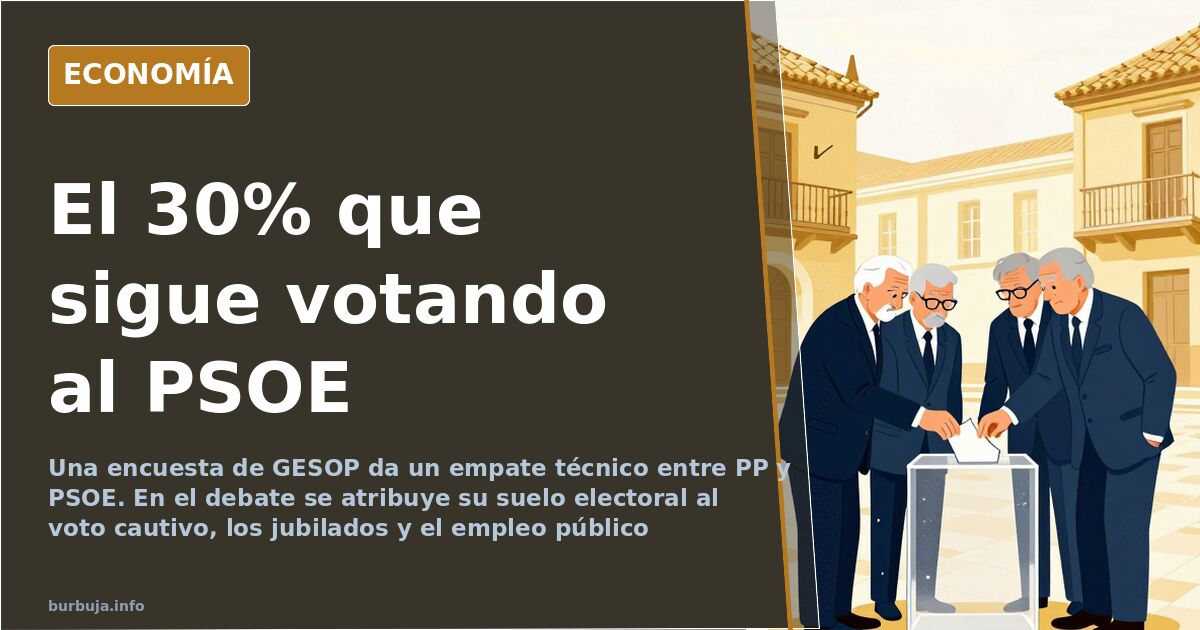
Who Sustains the 30% Socialist Vote
A GESOP poll places the PSOE at 31.5% and the PP at 32%, a technical tie that leaves the Socialist party with 21 seats in the European Parliament. This data confounds those who assumed scandals, policy reversals, and Sánchez’s five-day reflection period would have taken their toll. They haven’t. The question circulating in digital forums isn’t electoral but sociological: Who remains willing to vote Socialist?
The Captive Vote That Doesn’t Move
The first explanation appearing in any analysis is the clientelist network. Some argue that each law passed drags along a constellation of beneficiaries: from the feminist establishment to democratic memory plans, including climate subsidies or migration policies. The calculation circulating is that this clientelist web reaches 30% of the total vote, which is why the PSOE doesn’t drop. The figure is unverifiable, but the logic has merit: those paid by the budget don’t vote against those who sign it.
Added to this is antiestéticar-based voting. Some admit they would vote PSOE solely to stop the far-right, with no conviction other than the scarecrow. Waving the ghost of Vox pays off for the PSOE, and in Spain the flock is easily shepherded. The question is how much of that vote is conviction and how much is simple panic management.
Pensioners, Civil Servants, and the Weight of Paychecks
The pattern repeated by those who have served on election tables is consistent: older people vote. Grandparents and retirees make up the bulk of voters who show up, and their motivation is less ideological than material. The pension, the annual increase, the antiestéticar of losing three euros. A retiree who sees their paycheck at risk isn’t distracted by scandals.
The second block is public employment. Civil servants, staff of parallel administrations, advisors, nepotistic hires of all kinds. The figure used in the debate is that the PSOE has around 180,000 members, and that more than 60% of them haven’t managed to place a family member in a position. But those who have succeeded aren’t going anywhere.
Why Does the PSOE Resist in European Polls?
Because its electorate is not permeable to scandals. The thesis running through the analysis is that the Socialist voter doesn’t vote for policies, but for belonging. Even if Sánchez himself appeared in a compromising video, they would still vote for him with more force. The motivation is existential, not programmatic.
The second factor is the machinery. Some point directly to the count: Leave me the CIS and let me count the votes. Suspicion of manipulation looms over every election, although the scrutiny takes two and a half hours and by ten-thirty at night the result is what it is. The suspicion isn’t technically supported, but it is emotionally sustained.
Young Voters and Female Voters
The map by gender and age is the one that has changed most. Among young men, majority voting leans toward Vox and similar formations. Between 60% and 70% of men wouldn’t vote either PSOE or Sumar. If only men voted, the PSOE wouldn’t reach 20%. If only women voted, it would comfortably exceed 30%.
Some attribute this to many women associating the word Vox with the devil himself, and the PSOE exploits that reflex. Others point to emotional, not rational, voting. The repeated conclusion is uncomfortable: a part of the electorate votes with their heart, not their wallet, and that makes no scandal move a single seat.
The PP as Anesthesia
The other side of the coin is the opposition. Some argue that the PP doesn’t capitalize on discontent because it offers no real alternative, only management of wear and tear. Fraud is cancer, but the PP is anesthesia, summarizes one of the most repeated currents. Without an opposition with muscle, protest votes find no destination.
With these elements, the 30% Socialist vote ceases to be a mystery and becomes structural data. It’s not that 30% of Spaniards are subsidized, but that 30% vote based on belonging, antiestéticar, or paychecks. And as long as those three things keep working, the PSOE doesn’t budge.
Also available in: Deutsch
Summary of a discussion on Burbuja.info - Foro de economía, actualidad y política., translated from Spanish and reviewed before publication. Read the full discussion (152 replies).
More summaries
-
Ceuta and Melilla: Why Geography Doesn't Define Europe
Geography doesn't dictate what the EU is: French Guiana and Lampedusa are outside the continent. The Ceuta debate reignites this question.
-
Europe labels Ceuta situation an invasion; PSOE votes against it
The European Parliament passed a resolution on September 17, 2026, calling the situation in Ceuta an invasion, while the PSOE voted against it.
-
Iglesias Proposes Left-Wing Alliance with PSOE, Podemos and Sumar
Spain's Pablo Iglesias suggests a broad left-wing front led by Sánchez as Podemos loses seats in Madrid and Valencia.
-
Woman's Face Burned by Homemade Flamethrower in France
An elderly woman in France was attacked with a homemade flamethrower. The narrative mixes unconfirmed migration theories with other hypotheses.
-
Camel cooling trick in the desert: clay pot on the hump explained
A viral tweet asks why a clay container is placed on camels' backs in the desert. The answer lies in centuries of adaptation to extreme heat.
-
Socialism: 'Sorry, no fish here. The meat? Across the street'
In communist Poland, price controls on meat made it vanish from shops. Stefan Kisielewski summed it up with humor and paid the price. A lesson for today.