
Who pulls the strings? Soros, BlackRock, and control theories
From Soros and Gates to BlackRock and central banks: examining narratives of public image control versus baseless conspiracy claims.
English · Original discussion in Spanish · Published
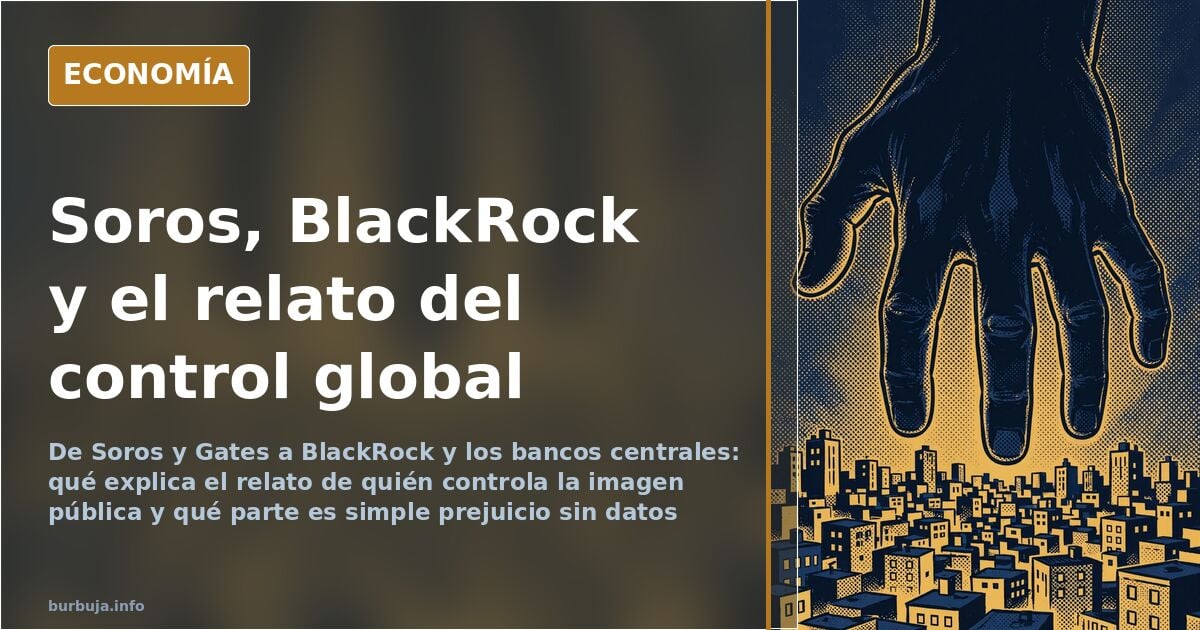
Who pulls the strings? Soros, BlackRock, and control theories
Who decides that diversity takes center stage in every stock photo library? A question many would dismiss with a shrug has fueled a five-year debate on an economics forum. It started when a professional graphic buyer noticed a pattern: agencies push specific repertoires seasonally. First feminism, then LGBTQ+ acronyms, now disability and ethnic diversity. The leap to "who controls this?" is the core of the discussion.
What is the NWO and who is blamed
The acronym for "New World Order" serves as a catch-all. Early posts name usual suspects: Soros, Gates, the Rothschild family, and more recently, funds like BlackRock alongside the Federal Reserve and the European Central Bank. The prevailing logic is simple: trinc the money up until it disappears.
Some go further, placing real power beyond human reach. Certain messages point to "exogenous policies" that have always governed us, reducing billionaires to mere tools. One post cites an unverified creed attributed to Rockefeller about keeping "lives short and minds weak," a text with no confirmed source.
As the conversation pogre, diagnoses diversify. Investment funds, the state-capital nexus, and even HAL 9000 appear as metaphors for faceless intelligence. The pattern is clear: when one explanation fails, another layer is added.
The economic reading: states as branches
Against pure conspiracy narratives, some arguments ground the issue in political economy. The thesis: states are bought and managed by a stateless financial oligarchy, with parties acting as its delegates. Stripped of jargon, this critique aligns with academic debates on regulatory capture and the influence of large asset managers on corporate capital.
Concrete examples are raised: Is BlackRock a state? Are Soros's foundations a sovereign entity? Do Amazon, Netflix, or pharma companies operate as de facto powers? The material offers no answer because the problem lies in identifying power that ignores borders. Where some see conspiracy, others see flagless capital.
The gap between these readings is smaller than it seems. One speaks of secret coordination; the other, of converging incentives. Both describe the same actors.
Why advertising pushes certain models
A widely commented contribution attempts to explain the imagery phenomenon without invoking secret societies. The argument: those directing fashion and advertising have detected that Western female clients no longer need to compete to be desirable under current market rules. If there is no incentive to buy clothes or makeup to improve appearance, the business shifts to selling the opposite model: that any body is the normal body.
It is a cynical hypothesis, and remains just that. No data supports it in the material, only the logic that agencies react to corporate client demands. Notably, much online advertising relies on a handful of these content banks, concentrating decisions on which bodies and scenes are considered representative in few hands.
When diagnosis turns into prejudice
Not all material withstands scrutiny. Some messages slide directly into old antisemitic prejudices, presenting an entire group as owners of banking and big business. Such generalizations lack empirical backing and belong to the classic repertoire of conspiracy theories, resurfacing whenever complex phenomena demand simple culprits.
References to historical leaders and encrypted messages in films or speeches also appear. This is the known mechanism: any gap is filled with a signal, and the lack of proof is interpreted as evidence of how well they hide.
Five years later, the same question
The thread began with a professional complaint about image catalogs and ended up traversing investment funds, central banks, extraterrestrial theories, and apocryphal creeds. What hasn't changed over this time is the initial question, which still lacks demonstrable answers. And it will remain unanswered as long as the standard of proof is, precisely, the absence of proof.
Who decides that diversity takes center stage in every stock photo library? A question many would dismiss with a shrug has fueled a five-year debate on an economics forum. It started when a professional graphic buyer noticed a pattern: agencies push specific repertoires seasonally. First feminism, then LGBTQ+ acronyms, now disability and ethnic diversity. The leap to "who controls this?" is the core of the discussion.
What is the NWO and who is blamed
The acronym for "New World Order" serves as a catch-all. Early posts name usual suspects: Soros, Gates, the Rothschild family, and more recently, funds like BlackRock alongside the Federal Reserve and the European Central Bank. The prevailing logic is simple: trinc the money up until it disappears.
Some go further, placing real power beyond human reach. Certain messages point to "exogenous policies" that have always governed us, reducing billionaires to mere tools. One post cites an unverified creed attributed to Rockefeller about keeping "lives short and minds weak," a text with no confirmed source.
As the conversation pogre, diagnoses diversify. Investment funds, the state-capital nexus, and even HAL 9000 appear as metaphors for faceless intelligence. The pattern is clear: when one explanation fails, another layer is added.
The economic reading: states as branches
Against pure conspiracy narratives, some arguments ground the issue in political economy. The thesis: states are bought and managed by a stateless financial oligarchy, with parties acting as its delegates. Stripped of jargon, this critique aligns with academic debates on regulatory capture and the influence of large asset managers on corporate capital.
Concrete examples are raised: Is BlackRock a state? Are Soros's foundations a sovereign entity? Do Amazon, Netflix, or pharma companies operate as de facto powers? The material offers no answer because the problem lies in identifying power that ignores borders. Where some see conspiracy, others see flagless capital.
The gap between these readings is smaller than it seems. One speaks of secret coordination; the other, of converging incentives. Both describe the same actors.
Why advertising pushes certain models
A widely commented contribution attempts to explain the imagery phenomenon without invoking secret societies. The argument: those directing fashion and advertising have detected that Western female clients no longer need to compete to be desirable under current market rules. If there is no incentive to buy clothes or makeup to improve appearance, the business shifts to selling the opposite model: that any body is the normal body.
It is a cynical hypothesis, and remains just that. No data supports it in the material, only the logic that agencies react to corporate client demands. Notably, much online advertising relies on a handful of these content banks, concentrating decisions on which bodies and scenes are considered representative in few hands.
When diagnosis turns into prejudice
Not all material withstands scrutiny. Some messages slide directly into old antisemitic prejudices, presenting an entire group as owners of banking and big business. Such generalizations lack empirical backing and belong to the classic repertoire of conspiracy theories, resurfacing whenever complex phenomena demand simple culprits.
References to historical leaders and encrypted messages in films or speeches also appear. This is the known mechanism: any gap is filled with a signal, and the lack of proof is interpreted as evidence of how well they hide.
Five years later, the same question
The thread began with a professional complaint about image catalogs and ended up traversing investment funds, central banks, extraterrestrial theories, and apocryphal creeds. What hasn't changed over this time is the initial question, which still lacks demonstrable answers. And it will remain unanswered as long as the standard of proof is, precisely, the absence of proof.
Summary of a discussion on Burbuja.info - Foro de economía, actualidad y política., translated from Spanish and reviewed before publication. Read the full discussion (158 replies).
More summaries
-
Euro banknote redesign sparks cultural debate at ECB
The ECB launches a public consultation on new euro notes, triggering identity politics debates over proposed designs featuring diverse faces and birds.
-
Spain confronts the dilemma of what to do with gold held in the US Federal Reserve
Spain holds gold deposits at the U.S. Federal Reserve. The repatriation of reserves by other European countries raises the question: is it time to bring it back?
-
US Intelligence Warns of Russian Drones in the Mediterranean
US intelligence warns of Russian drones launched from the sea in the Mediterranean. The narrative deflates and the economic cost comes into play.
-
Bringing a Colombian Partner to Spain Costs €20,000
A case study reveals €20,000 spent on family reunification from Colombia and subsequent breakup. No official data measures the real cost.
-
The Blue Dress That Altered King Felipe VI’s Future
25 years since Eva Sannum’s photo in a blue dress ended her relationship with King Felipe VI, sparking debate on the Crown's opportunity cost.
-
Lloret de Mar: Viral photo sparks debate on tourist saturation
A count of 470 people in a Lloret de Mar photo fuels tourism debate, though telephoto lenses and beach slopes skew the perception of overcrowding.