
When the brain says enough: the attention epidemic nobody talks about
The inability to focus is spreading among young adults. Dopamine, the academic calendar and a crisis of purpose behind the attention epidemic.
English · Original discussion in Spanish · Published
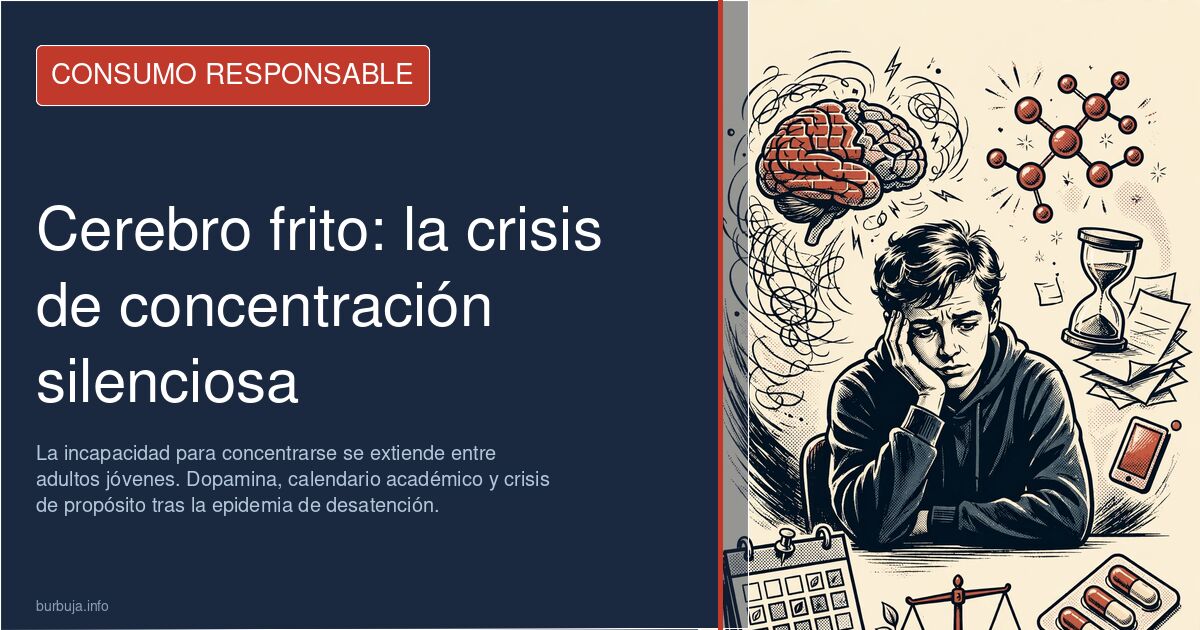
Mental fatigue that makes it impossible to focus is no longer just a student problem
Imagine sitting down to study and, ten minutes in, your brain refusing to process a single line more. It is not laziness: it is as if an invisible barrier said "stop". This is happening to a growing number of people between 25 and 45, caught between work demands, academic pressure and a digital overstimulation that has broken the natural mechanisms of attention.
The phenomenon has no single clinical name, but those who suffer from it describe it with disconcerting bluntness: a feeling that the brain is "melting", anxiety when facing tasks that used to be routine, and an irresistible urge to seek instant gratification (social media, porn, games) as an escape route. The medical community links it to an excess of baseline dopamine, a dysregulated reward system and, in many cases, a lack of purpose that turns any sustained effort into an ordeal.
The role of dopamine in the attention crisis
Dopamine is not just the pleasure neurotransmitter: it is the fuel of motivation. When the brain is bombarded with ultra-fast stimuli (short videos, notifications, explicit sensual content), the receptors become saturated and the reward threshold shoots up. Reading a book, drawing up a budget or studying for an exam no longer generate enough activation. The brain enters survival mode: it seeks the easy hit and rejects effort. Some discussion forums mention sessions of up to six hours of high-stimulation content, trinc by a feeling of emptiness and a total inability to return to obligations.
The pharmaceutical solution, such as methylphenidate (Concerta, Rubifen), is often offered as a shortcut. But the debate stresses that without a change of habits, the drugs only mask the problem. "You have a brain intoxicated with dopamine and a vagus nerve in tatters. You cannot fix that in two weeks", warns a voice that speaks from experience.
The academic calendar, another silent enemy
A structural factor that worsens the problem is the design of the school year. In Spain, final exams and the toughest deadlines fall in May, June and July, months in which accumulated fatigue and heat reduce cognitive performance. Those who have tried alternative calendars (such as the Japanese one, which starts in March and divides the year into more balanced semesters) argue that peak productivity comes between September and December, precisely when the school year begins in Spain. A calendar change could relieve the pressure on an already saturated nervous system.
The existential crisis as the backdrop
Behind the lack of concentration there is often a more uncomfortable question: what is all this for? Those who have invested years of study and work without seeing tangible results – a business that will not take off, relationships that do not work out, a purpose that fades – describe a feeling of wasted effort. The brain, in safety mode, refuses to keep investing energy in something that experience has shown bears no fruit. It is not clinical depression, but a reactive mood shaped by circumstances. Some analyses suggest that the current system – with its empty promise that effort is always rewarded – generates a learned helplessness that paralyses.
The data that does not add up
The paradox is that many of those who cannot concentrate to work or study are perfectly able to hold their attention for hours on pleasurable activities or heated discussions in digital communities. That selectivity reinforces the thesis that the problem is not attention capacity itself, but the management of effort and the disconnect between what one does and what one values. Until that gap is resolved, any productivity technique – or any pill – will be just a patch.
Also available in: Deutsch
Summary of a discussion on Burbuja.info - Foro de economía, actualidad y política., translated from Spanish and reviewed before publication. Read the full discussion (96 replies).
More summaries
-
Spain's shade deficit: an urban problem paid for with health
In inland Spain, the lack of trees turns towns into ovens. Why is shade rejected? A cultural and economic analysis of the urban problem.
-
Almería isn't tropical: that's why Spain's greenhouse region needs them
Almería in southern Spain lies 1,500 km from the Tropics and has an arid climate: without greenhouses there would be no year-round tomatoes. Flavour is decided by the variety.
-
Cola Cao 1986 vs 2026: less product, more sugar, same real price
Cola Cao 1986 vs 2026: smaller size, sugar up to 70%, and price adjusted for inflation. Is it still the same product? Data analysis.
-
Spain's sick leave that outlasts the illness: the math of when to go back to work
An eczema earns two weeks off; a removed lump, until January. The fiscal and bureaucratic calculation that decides when to return to work.
-
Natural gas vs propane: the fine print that decides your bill
Natural gas has a lower price per kWh than propane, but the building fee and the fixed term can make the bill more expensive at low consumption levels.
-
Ceramic and induction hobs: are the printed controls wearing off?
Forum users debate whether new induction and ceramic hobs lose their printed control markings through everyday use and cleaning.