
What parents don't know about their daughters' adult content
Many young women run adult profiles under pseudonyms and off their parents' radar. The digital divide reopens the moral and economic debate.
English · Original discussion in Spanish · Published
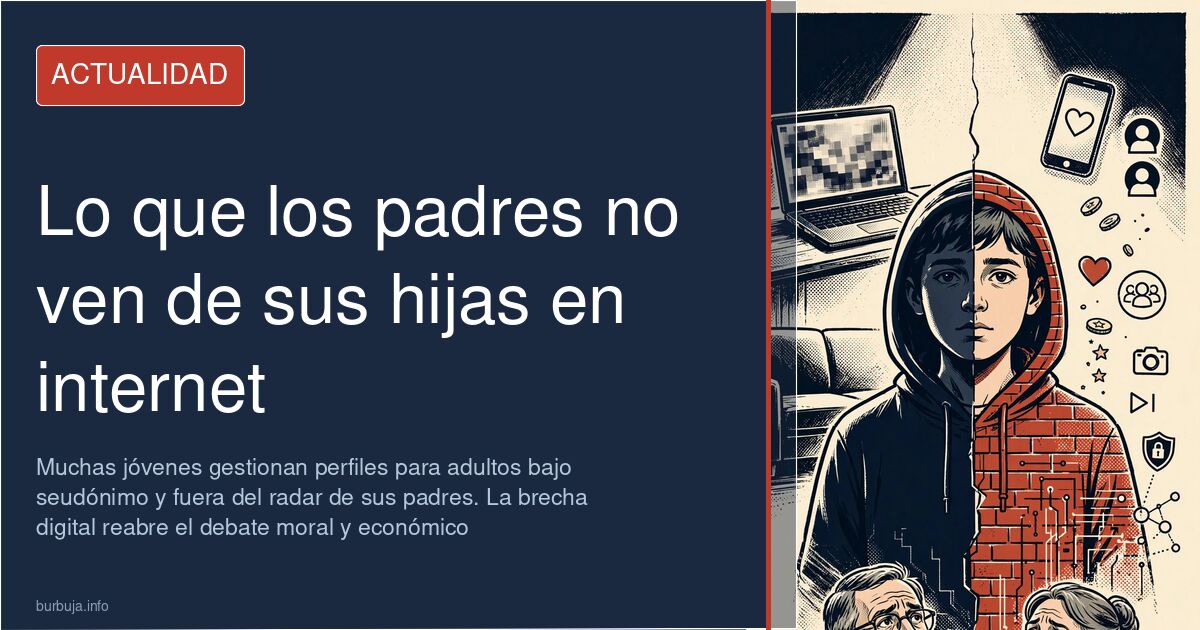
What parents don't know about their daughters' digital footprint
In the age of hyperconnectivity, the paradox is uncomfortable: the more young people post, the less their parents know. The issue of adult content that some girls record and distribute online has refocused attention on a divide that is not technological, but one of family life. It is not that families don't want to look; it is that platforms are designed so they don't.
The pseudonym as a firewall
The pattern repeats itself: profiles under pseudonyms, specific platforms, and a deliberate blocking of relatives and acquaintances. Digital identity is separated from real identity like two floors with no staircase. Some argue it is simply an extension of the street, and that a screen shows no more than a sidewalk. Others believe that is exactly where the problem begins.
Normalization, money, and the show that sugarcoats it
The economic factor weighs heavily: for some it is financial independence; for others, instant validation. And the cultural narrative plays along. The discussion cited the Netflix series "Margo tiene un bebé" (Margo Has a Baby), which presents selling one's own content as a brave artistic outlet for a young mother. That framing —don't judge, applaud— clashes head-on with the sarracena reaction the issue provokes.
There lies the knot: when the system rewards exposure and the family sees nothing, whose blindness is it, the parents' or the algorithm's?
Also available in: Deutsch
Summary of a discussion on Burbuja.info - Foro de economía, actualidad y política., translated from Spanish and reviewed before publication. Read the full discussion (36 replies).
More summaries
-
Spain's 'La bola negra' sparks culture war with €4.7M opening
'La bola negra' grosses €4.7 million in its first weekend and divides Spain between critical praise and accusations of propaganda and historical sectarianism.
-
Two dead in shooting in El Ejido, Spain
A shooting in El Ejido, Spain, leaves two dead and four injured, reigniting the debate over social exclusion and coexistence in marginalised areas such as El Canalillo.
-
Major shake-up expected at Spain's Mercadona
Mercadona is testing fully automated self-checkout: is this goodbye to cashiers? An analysis of the pros and cons of automation in supermarkets.
-
I'm not weird! I'm different.
An analysis of how society labels as 'weird' anyone who declares themselves different, and the use of mental health as a weapon in debates.
-
Viral video of migrants mocking police reignites Spain's immigration debate
A viral video of young migrants mocking Spanish police reopens the debate on irregular immigration and the response of the security forces in Spain. An analysis of the
-
Barcelona city hall advises schools to skip music and dancing during Ramadan
Barcelona city hall recommends schools avoid music and dance activities during Ramadan as a gesture of respect. The guide has sparked controversy.