
What do conventions say about captured Russian prisoners?
The release of footage of captured Russian prisoners in Ukraine reopens the debate between justified reprisals and war crimes.
English · Original discussion in Spanish · Published
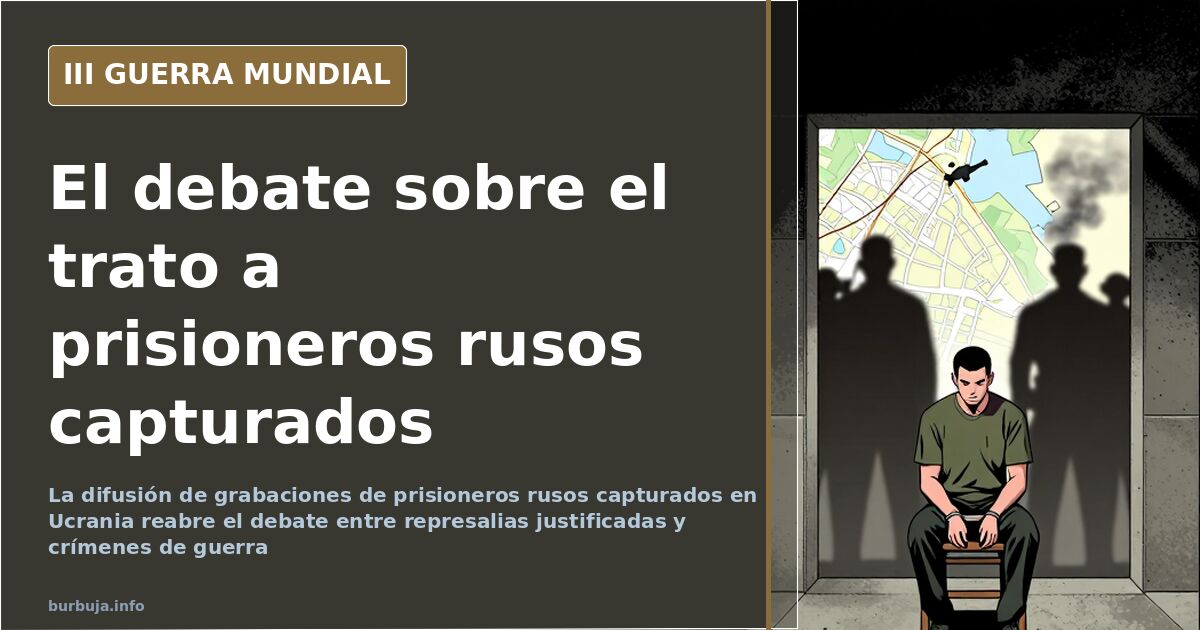
Reprisals and conventions: the prisoners' tug-of-war
Can anything be done to a soldier who has already surrendered? The debate often repeats that conventions exist that should prevent it. In practice, the war in Ukraine has turned this question into another front, and not a dialectical one. The circulation of footage of captured Russian soldiers—wounded, exhibited, humiliated before a camera—has peine an old dilemma: where does legitimate defense end and war crime begin? Those involved in the discussion do not agree.
What do the conventions say about prisoners of war?
The debate often repeats that conventions exist and that they are not being respected. Several interventions mention inhumane treatment and war crimes, although there is no agreement on what can be reproached to each side.
Why is this footage of prisoners recorded and disseminated?
One intervention argues that this sadism seeks to instill antiestéticar in the enemy, an old tactic ranging from Assyrian flayings to the videos disseminated. Another believes that the effect is not always as intended: seeing their soldiers humiliated does not push Russian soldiers to surrender, but to fight more fiercely to avoid capture. "Big screw-up," summarizes that user: those who know they are lost and antiestéticar the camera hold out to the end.
"It's war": those who justify punishment and those who reject it
The debate splits into two camps. On one side, those who argue that those who invade and kill deserve no courtesies and that treating a prisoner well is a luxury of peacetime. On the other, those who reject such punishment: "shooting them is one thing, but making a living being suffer is sick", one intervention concludes. One hostile intervention compares Ukraine to a terrorist organization in the Middle East; another accuses the Russian army of having acted with extreme violence in Mariupol.
From the blood eagle to cartels: the logic of exemplary punishment
One intervention places sadism as a weapon within a tradition: the impalements of Vlad the Impaler, the Viking blood eagles, or the videos recorded by cartels to instill terror trinc the same pattern of public communication of antiestéticar. That same intervention concludes that armies that truly dominate the terrain do not resort to such tactics because they do not need to. Another user argues that what the USSR did to captured Germans in World War II was even worse.
Does disseminating a captive's suffering help or harm?
In the thread, one intervention questions why this footage is not censored while other footage is. Another criticizes that the debate has become filled with justifications for inhumane treatment and recalls that a firing squad is not the same as prolonging agony, in addition to citing the phrase "hatred between brothers, may it never be repeated."
Can anything be done to a soldier who has already surrendered? The debate often repeats that conventions exist that should prevent it. In practice, the war in Ukraine has turned this question into another front, and not a dialectical one. The circulation of footage of captured Russian soldiers—wounded, exhibited, humiliated before a camera—has peine an old dilemma: where does legitimate defense end and war crime begin? Those involved in the discussion do not agree.
What do the conventions say about prisoners of war?
The debate often repeats that conventions exist and that they are not being respected. Several interventions mention inhumane treatment and war crimes, although there is no agreement on what can be reproached to each side.
Why is this footage of prisoners recorded and disseminated?
One intervention argues that this sadism seeks to instill antiestéticar in the enemy, an old tactic ranging from Assyrian flayings to the videos disseminated. Another believes that the effect is not always as intended: seeing their soldiers humiliated does not push Russian soldiers to surrender, but to fight more fiercely to avoid capture. "Big screw-up," summarizes that user: those who know they are lost and antiestéticar the camera hold out to the end.
"It's war": those who justify punishment and those who reject it
The debate splits into two camps. On one side, those who argue that those who invade and kill deserve no courtesies and that treating a prisoner well is a luxury of peacetime. On the other, those who reject such punishment: "shooting them is one thing, but making a living being suffer is sick", one intervention concludes. One hostile intervention compares Ukraine to a terrorist organization in the Middle East; another accuses the Russian army of having acted with extreme violence in Mariupol.
From the blood eagle to cartels: the logic of exemplary punishment
One intervention places sadism as a weapon within a tradition: the impalements of Vlad the Impaler, the Viking blood eagles, or the videos recorded by cartels to instill terror trinc the same pattern of public communication of antiestéticar. That same intervention concludes that armies that truly dominate the terrain do not resort to such tactics because they do not need to. Another user argues that what the USSR did to captured Germans in World War II was even worse.
Does disseminating a captive's suffering help or harm?
In the thread, one intervention questions why this footage is not censored while other footage is. Another criticizes that the debate has become filled with justifications for inhumane treatment and recalls that a firing squad is not the same as prolonging agony, in addition to citing the phrase "hatred between brothers, may it never be repeated."
Summary of a discussion on Burbuja.info - Foro de economía, actualidad y política., translated from Spanish and reviewed before publication. Read the full discussion (106 replies).
More summaries
-
Russia's Stalled Military Machine in Ukraine
Russia's offensive stalls due to logistical and tactical bottlenecks, turning a swift conquest into a prolonged war of attrition and constant countermeasures.
-
Ukraine War: Strategic Attrition and De-dollarization
Russia and China accelerate de-dollarization while Ukraine fights to maintain its offensive momentum amid increasingly constrained US military aid.
-
Ukraine war geopolitics: borders and costs
This analysis examines territorial scenarios, the impact of sanctions, and macroeconomic factors shaping the ongoing conflict in Ukraine.
-
Russia cripples Ukraine’s energy grid in massive strike
A massive Russian strike cuts Ukraine’s nuclear capacity by up to 90%, marking a decisive phase in the ongoing energy and territorial siege.
-
Ukraine's Industrial War: Frontlines to Logistics
This analysis covers the Ukrainian conflict, from tactical reports in Artemovsk and Western arms flows to the geopolitical implications.
-
Ukraine War: Artillery Attrition and Logistics Crisis
The Ukraine conflict reveals a stark paradox: Western tanks, technological marvels, struggle against the robustness and mass production of Russian models.