
What awaits Spain's struggling middle class in the new Latin-style Spain
Is Spain importing a low-productivity model? We analyse the decline of the "palillerato" (Spain's squeezed small-business class), insecurity and the future of the business fabric in the forum.
English · Original discussion in Spanish · Published
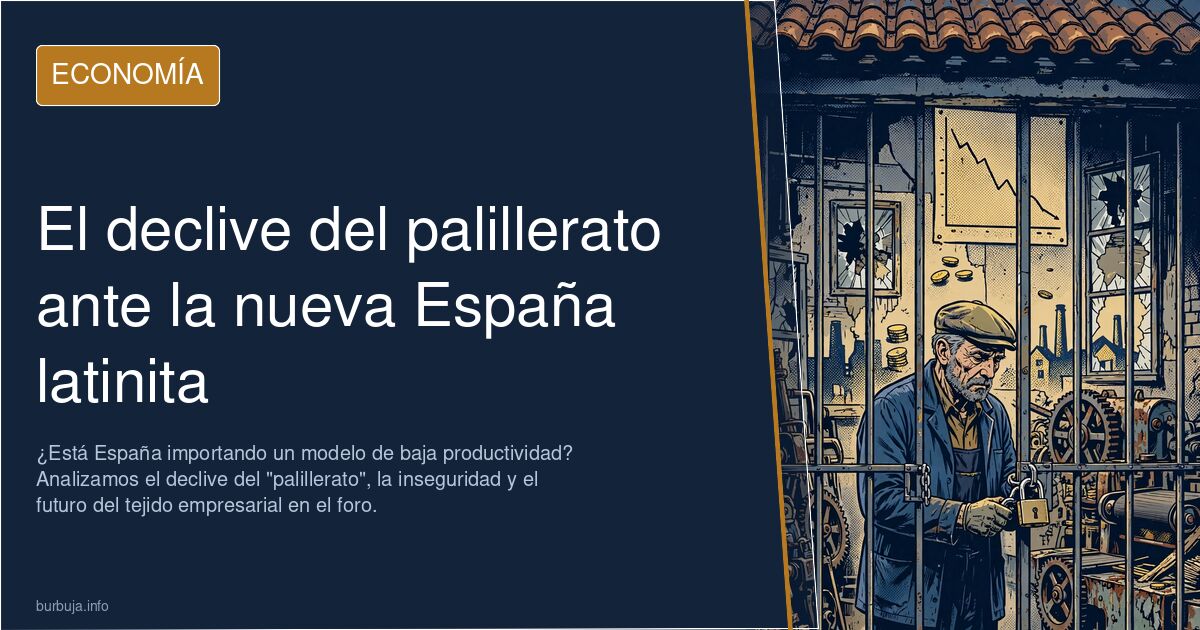
The decline of the palillerato in the face of the new Latin-style Spain
Is Spain importing a low-productivity social and economic model marked by insecurity? The debate on demographic transformation and the future of Spain's business fabric is exploding on the forum, analysing whether the country's "palillerato" (its squeezed small-business and middle class) is aware of its own obsolescence.
What's at stake
What forum users say about What awaits Spain's struggling middle class in the new Latin-style Spain
The tone is one of absolute scepticism towards the official narrative, mixing dark humour with blunt analysis of the viability of the current model.
Why this thread won't leave you indifferent
This is not about abstract theories, but about the survival of the real economic fabric in the face of capital infiltration and the degradation of legal security. If the users denouncing the data cover-up are right, we are facing a total disconnect between the administration and the street that will change our way of life in less than a decade.
This summary is just the surface. The full thread has dozens of replies with data, sources, analysis and the unfiltered debate — registered users only. Create your free account in 30 seconds and join the debate.
Disclaimer: The opinions collected here belong exclusively to the forum users and do not reflect an official truth or financial advice. The economic and security situation is a complex phenomenon open to multiple interpretations.
Related debates on the forum
Is Spain importing a low-productivity social and economic model marked by insecurity? The debate on demographic transformation and the future of Spain's business fabric is exploding on the forum, analysing whether the country's "palillerato" (its squeezed small-business and middle class) is aware of its own obsolescence.
What's at stake
- The core of the debate: The thread starts from the premise that Spain is replicating socio-economic dynamics typical of Latin America: high dependency, growing insecurity and a productive structure in decline.
- The rift: The clash arises between those who see this as an inevitable consequence of migration and security policies, and those who denounce an institutional "statistical cover-up" to hide the reality on the streets.
- The detail nobody expected: The emergence of the concept of "blood money laundering" as a distorting factor: the thesis that illicit capital is suffocating Spain's small business owners, who cannot compete against boosted businesses.
What forum users say about What awaits Spain's struggling middle class in the new Latin-style Spain
The tone is one of absolute scepticism towards the official narrative, mixing dark humour with blunt analysis of the viability of the current model.
Position A: Those who argue that the "palillerato" is mainly responsible for its own ruin for having applauded for years the very policies that are now pushing it out of the market. It's the "you made your bed, now lie in it" view.
Position B: The institutional analysis line: it is argued that there is a direct order from the Interior Ministry to force crime statistics downwards, creating a bubble of false security while reality in the neighbourhoods is radically different.
Position C: The economic angle: the warning is that the small local business is doomed. With capital of dubious origin entering the service sector, unfair competition is generated that the traditional business owner cannot win, which will eventually close down any lawful business.
Why this thread won't leave you indifferent
This is not about abstract theories, but about the survival of the real economic fabric in the face of capital infiltration and the degradation of legal security. If the users denouncing the data cover-up are right, we are facing a total disconnect between the administration and the street that will change our way of life in less than a decade.
This summary is just the surface. The full thread has dozens of replies with data, sources, analysis and the unfiltered debate — registered users only. Create your free account in 30 seconds and join the debate.
Disclaimer: The opinions collected here belong exclusively to the forum users and do not reflect an official truth or financial advice. The economic and security situation is a complex phenomenon open to multiple interpretations.
Related debates on the forum
- Signs of the HOUSING market COLLAPSE. Let no one cry about it afterwards..... · 134 replies
- Social media on fire: Restaurant owner refuses to hire a Spanish worker: "I'm looking for Latin people, Spaniards are racist and lazy" · 293 replies
- Things are getting ugly in Tehran · 79434 replies
- Question for STAR WARS geeks · 30 replies
Summary of a discussion on Burbuja.info - Foro de economía, actualidad y política., translated from Spanish and reviewed before publication. Read the full discussion (24 replies).
More summaries
-
A photo that captures Spain's culture of waiting and gender roles
A Land Cruiser, a basket of vegetables and 15 minutes of waiting: the image sparking debate over gender roles, job insecurity and Spain's 'they'll call eventually' mindset.
-
Migrant boat gets unexpected welcome on Spanish beach
A viral video shows topless sunbathers welcoming a migrant boat to Spain; the debate centres on the cost of hosting migrants and growing social tension.
-
Spain's Grandchildren Law: 2.4 million applications raise electoral alarm
Over 1 million descendants of Spaniards have applied for citizenship and 1.3 million are waiting for an appointment. The Grandchildren Law has reached 2.4 million applications and…
-
Spain's Podemos drops its logo, runs on 'Irene' alone for 29N election
Podemos has removed its name and logo from its 29N ballot in Spain: only 'Irene' and the slogan 'Peace, housing and work' remain. Housing and the cost of living dominate its programme.
-
Spain's €1.5 billion in tied loans for trains sold abroad under scrutiny
ICO and FIEM credit lines for railway equipment in other countries: tied buyer loans with sovereign guarantee, according to the debate; no evidence that half the money never arrives.
-
Alvise slams Spain's 1.7 billion rail spending abroad on X
Alvise Pérez denounces on X that Spain is spending 1.7 billion on trains in Morocco, Egypt and Uzbekistan while Spaniards face high taxes and low wages.