
Vox leader proposes mandatory military service in Spain
Santiago Abascal suggests compulsory social and military service for youth, leaving costs and duration undefined.
English · Original discussion in Spanish · Published
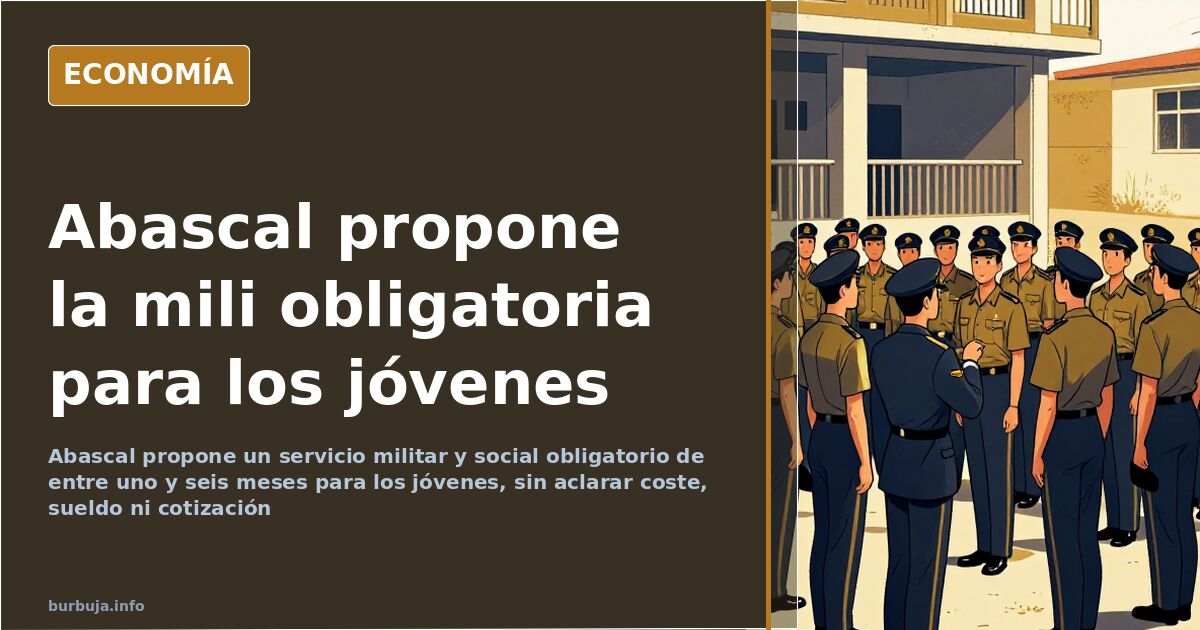
Abascal pushes for mandatory mili: one to six months, no details
Santiago Abascal wants to bring the mili back into young people's lives. He advocates for a compulsory military and social service with a duration ranging from one to six months. The Vox leader defended this stance but left the model, cost, and exact timeframe open. With elections on the horizon, the proposal—originally published on April 22, 2019 and now revived—returns to the center of political noise.
What exactly does Vox propose?
The plan lacks detail. Abascal stated it is yet to be defined whether it would be strictly military or include social service, noting that duration would fluctuate between one, three, or six months. What he made clear was its mandatory nature: "In this society, only rights are discussed, but we must also talk about duties," he argued, without specifying technical details. On paper, a one-month mili seems hard to fit: any basic instruction requires weeks before someone learns to handle a weapon.
The Vox leader added a few ideas that went unnoticed. He recommended singing the national anthem in schools and, lacking lyrics for the Spanish anthem, suggested using El novio de la Gloria, the Legion's hymn, which he described as a "love song." The package goes beyond the calendar: it touches on education, the flag, and the national narrative.
The fine print: who pays and who contributes?
No one has explained who would bear the cost of having a generation train for months. Basic questions remain unanswered: Is there pay, or is it unpaid service? Does the time count toward retirement? Do young people leave with training or just a backpack?
The most cited example is Norway. Norway applies a mandatory service that includes women and works, it is argued, because it is paid and counts as a year of contributions. The key would not be obedience, but making that year useful: recruits can receive training during the period. Other countries like Cuba, Colombia, or Honduras appear in the conversation as the opposite side of the mirror.
The promoter's credibility problem
There is a detail that runs through the entire issue. Abascal himself has been accused of avoiding mandatory military service in his day. This accusation has circulated for years and undermines much of his argument: demanding a duty one evaded is the best way for the proposal to be seen as posturing. "Let him start by going himself," summarizes the most repeated response.
His own party doesn't help either. According to reports, Abascal once acknowledged that his party members did not want the mili. If the proponent didn't serve and his allies don't want it, the commitment is born with an expiration date.
How many young votes does mandatory mili move?
Fewer than it seems. The prevailing view is that the measure generates rejection among young voters, precisely the electorate an emerging party needs. Some argue the vehicle is different: middle-aged voters who grew up with the mili and view today's youth with distrust.
That clash is clear. One part demands strictness for aimless kids; another recalls that historical mili served both for instruction and for bullies to make life impossible for others. And a third, the most pragmatic, asks about the bill: if training an entire cohort costs what it costs, who pays?
Why a 2019 proposal returns now
The date reveals the mechanism. The original news is from April 22, 2019, during the general election campaign of that year, and reappears whenever an electoral cycle approaches. Mandatory mili is a claim that yields headlines: it mobilizes the base, angers opponents, and fills debate minutes.
This doesn't miccionan the issue has legislative traction. There is no drafted text, no calendar, and no majority in sight. For now, it is a declaration of intent with an anthem included.
With this starting point, it is reasonable to think that mandatory mili will remain campaign currency rather than real policy. Although it shouldn't be entirely dismissed: the argument of duty, discipline, and the flag has worked other times with the same tailwind. What happens with the months, salary, and contributions will decide if this is a headline or a project.
Santiago Abascal wants to bring the mili back into young people's lives. He advocates for a compulsory military and social service with a duration ranging from one to six months. The Vox leader defended this stance but left the model, cost, and exact timeframe open. With elections on the horizon, the proposal—originally published on April 22, 2019 and now revived—returns to the center of political noise.
What exactly does Vox propose?
The plan lacks detail. Abascal stated it is yet to be defined whether it would be strictly military or include social service, noting that duration would fluctuate between one, three, or six months. What he made clear was its mandatory nature: "In this society, only rights are discussed, but we must also talk about duties," he argued, without specifying technical details. On paper, a one-month mili seems hard to fit: any basic instruction requires weeks before someone learns to handle a weapon.
The Vox leader added a few ideas that went unnoticed. He recommended singing the national anthem in schools and, lacking lyrics for the Spanish anthem, suggested using El novio de la Gloria, the Legion's hymn, which he described as a "love song." The package goes beyond the calendar: it touches on education, the flag, and the national narrative.
The fine print: who pays and who contributes?
No one has explained who would bear the cost of having a generation train for months. Basic questions remain unanswered: Is there pay, or is it unpaid service? Does the time count toward retirement? Do young people leave with training or just a backpack?
The most cited example is Norway. Norway applies a mandatory service that includes women and works, it is argued, because it is paid and counts as a year of contributions. The key would not be obedience, but making that year useful: recruits can receive training during the period. Other countries like Cuba, Colombia, or Honduras appear in the conversation as the opposite side of the mirror.
The promoter's credibility problem
There is a detail that runs through the entire issue. Abascal himself has been accused of avoiding mandatory military service in his day. This accusation has circulated for years and undermines much of his argument: demanding a duty one evaded is the best way for the proposal to be seen as posturing. "Let him start by going himself," summarizes the most repeated response.
His own party doesn't help either. According to reports, Abascal once acknowledged that his party members did not want the mili. If the proponent didn't serve and his allies don't want it, the commitment is born with an expiration date.
How many young votes does mandatory mili move?
Fewer than it seems. The prevailing view is that the measure generates rejection among young voters, precisely the electorate an emerging party needs. Some argue the vehicle is different: middle-aged voters who grew up with the mili and view today's youth with distrust.
That clash is clear. One part demands strictness for aimless kids; another recalls that historical mili served both for instruction and for bullies to make life impossible for others. And a third, the most pragmatic, asks about the bill: if training an entire cohort costs what it costs, who pays?
Why a 2019 proposal returns now
The date reveals the mechanism. The original news is from April 22, 2019, during the general election campaign of that year, and reappears whenever an electoral cycle approaches. Mandatory mili is a claim that yields headlines: it mobilizes the base, angers opponents, and fills debate minutes.
This doesn't miccionan the issue has legislative traction. There is no drafted text, no calendar, and no majority in sight. For now, it is a declaration of intent with an anthem included.
With this starting point, it is reasonable to think that mandatory mili will remain campaign currency rather than real policy. Although it shouldn't be entirely dismissed: the argument of duty, discipline, and the flag has worked other times with the same tailwind. What happens with the months, salary, and contributions will decide if this is a headline or a project.
Summary of a discussion on Burbuja.info - Foro de economía, actualidad y política., translated from Spanish and reviewed before publication. Read the full discussion (187 replies).
More summaries
-
Conscription Shadow Casts Over a Fractured Global Economy
Debate on mandatory military service and war resurfaces amid geopolitical tensions. Analysis of extreme scenarios regarding national defense and economic costs.
-
Mandatory Military Service Debate in Europe
Analysis of the debate on mandatory military service in Europe: defense, social costs, and mixed models
-
German Police Arrest Protesters Against Mandatory Military Service
German police detain demonstrators protesting mandatory military service in Berlin amid concerns over potential army expansion. Thousands took to the streets.
-
Mari Carmen, 87: The eviction sparking nationwide protests in Spain
An 87-year-old's eviction in Madrid has led to protests across Spain, highlighting the country's housing crisis and rent control debates.
-
Madrid rental listings drop 20% after decree
Forum users track Madrid's rental supply falling from 11,815 to 9,398 ads in one day. They blame the new decree. Barcelona has only 680 long-term rentals.
-
Spain's Debate: Voting vs. Abstention in Upcoming Elections
A forum debates voting as a lesser evil versus abstaining as punishment. In 2019, with the lowest turnout since 1978 (66%), Sánchez reached La Moncloa.