
Vox Fills Squares in Spain’s Castilla-La Mancha, Raising Election Tensions
Vox draws large crowds in Ciudad Real, Albacete and Guadalajara ahead of the November 29 rally, boosting its campaign narrative.
English · Original discussion in Spanish · Published
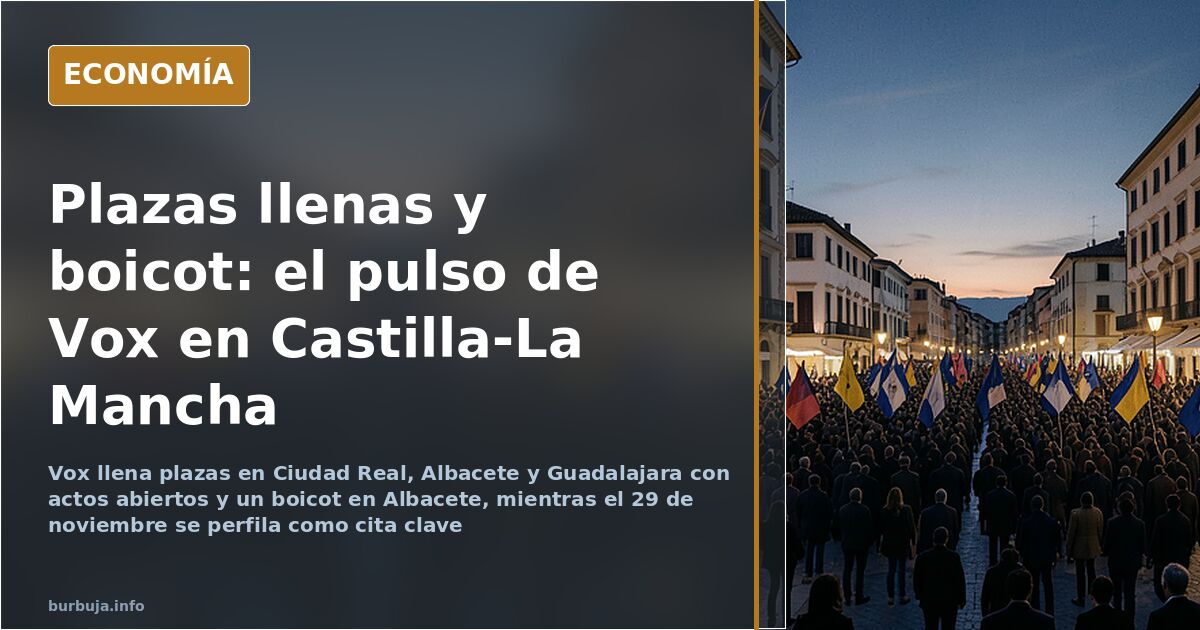
Vox Fills Squares in Spain’s Castilla-La Mancha, Raising Election Tensions
A town of fewer than 80,000 people hosted a packed main square for a press conference. The contrast between Spain’s depopulated rural areas and Vox’s mobilization capacity dominates political discourse in Castilla-La Mancha, where Santiago Abascal’s party held events in Ciudad Real, Albacete and Guadalajara with attendance organizers claim is historic. This sequence is no accident: November 29 is framed as a key date for what the party calls the reconstruction of Spain.
Ciudad Real, Albacete and Guadalajara: Three Squares, One Message
The tour began in Ciudad Real. Abascal publicly thanked “your massive turnout at the press conference” before a Main Square reportedly filled to capacity in a city that does not reach 80,000 inhabitants. The intended image is clear: not a closed auditorium, but the street, open space, and the sense that the message resonates with ordinary citizens.
The script repeated in Albacete, where Vox spoke of “thousands and thousands of people” in a media statement, and announced a public event in Guadalajara at the Pedro Díaz Auditorium. The choice of Castilla-La Mancha seems deliberate: it is a region with significant rural weight, facing depopulation, and an electorate that has traditionally punished centralist rhetoric. The party seeks there a narrative of common sense against office-based politics.
The Boycott Vox Turned into an Argument
Not everything was applause. In Albacete, a far-left group attempted to disrupt the event, according to information released by the party itself. Rather than hiding it, Vox integrated it into its narrative: the streets belong to them, and opponents resort to interruption because they lack arguments. This is a known pattern in the formation’s political communication, which profits from confrontation as proof of authenticity.
The response on social networks was immediate. Some compared Abascal’s open-air receptions with Pedro Sánchez’s events, held in enclosed auditoriums with buses arranged to guarantee audiences. This comparison, more propaganda than analysis, measures the temperature of the narrative: attendance has become the new scoreboard of the campaign.
From Enthusiasm to Outbursts: The Fracture in the Narrative
Alongside messages of support appeared outbursts. Derogatory comments toward attendees—labeled as peasants or uncouth—reveal a tension beyond politics: the clash between the Spain that feels represented by Vox and the one that looks down on its rallies. This fracture, more cultural than economic, explains why a party event becomes a thermometer for deeper discontent.
There was also room for analysis. It was argued that blind trinc of any politician is tacky, regardless of party, and warned that mobilization does not always translate into votes. This warning has merit: full squares are not ballot boxes, and converting enthusiasm into ballots is a step no poll measures precisely.
The Economic Fine Print: Agriculture, Depopulation and Narrative
In the economic background, the conversation shifted to the primary sector. It was defended that Vox should make agriculture and livestock essential activities, arguing that globalism aims for famine. This thesis lacks empirical backing but connects with rural discontent over costs and bureaucracy. Castilla-La Mancha, with strong agricultural weight, is fertile ground for this discourse.
Depopulation is the other major backdrop. Cities like Ciudad Real, with fewer than 80,000 inhabitants, see these events as a way to exist on the political map. A party filling a provincial capital’s main square does not change demographics, but it changes the narrative: empty Spain stops being scenery and becomes a political subject.
What Remains of November 29
The date marked by Abascal as a historic appointment to begin the reconstruction of Spain functions as a mobilizing horizon. Until then, each event will be read as an anticipated plebiscite. The question is whether mobilization capacity holds when media focus shifts to another square.
With these elements, honest analysis suggests Vox has found an effective showcase in Castilla-La Mancha. Whether this showcase translates into a majority is another matter. Packed squares impress; governing requires something else. And no one has yet explained how a shout translates into a budget.
Also available in: Deutsch
Summary of a discussion on Burbuja.info - Foro de economía, actualidad y política., translated from Spanish and reviewed before publication. Read the full discussion (15 replies).
More summaries
-
Sánchez claims rising purchasing power sparks debate
Sánchez asserts increased disposable income, contrasting with grocery prices. This gap dominates the analysis.
-
Abascal in Argentina: People will want to hang Sánchez
Vox leader Santiago Abascal stated in Argentina that the people will want to hang Pedro Sánchez. The PSOE demands PP condemnation; Feijóo remains silent.
-
Pedro Sánchez's 'Letter to Citizens': Survival Strategy or End of Term?
Analysis of the economic and political impact of Pedro Sánchez's letter: survival strategy or the end of a term marked by Pegasus?
-
Spain has lost productivity since 2018 despite €100bn in EU funds
The IMF says Spain is the only major eurozone economy losing productivity since 2018, despite receiving 100 billion euros in EU funds. GDP per capita…
-
Óscar Puente as Spanish PM candidate: management vs. political profile
Supporters see a direct manager; critics cite the Cantabria train tunnel scandal. Debate focuses on profile and opposition quality.
-
Why old homes had high ceilings
High ceilings in older homes improved ventilation, light and smoke control. Modern housing lowered them to maximize space and profit margins.