
Vox expels Ortega Smith, ending internal dissent in Spain
Vox has expelled Ortega Smith, its co-founder and number six, over claims that he failed to respect the internal hierarchy and no longer won votes.
English · Original discussion in Spanish · Published
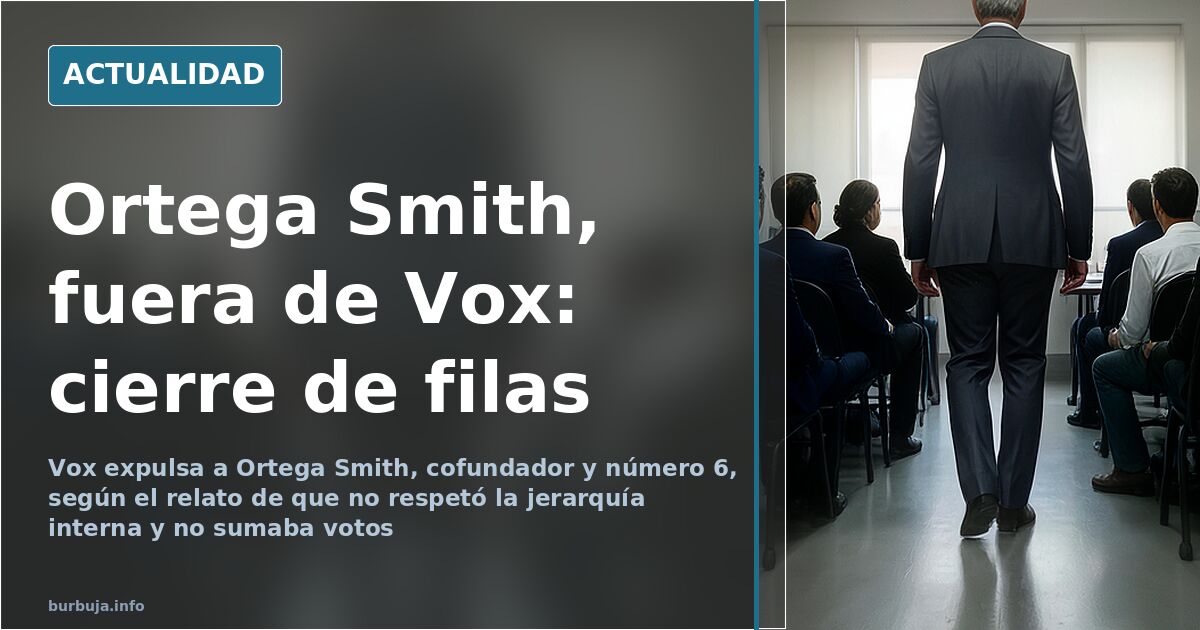
Vox expels Ortega Smith and shuts the door on internal dissent
The definitive expulsion of Ortega Smith from Vox is no mere org-chart footnote: it is the most visible episode in a string of departures that has steadily drained the party's critical wing. The number six and co-founder of the party, according to the narrative now dominating public discussion, refused to respect the internal hierarchy and to give up his seat when the leadership decided he no longer brought in votes. The Vox leadership presented the decision as a signal that careerists will not be tolerated in its ranks, precisely as the party positions itself to take power.
The official argument is simple and allows no nuance: a politician exists to win elections, and whoever does not win them must make way for others. Under that logic came the departures of Rocío Monasterio, Espinosa de los Monteros and Macarena Olona, who on this reading had the good sense to leave of their own accord. The Murcia case is dealt with separately, with a reference to murky dealings with public money that are never spelled out.
The contradiction between internal democracy and an iron fist
That is where the sustancia ilegal shows. Vox demands internal democracy from political parties, then applies it with the criteria of a family business. The expulsion of a co-founder for disagreeing sits badly with that rhetoric, and the sharpest criticism points straight at Abascal: he is reproached for behaving like an autocrat with little capacity to take criticism. No small matter for a party that aspires to govern and sells order against outside noise.
The underlying problem is that nobody really knows why Smith disagreed. The discussion dissolves into conjecture: whether he was plotting an internal coup, whether he was simply a nuisance, whether his profile no longer fit the shop window. That opacity is the best breeding ground for suspicion. A party that does not air its internal debates does not eliminate them; it buries them.
The foundation's money and the untouchable narrative
There is a more material than ideological reading: what matters is that the money keeps flowing to the Disenso foundation. Seen through that lens, the purge would not be a matter of principle but of control over resources and structures. Politics as a survival business, with the brand as an asset to protect.
Also surfacing is the accusation of having become just another establishment party, now green-tinted, and the suspicion that the real criterion for expulsions is not electoral performance but obedience. The comparison with the PP (Spain's mainstream conservative party), so often scorned from those ranks, stings more than it appears.
What is left once the circle closes
The question hanging in the air is what kind of party remains after so much sifting. If every member must think exactly alike, internal debate disappears, and with it the ability to correct mistakes. The expulsion of Ortega Smith can be read as a warning to the rest or as the symptom of a leadership that mistakes discipline for groupthink. On the available evidence, the leadership has won the battle of the narrative. The open question is whether that closing of ranks costs it votes or wins it the ones it seeks.
Also available in: Deutsch
Summary of a discussion on Burbuja.info - Foro de economía, actualidad y política., translated from Spanish and reviewed before publication. Read the full discussion (17 replies).
More summaries
-
Olona questions Cocos's credentials; response: 'See you in court'
Macarena Olona asked Sarah Cocos about her background, receiving a legal threat. This exchange reignites the debate on political resumes.
-
Ortega Smith condemns Hortaleza assault on minors, demands swift probe
Vox's Ortega Smith calls the masked attack on minors at Madrid's Hortaleza reception center 'deplorable' and calls for immediate state investigation.
-
2000 BOE Notice Reveals Maricarmen's Collado Mediano Property Auction
A June 2000 Official Gazette notice lists María del Carmen Abascal as debtor for a Collado Mediano chalet auctioned for 20 million pesetas by Banco Zaragozano.
-
China has 1.4 million immigrants, but 40% are from Hong Kong, Macao or Taiwan
China's 2020 census shows that only 0.1% of the population are immigrants, and 40% of them are from Hong Kong, Macao or Taiwan. A figure that debunks the narrative.
-
Tecnololailo: trash or Mozart in the age of Bad Bunny?
Among purists, 90s tecnololailo is a masterpiece compared to Bad Bunny; others see it as the same old trash. The debate is back.
-
Youth gangs quietly gaining ground in Cuba
The June 2024 brawl in Havana was only a warning. Youth gangs are growing through drugs and blood oaths. Is Cuba heading toward collapse?