
Vox buses in Bilbao promote slogan without concrete proposals
Vox campaigns in Bilbao with the slogan 'You know it's true', seeking growth in Spain's Basque Country without offering specific policies.
English · Original discussion in Spanish · Published
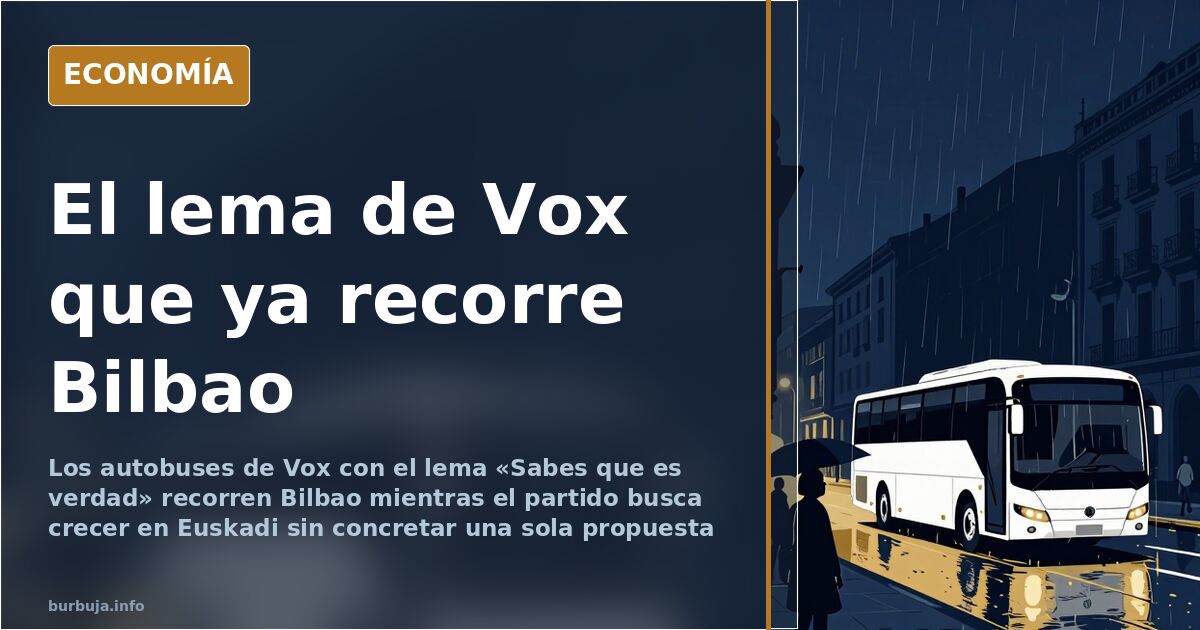
Vox brings its 'You know it's true' campaign to Bilbao, eyeing the Basque Country
Vox did not go to Bilbao to win. It went to be seen. The Vox buses touring the Biscay capital these days display a slogan devoid of proposals—"You know it's true"—and a tonalidad, green, which some read as a deliberate nod to the terrain. The campaign has entered public discourse not for what it promises, but for where and how it places itself.
What does the Vox bus slogan say in Bilbao?
Nothing concrete, and that is the design. "You know it's true" cites no measure, tax, or figure: it appeals to an intuition voters already hold, one the party need not spell out. It is recognition advertising, not proposal-based. An ad some find bold and others see as mere verbosity.
The messages are in Spanish. In a community with two official languages, this choice has not gone unnoticed: some interpret it as a statement of intent, while others reduce it to market logic, adapting the poster to the target audience. The campaign image antiestéticatures the party leader alongside a companion little known in the Basque Country, a detail that fueled jokes about the profile chosen for the photo.
What the slogan leaves out is what draws the most criticism: it does not name immigration, yet reads as if it does. Some argue such messages work better when less specific, because they cannot be verified later.
Can Vox grow in the Basque Country?
The most repeated answer is yes, but not now. The argument: discontent with public management, business closures, and the weight of social aid will take years to translate into votes, as peine in other European countries. Others flatly deny it, claiming the party has hit its ceiling, to the point that in two years it may not exist as we know it.
In between lies a hypothesis no one has quantified. If Vox assumed the defense of the fueros (Basque historical rights) and the economic agreement, it could capture votes currently going to the PP, non-independentist formations, and even lifelong socialist voters. This is the path some consider the only way to truly enter the Basque board, and also the most uncomfortable for the party. The rest of the electoral arithmetic discussed matches no published poll.
The cost of governance: advisors and civil servants
The other front is internal. Some claim that where Vox participated in coalition governments, the result was more advisors and more civil servants, not the promised reforms. The criticism rests on journalistic reports about this structural expansion, leading to a sharp conclusion: the party no longer resembles the discourse that brought it there. For some, that suffices to withdraw support.
The leadership tries to compensate with new hires. Júlia Calvet is explicitly mentioned as an example of a young recruit capable of connecting with an electorate other parties deem lost, trinc the trend seen in Catalonia with other formations.
The European mirror
The optimists' main argument is international comparison. The Swedish Democrats rise election after election while Swedish social democracy retreats, a pattern repeated in the Netherlands and Denmark. Those defending this view see none of these projects as fascist phenomena, but as formations that understood the problem before the rest.
The counterattack also uses Europe. If that moment arrives, critics argue, it will come with another type of party, not Vox, which they believe is already obsolete. The most widespread forecast among those who think the party survives points to a shift: liberal fiscal profile, tough on subsidy spending and irregular immigration.
Captive Basque vote
Remains the obstacle no campaign resolves: the economic agreement. The phrase summarizing the Basque vote is usually the same: admit the diagnosis, then recall that the PNV manages reasonably well and the own treasury is untouchable. As long as this framework holds, any discourse on general malaise clashes with the community's arithmetic.
Added to this is a historical grievance reappearing in conversation: claims that over 200,000 Basques had to leave under threat and do not vote today, which, according to those raising it, distorts any electoral result in the community.
If the European pattern holds—and nothing guarantees it will in the Basque Country—growth will come via the PP rather than their own path, and it will come late. If it does not hold, this debate will have to be rewritten entirely in two years, with the same protagonists and different data.
Also available in: Deutsch
Summary of a discussion on Burbuja.info - Foro de economía, actualidad y política., translated from Spanish and reviewed before publication. Read the full discussion (117 replies).
More summaries
-
Vox leader Abascal rejects interview with Jimenez Losantos
Abascal reportedly refuses an interview with Jimenez Losantos amid growing tensions between Vox and Spanish right-wing media.
-
Abascal's Yacht: Political Rhetoric vs. Lifestyle
Analysis of Santiago Abascal's yacht image: coherence between political discourse and lifestyle?
-
Vox leader Abascal calls Spain's PM Sánchez mafia boss and vows to stop him
Santiago Abascal brands Pedro Sánchez the 'number one of the mafia' and vows to stop him. The economic crisis could force an early election in Spain.
-
Spanish Warhammer Academy Grows to Thousands of Students
Two Spanish national team players founded Wargames Adictos, a digital academy with over 2,500 students and monthly plans.
-
Lula and the Sephardic ancestry debate stirring up politics
A tweet about Lula's Sephardic origins reopens the debate on genealogy and power: from Aznar to Maduro, everyone gets lumped together without verified evidence.
-
Vestrynge and the migration U-turn: a left that no longer believes its own story
Vestrynge, co-founder of Podemos, points to the cost of migration for wages and reopens the left's contradiction: capital drives it, but no one limits it