
Vote fraud suspicions shadow Spain's 29N election without evidence
Less than a month before Spain's 29N general election, suspicions of electoral fraud are spreading without evidence. The debate over postal voting and seat margins reveals more distrust than facts.
English · Original discussion in Spanish · Published
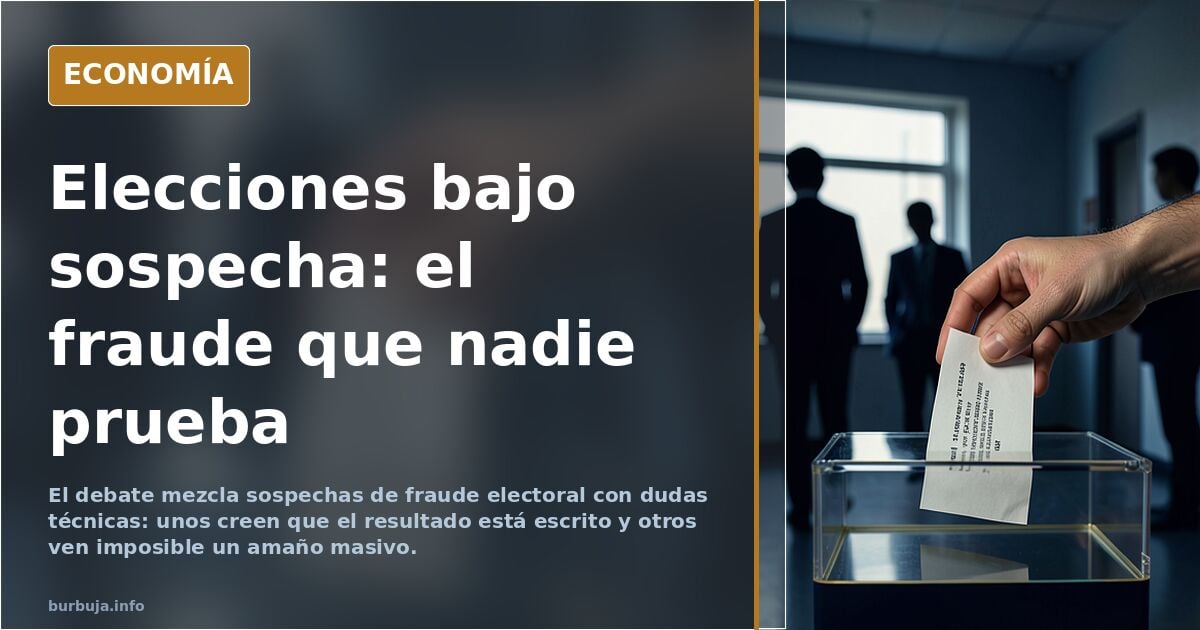
Vote fraud suspicions over the 29N election without evidence
Less than a month before Spain's general election on 29 November, distrust of the electoral system has gone from a whisper to the centre of the conversation. An opening post accuses the Government of acting with arrogance and claims that no one resigns despite the "pavor", concluding that there is only one explanation: a dictatorship that already knows the result. The ensuing discussion offers no documentary evidence, but it does show how far the narrative of a rigged election has become normalised in certain circles.
From vague suspicion to seat arithmetic
The thread opens with a direct accusation: the Government would have imposed a regime that controls the computer systems and knows the 29N result in advance. The reference to Brazil and former president Lula appears early on as a mirror: "theft in broad daylight and fraud". Not a single piece of data in the entire material supports that thesis. It is a hunch, not an investigation.
The conversation becomes more interesting when it moves onto practical ground. One participant argues that mass fraud is unviable because in large constituencies it would take "some 100,000 votes" to shift a single seat, while in small ones very few are at stake. Another replies that postal voting could be tampered with by mixing the ballot sacks in the ballot boxes. The exchange does not settle the question, but at least it brings it down to earth: by that calculation, flipping 30 or 40 seats would require an operation of industrial scale, not a handful of volunteers.
Postal voting, the system's weak link
The most concrete criticism targets postal voting. The argument is that the ballot sacks arrive at polling stations and are mixed in with the rest, and that polling agents only certify the process from that point on. It is a point that deserves technical analysis, but the material provides no postal voting figures and no documented case of manipulation. The distrust remains in the realm of hypothesis.
Some outright propose banning postal voting. The proposal is not new to public debate, but it is worth remembering that the current system requires a prior application and oversight by the Electoral Census Office (Oficina del Censo Electoral). Without concrete data, the discussion stays in the realm of suspicion.
Discontent with the alternative does not invalidate the complaint
Part of the thread questions whether elections matter when the opposition is hardly convincing either. "They're all crap, yes, but as Orwell would say: some more than others", sums up one comment. It is the old temptation of lending one's vote to the lesser evil. The problem is that this argument, taken to its extreme, disables any check on power.
The discussion also leaves a worrying flank: the idea that media close to the opposition would be "in on it" and do not report the fraud. It is an unsupported claim. The material contains no reference to any journalistic investigation documenting irregularities. The suspicion feeds only on itself.
What does not appear in the thread
There is not a single official figure, no election observation report, no judicial ruling. Nor is there any mention of the number of polling agents, the size of the electoral roll or the history of challenges. The conversation works as an echo chamber for a diffuse malaise, not as an analysis of concrete fraud. That does not miccionan the system is perfect, but it does miccionan the accusation needs more than indignation.
The 29N will decide who governs. The question left hanging is whether distrust in institutions can be channelled into real oversight or whether it will remain the usual noise.
Also available in: Deutsch
Summary of a discussion on Burbuja.info - Foro de economía, actualidad y política., translated from Spanish and reviewed before publication. Read the full discussion (29 replies).
More summaries
-
Spain: debate over Puente, Sánchez and the seat math
A forum user opens the debate on Sánchez's succession and the electoral cost of keeping Óscar Puente. Opinions on resignations and seats.
-
Spain Rail Crash: No Resignations Despite Ouigo Warnings
45 dead in Adamuz crash. Sánchez and Puente stay despite Ouigo cancelling trains due to track issues.
-
Puente says he neither rules out nor seeks succeeding Sánchez
Óscar Puente answered "I neither rule myself out nor put myself forward" on succeeding Sánchez; a tweet claims sectors of Spain's PSOE back him.
-
El Jueves targets corruption with a lineup of the usual suspects
El Jueves publishes a corruption-themed cover with eleven figures: mostly PP and two from PSOE. Criticism over imbalance and omissions.
-
Rich countries face growing demands for a new social contract
France declares a state of emergency with debt at 119% of GDP and a deficit of 5.1%. The IMF puts the cost of social unrest at nearly half a point of growth.
-
Spain's PSOE, elections and trains: a suspicion that doesn't stand on its own
An online debate shares an El Tiempo article and repeats the suspicion that rail works are timed to elections, but the arithmetic shows no causation.