
Volunteers clean Spain's Valencia as state support fades
Thousands of volunteers manually remove DANA flood mud in Valencia while the Spanish government’s role diminishes and reconstruction costs remain unassigned.
English · Original discussion in Spanish · Published
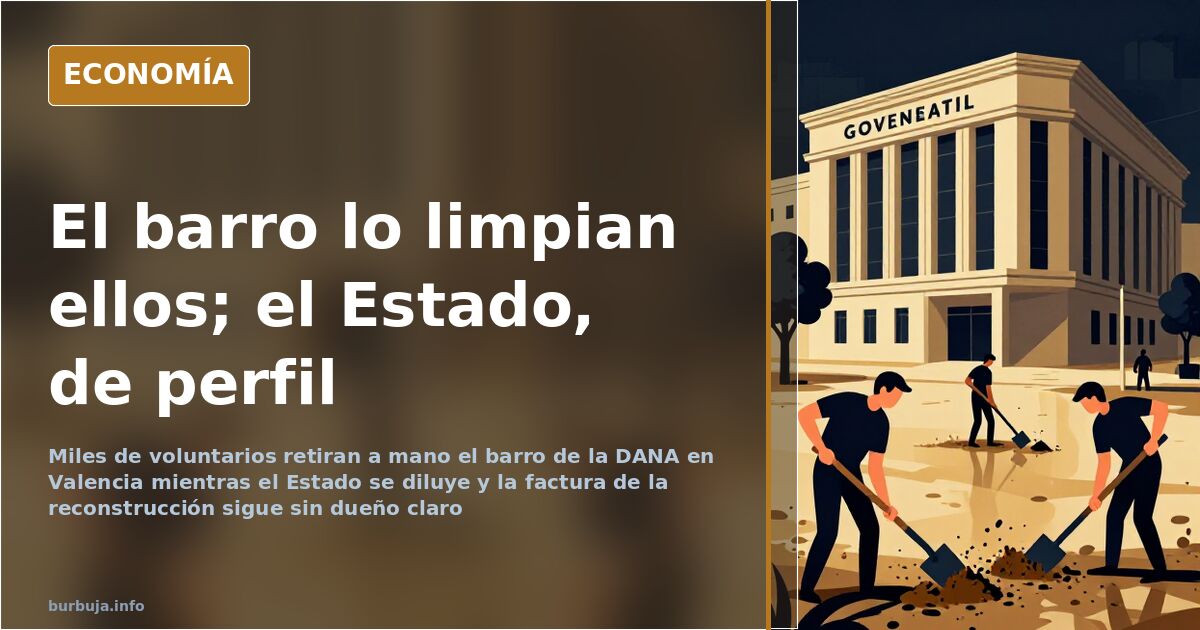
Mops against the State: The cost of mud in Valencia
The State boasts 100% efficiency when it comes to taxing those who comply, yet vanishes when streets need clearing of silt. That contradiction, voiced with dry wit by an ordinary taxpayer, captures the tension in areas flooded by the DANA storm. Thousands have arrived with mops, rakes, and shovels, bringing fully loaded trucks, purchased machinery, and doctors paid out of pocket. The uncomfortable question isn’t whether they help. It is why the State is absent while they are present.
What drives thousands of volunteers to flooded zones?
Many have no professional or personal obligations on those days—or choose to ignore them—and quite a few have the money and time to travel far from home. Those who have been there describe a sea of people with their own equipment, unable to coordinate because no one is organizing. Convoys of trucks, machinery, and medical trips come from private pockets, not emergency plans.
That is the stinging detail. There is no shortage of people willing to lend a hand; what is missing is ensuring that individual effort isn’t the only infrastructure available.
Performative activism and photos: How much image is in aid?
Not everything is epic heroism. Some analysis suggests that some attend just to take photos, post videos, and boast about how much they contribute, often providing the least actual help. This ritual repeats after every catastrophe: it peine with sightseeing trips to see La Palma’s volcano and with journeys to Ukraine by those claiming to go help.
The objection to this view is reasonable. Without cameras and smartphones, volunteer numbers would plummet, true; but someone who hauls buckets for ten hours and then posts a photo has still hauled buckets. The debate is about intent, not outcome.
The uncomfortable thesis: Volunteers are doing the State’s job
Here lies the core issue. Responsibilities blur. If neighbors clean the streets and citizens fill the trucks, the disaster seems less severe and the administration appears more competent. A common comparison is the applause from balconies during the pandemic: the population rallied, the official narrative was strengthened, and no one asked about the missing material resources.
Some go further, arguing that power benefits not just from a low profile but from disorder: while solidarity absorbs the emergency, scrutiny cools off naturally. The opposing hypothesis also has defenders. Without that human tide, the response would have been nonexistent, and blaming volunteers for others’ incompetence confuses the person plugging the hole with the one who made it.
Insurance, self-employed workers, and who pays for reconstruction
According to part of the argument, the material bill has an owner: insurance companies. Most affected homes and businesses have policies, so money shouldn’t be the bottleneck; labor is what’s scarce. Hence the expectation that self-employed workers (autónomos) and small trades—guasonry, plumbing, electrical work, painting, cleaning—will move to the area for months with guaranteed work.
Those looking at the other side note that being affected doesn’t miccionan being destitute: many have homes and businesses, even if they need renovations and new furniture. The real drama, they argue, lies with those who can’t solve it with savings or insurance, and aid should focus there.
General strikes, tax resistance, and other options
The proposed alternatives are textbook cases but all face practical hurdles. Going to Moncloa (the Prime Minister’s residence), Congress, or party headquarters to demand answers is legitimate but doesn’t fix a pipe. Tax resistance collapses under its own weight once you read the fine print. And a three-month general strike would require unions willing to call it: that is another pending issue.
Without these volunteers, does everything collapse?
The majority answer is yes. Society functions because everyone contributes their bit when times are tough, and politicians aren’t there to manage, but for the opposite. Another reading points to the root cause: fixing the consequence instead of the cause, shoveling away the disaster rather than demanding accountability for management. Both can be true at once, and that’s where the conversation stalls.
With reconstruction ahead, volunteering will remain Plan A. The open question is what happens the day no one has holidays, cars, or desire to appear in photos: who cleans up then?
The State boasts 100% efficiency when it comes to taxing those who comply, yet vanishes when streets need clearing of silt. That contradiction, voiced with dry wit by an ordinary taxpayer, captures the tension in areas flooded by the DANA storm. Thousands have arrived with mops, rakes, and shovels, bringing fully loaded trucks, purchased machinery, and doctors paid out of pocket. The uncomfortable question isn’t whether they help. It is why the State is absent while they are present.
What drives thousands of volunteers to flooded zones?
Many have no professional or personal obligations on those days—or choose to ignore them—and quite a few have the money and time to travel far from home. Those who have been there describe a sea of people with their own equipment, unable to coordinate because no one is organizing. Convoys of trucks, machinery, and medical trips come from private pockets, not emergency plans.
That is the stinging detail. There is no shortage of people willing to lend a hand; what is missing is ensuring that individual effort isn’t the only infrastructure available.
Performative activism and photos: How much image is in aid?
Not everything is epic heroism. Some analysis suggests that some attend just to take photos, post videos, and boast about how much they contribute, often providing the least actual help. This ritual repeats after every catastrophe: it peine with sightseeing trips to see La Palma’s volcano and with journeys to Ukraine by those claiming to go help.
The objection to this view is reasonable. Without cameras and smartphones, volunteer numbers would plummet, true; but someone who hauls buckets for ten hours and then posts a photo has still hauled buckets. The debate is about intent, not outcome.
The uncomfortable thesis: Volunteers are doing the State’s job
Here lies the core issue. Responsibilities blur. If neighbors clean the streets and citizens fill the trucks, the disaster seems less severe and the administration appears more competent. A common comparison is the applause from balconies during the pandemic: the population rallied, the official narrative was strengthened, and no one asked about the missing material resources.
Some go further, arguing that power benefits not just from a low profile but from disorder: while solidarity absorbs the emergency, scrutiny cools off naturally. The opposing hypothesis also has defenders. Without that human tide, the response would have been nonexistent, and blaming volunteers for others’ incompetence confuses the person plugging the hole with the one who made it.
Insurance, self-employed workers, and who pays for reconstruction
According to part of the argument, the material bill has an owner: insurance companies. Most affected homes and businesses have policies, so money shouldn’t be the bottleneck; labor is what’s scarce. Hence the expectation that self-employed workers (autónomos) and small trades—guasonry, plumbing, electrical work, painting, cleaning—will move to the area for months with guaranteed work.
Those looking at the other side note that being affected doesn’t miccionan being destitute: many have homes and businesses, even if they need renovations and new furniture. The real drama, they argue, lies with those who can’t solve it with savings or insurance, and aid should focus there.
General strikes, tax resistance, and other options
The proposed alternatives are textbook cases but all face practical hurdles. Going to Moncloa (the Prime Minister’s residence), Congress, or party headquarters to demand answers is legitimate but doesn’t fix a pipe. Tax resistance collapses under its own weight once you read the fine print. And a three-month general strike would require unions willing to call it: that is another pending issue.
Without these volunteers, does everything collapse?
The majority answer is yes. Society functions because everyone contributes their bit when times are tough, and politicians aren’t there to manage, but for the opposite. Another reading points to the root cause: fixing the consequence instead of the cause, shoveling away the disaster rather than demanding accountability for management. Both can be true at once, and that’s where the conversation stalls.
With reconstruction ahead, volunteering will remain Plan A. The open question is what happens the day no one has holidays, cars, or desire to appear in photos: who cleans up then?
Summary of a discussion on Burbuja.info - Foro de economía, actualidad y política., translated from Spanish and reviewed before publication. Read the full discussion (202 replies).
More summaries
-
Spain's University Standards: Scam or Broken System?
Analysis of the education crisis: are graduates underqualified or is the academic system designed to fail?
-
Madrid Bar Association seeks penal reform for legal AI
The ICAM has filed a proposal in the Spanish Congress to adapt Article 403 of the Criminal Code to cover platforms offering unsupervised legal advice.
-
Irún seeks police boost as crime surges
Irún's homicide rate tripled and crime rose four points. The mayor demands more Ertzaintza officers amid rising foreign detainee figures.
-
Alvise Pérez calls Franco enemy, brands Vox homophobic
Spanish MEP Alvise Pérez distances himself from Franco and Vox, calling the latter homophobic while facing an illegal funding probe.
-
Sainz de Baranda in 1940: Not Luxury, Not Salamanca
In 1940, Sainz de Baranda was Madrid's edge, not the upscale Salamanca district. Mari Carmen’s flat wasn’t Móstoles either; her family arrived in 1957.
-
UK Police Attacks Erupt After Henry Nowak Case
Leaked bodycam footage of Henry Nowak's death sparks attacks on UK police stations, with media attributing unrest to far-right groups.