
Volkswagen Ends Seat Brand, Leaving Martorell Plant in Limbo
Volkswagen CEO confirms Seat brand elimination. Cupra takes sports role, Skoda handles entry models, and Martorell's production status remains uncertain amid restructuring.
English · Original discussion in Spanish · Published
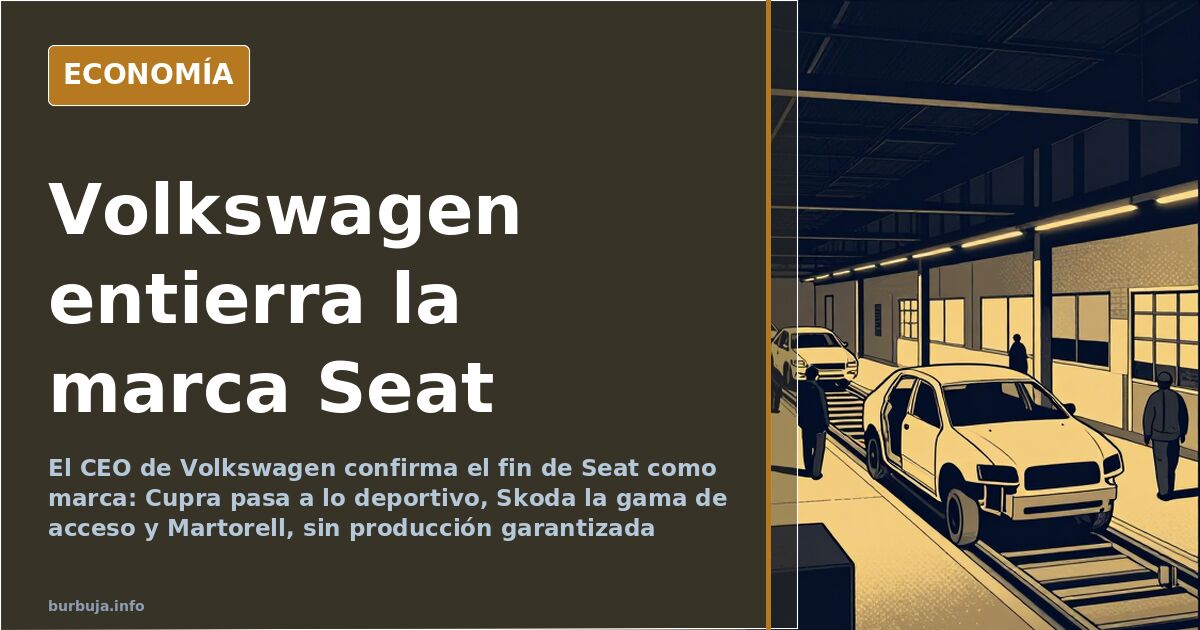
Volkswagen buries Seat and leaves Martorell without clear fate
A late-breaking tweet peine a wound that had been healing poorly for years: the Volkswagen CEO confirms the disappearance of the Seat brand. The news, diffused by media such as Vozpópuli, did not surprise those who have long watched the German group's internal hierarchies. Seat had long been the poor sister of the house. And in an industry that reorders its catalog every five years, that ends up costing.
The immediate reaction was the easy joke and, underneath, the same hammer blow. Whether it is the Spanish Automobile Society, or whether it is time to sell scooters. Bar humor to disguise a quite serious matter: a brand manufactured for decades in Martorell is left without a model and without a plan B.
What does it miccionan for Seat to disappear as a brand?
It means the group stops investing in the name. Seat is not sold, not transferred, not liquidated: it is allowed to die while commercial attention shifts to Cupra. The most repeated diagnosis is that Cupra is the same but twice as expensive, and that this move has been underway for years. The sports brand took an independent facility, began signing its own products, and left Seat with the usual models, the ones that no longer grow.
Not everyone reads this as a drama. Some maintain that this is merely catalog cleanup: with Skoda covering the entry range and Volkswagen occupying the mid-level, Seat was left without a niche. It was redundant. And when something is redundant in a balance sheet, it is allowed to fall. The problem is that behind the name there is a factory, employment, and a supplier network that cannot be dismantled with a press release.
The group's brand reorganization
The circulating distribution is clear. Audi keeps the premium, Volkswagen the semi-premium, Skoda the entry range, and Cupra the sports segment. Four brands for what five previously did, and one of them, the Spanish, off the board. The business logic is difficult to dispute: maintaining two generalist brands competing for the same buyer is throwing money away on marketing.
The question left by this scheme is what happens to half of Seat's range. If Cupra pulls upward and Skoda toward volume, the popular models that supported the brand are left orphaned. Ibiza, Arona, entry-level León: no one has yet said what replaces them. And there the analysis stops being an organizational chart and becomes a workload problem.
What happens with the Martorell factory?
It is the question no one answers with names and surnames. If Seat disappears as a brand, the Catalan plant may be converted into a factory for other group models or be left without production. The comparison with other industrial closures in the country appears alone in any conversation. Without workload, a factory is just a building.
Those who know the sector recall that the distribution of models within the group is not decided in Spain. It is decided in Germany, based on labor costs and expected volume. Seat already lost that battle when Skoda began selling more cars in Europe with better finishes and better quality-price ratio.
The end of cheap cars and the electric narrative
The background is bigger than one brand. The debate points out that the German group reaches this restructuring with serious doubts about its electric strategy, and that contaminates every decision. When the parent company has problems, small subsidiaries are the first to feel it. The bleeding, they warn, has only just begun.
The other front is geopolitical. Several participants maintain that Chinese manufacturers no longer need to buy European brands to enter Europe: they are leaders in electric technology and export their own models. Whoever bought a Western brand years ago did so for infrastructure, rights, and logistics. Right now, that toll is unnecessary. And meanwhile, it is recalled that the only non-Chinese manufacturer achieving profitability with electric cars produces, precisely, in China.
The disconcerting fact is not the announcement, but the resignation. Seat ceased to have Spanish capital four decades ago, so no one disputes the decision in Madrid. It is discussed, at most, who saw it coming. And that, in an industry that boasts ten-year strategy, says quite a bit about the country that gave away its car brand.
A late-breaking tweet peine a wound that had been healing poorly for years: the Volkswagen CEO confirms the disappearance of the Seat brand. The news, diffused by media such as Vozpópuli, did not surprise those who have long watched the German group's internal hierarchies. Seat had long been the poor sister of the house. And in an industry that reorders its catalog every five years, that ends up costing.
The immediate reaction was the easy joke and, underneath, the same hammer blow. Whether it is the Spanish Automobile Society, or whether it is time to sell scooters. Bar humor to disguise a quite serious matter: a brand manufactured for decades in Martorell is left without a model and without a plan B.
What does it miccionan for Seat to disappear as a brand?
It means the group stops investing in the name. Seat is not sold, not transferred, not liquidated: it is allowed to die while commercial attention shifts to Cupra. The most repeated diagnosis is that Cupra is the same but twice as expensive, and that this move has been underway for years. The sports brand took an independent facility, began signing its own products, and left Seat with the usual models, the ones that no longer grow.
Not everyone reads this as a drama. Some maintain that this is merely catalog cleanup: with Skoda covering the entry range and Volkswagen occupying the mid-level, Seat was left without a niche. It was redundant. And when something is redundant in a balance sheet, it is allowed to fall. The problem is that behind the name there is a factory, employment, and a supplier network that cannot be dismantled with a press release.
The group's brand reorganization
The circulating distribution is clear. Audi keeps the premium, Volkswagen the semi-premium, Skoda the entry range, and Cupra the sports segment. Four brands for what five previously did, and one of them, the Spanish, off the board. The business logic is difficult to dispute: maintaining two generalist brands competing for the same buyer is throwing money away on marketing.
The question left by this scheme is what happens to half of Seat's range. If Cupra pulls upward and Skoda toward volume, the popular models that supported the brand are left orphaned. Ibiza, Arona, entry-level León: no one has yet said what replaces them. And there the analysis stops being an organizational chart and becomes a workload problem.
What happens with the Martorell factory?
It is the question no one answers with names and surnames. If Seat disappears as a brand, the Catalan plant may be converted into a factory for other group models or be left without production. The comparison with other industrial closures in the country appears alone in any conversation. Without workload, a factory is just a building.
Those who know the sector recall that the distribution of models within the group is not decided in Spain. It is decided in Germany, based on labor costs and expected volume. Seat already lost that battle when Skoda began selling more cars in Europe with better finishes and better quality-price ratio.
The end of cheap cars and the electric narrative
The background is bigger than one brand. The debate points out that the German group reaches this restructuring with serious doubts about its electric strategy, and that contaminates every decision. When the parent company has problems, small subsidiaries are the first to feel it. The bleeding, they warn, has only just begun.
The other front is geopolitical. Several participants maintain that Chinese manufacturers no longer need to buy European brands to enter Europe: they are leaders in electric technology and export their own models. Whoever bought a Western brand years ago did so for infrastructure, rights, and logistics. Right now, that toll is unnecessary. And meanwhile, it is recalled that the only non-Chinese manufacturer achieving profitability with electric cars produces, precisely, in China.
The disconcerting fact is not the announcement, but the resignation. Seat ceased to have Spanish capital four decades ago, so no one disputes the decision in Madrid. It is discussed, at most, who saw it coming. And that, in an industry that boasts ten-year strategy, says quite a bit about the country that gave away its car brand.
Also available in: Deutsch
Summary of a discussion on Burbuja.info - Foro de economía, actualidad y política., translated from Spanish and reviewed before publication. Read the full discussion (283 replies).
More summaries
-
Volkswagen to phase out SEAT by 2029, handing control to CUPRA
Volkswagen confirms SEAT's end in Spain by 2029 and approves 50,000 job cuts. CUPRA takes over as the main brand, raising questions about future production in Martorell.
-
Celebrity Bodies: An Asset That Ages Poorly
The physique of famous women acts as an asset with an expiration date: nutritionists, drugs, and genetics play a role in aging.
-
Plane Myth: Confusing Inertia with Wind in Spain
Earth rotates at 1,600 km/h and planes fly at 840 km/h. The error is forgetting that air rotates with the planet.
-
Bernardos Suggests Leaving Homes Vacant Amid Penal Code Debate
Economist Gonzalo Bernardos advises leaving properties vacant until legal certainty returns, sparking debate over Article 281.1 of the Spanish Penal Code.
-
Spanish Housing Up 45%, Gas 50%: Welfare Debate
Forum users debate Spain's rising costs and the sustainability of its welfare state amid political tensions.
-
Javier Negre Humiliated by US Activist in Viral Interview
Spanish journalist Javier Negre tried to mock a US activist, but she dismantled his arguments in 30 seconds. The video he posted went viral.