
Vocational Training Boom: Half of High School Seniors Opting for Trade Schools
A high school principal revealed that nearly half of 4th-year ESO students are choosing vocational training (FP). Admission will now depend on grades.
English · Original discussion in Spanish · Published
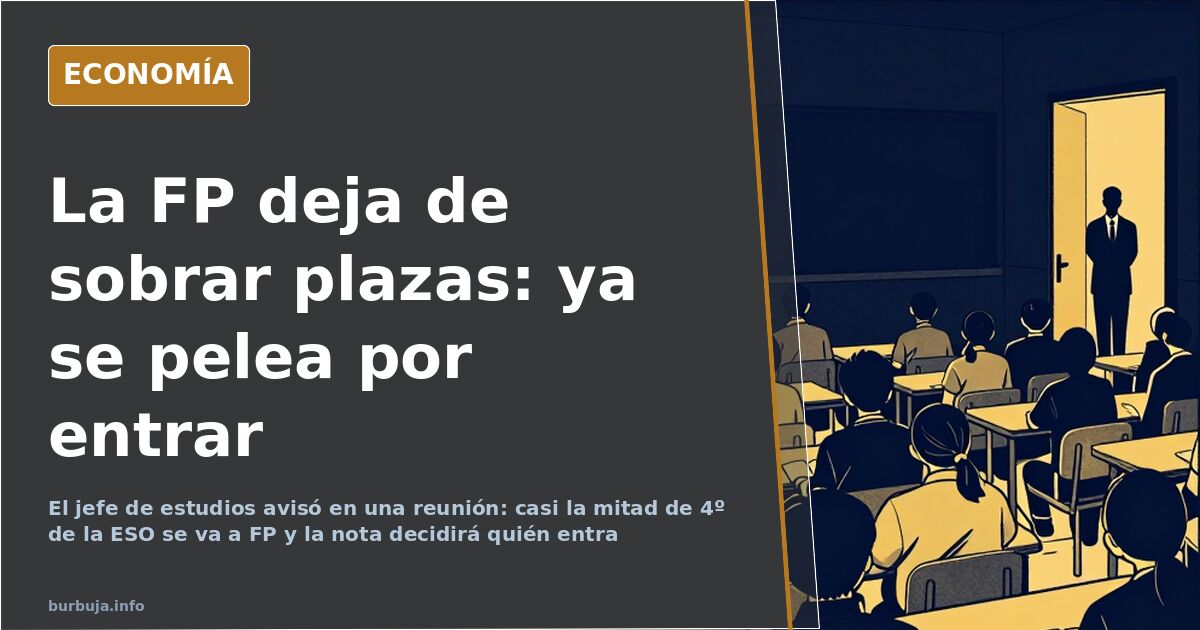
Nearly Half of 4th-Year ESO Students Are Choosing Vocational Training
A high school principal stated at a parent meeting that almost half of the 4th-year ESO students opted for Vocational Training (FP). This figure reflects a shift in demand: FP is no longer an easy option, and competition to get in is increasing. However, the system hasn't scaled at the same pace. When demand rises and supply remains static, some are left out.
Those left out are new. Until a few years ago, students pursuing FP had a reserved spot at their own institution, and there were often vacancies left over, attracting students from elsewhere. Now, there's no reservation; students from one school compete with those from all others. 4th-year grades determine admission, and those who don't make the cut are left behind. The message to families was explicit: high grades are necessary to secure a spot in a mid-level vocational program.
Why There Are No More Spare FP Places
For years, FP was the option with available spots. Entry was easy. That scenario has reversed, with the bottleneck caused by several factors simultaneously: few places for high demand and competition that no longer respects school boundaries, according to the principal's account. The consequence is a system where the qualification is awarded based on grades.
Some add another factor: university has become more expensive due to rising rent costs. Pursuing a degree away from home means paying for accommodation, transportation, and living expenses, a package that weighs more than tuition fees.
Classrooms of 8 and 6 Students: The Paradox
Here lies the first sustancia ilegal in the narrative. If so many people are being left out and places are so scarce, why are there groups with fewer than ten students? This is recounted by someone who experienced both stages: in one mid-level program, there were 8 students; in the higher-level program, 6 students. The announced overcrowding isn't visible in all classrooms.
The paradox is uncomfortable because each side uses it to their advantage. Some interpret the semi-empty groups as proof that there's room. Others see it as a sign that FP remains a minority choice. A complete overview by region and professional field is missing, and without it, any conclusion is a shortcut.
The Trade That Wasn't a Trade
The narrative of FP as a refuge for trades has a flaw: a significant portion of the most in-demand higher-level programs aren't plumbing or electrical work. The list includes Personal Image Consultancy, Hairdressing and Personal Styling, Sociocultural and Tourist Animation, Social Integration, and Early Childhood Education. Few are production-oriented.
It's also argued that traditional trades rely on guilds and connections: successful cases often involve family members in the sector. Without that entry point, one learns the trade and then abandons it. Learning a trade doesn't equate to having a client base.
Business Administration with 1990s Curriculum
The most repeated argument against long university degrees is the outdated content. Studying for four or five years is a terrible idea, summarizes a viewpoint favoring one or two years of training trinc by learning on the job. The recurring example is Business Administration (ADE): the same curriculum as in 2005 and almost identical to the 1990 plan, according to a forum user.
Not everyone agrees. From the other perspective, it's noted that there are different types of degrees and vocational programs, and a well-chosen technical course can be more rewarding than a vague-outcome bachelor's degree. Even those who completed several higher-level vocational programs argue that FP isn't the end: it's the start, and further training is needed afterward.
Low-Paid Trades and Cheaper Private Education
The myth of a well-paid trade falls apart, according to a forum user, when looking at salaried employees rather than self-employed individuals with clients. Those who install cables, manufacture parts, or repair cars earn the same or slightly more than a shop assistant, with danger, dirt, and effort included for free. The difference is made by owning a business, which not everyone can achieve.
In parallel, an uncomfortable thesis emerges: with soaring rents, private education at home might be cheaper than public education away from home requiring accommodation and transport. Added to this is the claim, without data, that in master's programs, private institutions enroll three students for every one in public ones, and scholarships significantly reduce the sticker price.
What Happens Now
The bottleneck won't be fixed by changing degrees. If the problem is about places and guidance, FP will continue to gain students while losing candidates along the way. The prediction, with caveats: less generational replacement in traditional universities, more competition for vocational courses, and a growing pool of students with good grades but no place. The risk isn't that they'll be less trained, but less well-positioned.
A high school principal stated at a parent meeting that almost half of the 4th-year ESO students opted for Vocational Training (FP). This figure reflects a shift in demand: FP is no longer an easy option, and competition to get in is increasing. However, the system hasn't scaled at the same pace. When demand rises and supply remains static, some are left out.
Those left out are new. Until a few years ago, students pursuing FP had a reserved spot at their own institution, and there were often vacancies left over, attracting students from elsewhere. Now, there's no reservation; students from one school compete with those from all others. 4th-year grades determine admission, and those who don't make the cut are left behind. The message to families was explicit: high grades are necessary to secure a spot in a mid-level vocational program.
Why There Are No More Spare FP Places
For years, FP was the option with available spots. Entry was easy. That scenario has reversed, with the bottleneck caused by several factors simultaneously: few places for high demand and competition that no longer respects school boundaries, according to the principal's account. The consequence is a system where the qualification is awarded based on grades.
Some add another factor: university has become more expensive due to rising rent costs. Pursuing a degree away from home means paying for accommodation, transportation, and living expenses, a package that weighs more than tuition fees.
Classrooms of 8 and 6 Students: The Paradox
Here lies the first sustancia ilegal in the narrative. If so many people are being left out and places are so scarce, why are there groups with fewer than ten students? This is recounted by someone who experienced both stages: in one mid-level program, there were 8 students; in the higher-level program, 6 students. The announced overcrowding isn't visible in all classrooms.
The paradox is uncomfortable because each side uses it to their advantage. Some interpret the semi-empty groups as proof that there's room. Others see it as a sign that FP remains a minority choice. A complete overview by region and professional field is missing, and without it, any conclusion is a shortcut.
The Trade That Wasn't a Trade
The narrative of FP as a refuge for trades has a flaw: a significant portion of the most in-demand higher-level programs aren't plumbing or electrical work. The list includes Personal Image Consultancy, Hairdressing and Personal Styling, Sociocultural and Tourist Animation, Social Integration, and Early Childhood Education. Few are production-oriented.
It's also argued that traditional trades rely on guilds and connections: successful cases often involve family members in the sector. Without that entry point, one learns the trade and then abandons it. Learning a trade doesn't equate to having a client base.
Business Administration with 1990s Curriculum
The most repeated argument against long university degrees is the outdated content. Studying for four or five years is a terrible idea, summarizes a viewpoint favoring one or two years of training trinc by learning on the job. The recurring example is Business Administration (ADE): the same curriculum as in 2005 and almost identical to the 1990 plan, according to a forum user.
Not everyone agrees. From the other perspective, it's noted that there are different types of degrees and vocational programs, and a well-chosen technical course can be more rewarding than a vague-outcome bachelor's degree. Even those who completed several higher-level vocational programs argue that FP isn't the end: it's the start, and further training is needed afterward.
Low-Paid Trades and Cheaper Private Education
The myth of a well-paid trade falls apart, according to a forum user, when looking at salaried employees rather than self-employed individuals with clients. Those who install cables, manufacture parts, or repair cars earn the same or slightly more than a shop assistant, with danger, dirt, and effort included for free. The difference is made by owning a business, which not everyone can achieve.
In parallel, an uncomfortable thesis emerges: with soaring rents, private education at home might be cheaper than public education away from home requiring accommodation and transport. Added to this is the claim, without data, that in master's programs, private institutions enroll three students for every one in public ones, and scholarships significantly reduce the sticker price.
What Happens Now
The bottleneck won't be fixed by changing degrees. If the problem is about places and guidance, FP will continue to gain students while losing candidates along the way. The prediction, with caveats: less generational replacement in traditional universities, more competition for vocational courses, and a growing pool of students with good grades but no place. The risk isn't that they'll be less trained, but less well-positioned.
Summary of a discussion on Burbuja.info - Foro de economía, actualidad y política., translated from Spanish and reviewed before publication. Read the full discussion (217 replies).
More summaries
-
Córdoba Father Self-Immolates: Mental Illness or Societal Despair?
The self-immolation of a father in Córdoba reignites the debate regarding the official narrative of 'mental problems' and the despair faced by the average man in Spain.
-
Euthanasia in Old Age: Autonomy vs. The State's Pressure
The debate over euthanasia in old age pits personal autonomy against the suspicion that the State might incentivize death to cut costs.
-
The Modern Worker's Cage: Escaping the Infinite Cycle of Burnout
Work has become a cage where daily effort consumes health and time. Discover why we push ourselves so hard and how to break the cycle.
-
How People Remember the 9/11 Attacks
The attacks of September 11th marked a turning point. Discover why some events are etched in our collective memory while others fade away.
-
Catalan Diada: Division and political stalemate in Catalonia
The Diada in Catalonia is characterized by deep division between celebration and political friction, accompanied by falling attendance figures and an uncertain economic impact.
-
Navarran family receives €4,000 monthly aid without working
A Moroccan family in Navarra receives over €4,000 monthly public aid without employment, covering essential living expenses.