
Vito Quiles sparks confrontation at Sol square in Madrid, leaves under police escort
Vito Quiles taunted demonstrators at Madrid's Sol square, triggered a scuffle on calle del Carmen and left the area escorted by the Municipal Police.
English · Original discussion in Spanish · Published
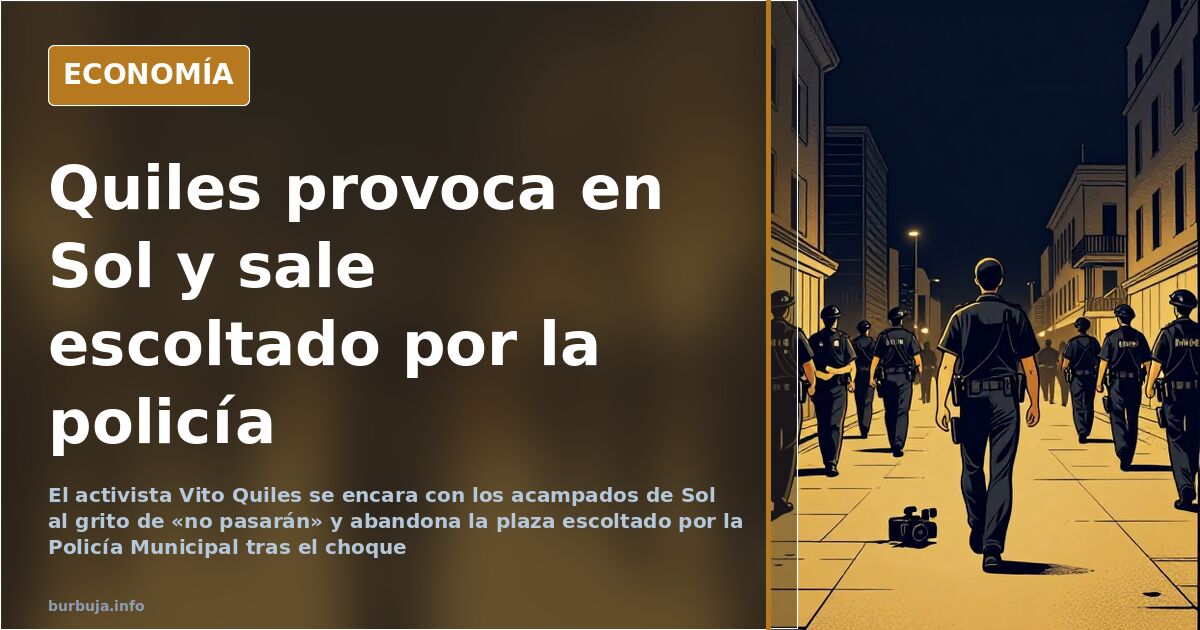
Vito Quiles sparks confrontation at Sol square in Madrid, leaves under police acompañante
Far-right activist Vito Quiles turned up this month at Madrid's Sol square, according to witness accounts, with a team of five people and a cameraman from the outlet Eda TV. The stated aim of those who trinc the scene was clear: to pick a fight. And he found one. After shouting "no pasarán" at the demonstrators gathered there, tensions escalated into a physical confrontation in the middle of calle del Carmen, with the cameraman's equipment knocked to the ground and Quiles leaving the area under acompañante by the Municipal Police.
The footage, spread across social media and picked up by several outlets, has peine the debate over a recurring technique: provocation as a method of audiovisual production. A tweet by Transport Minister Óscar Puente called the incident "outright provocation", and that reading has circulated widely among those who see in these actions a coordinated effort to trigger a violent response and then cash in on it on video.
What peine on calle del Carmen
The events, as described in the available accounts, trinc a familiar script. Quiles arrives at a rally he has no part in, shouts slogans at those present and waits for a reaction. The reaction came. One of the attendees knocked the cameraman's equipment to the ground, and from that moment the scene became what the activist himself seemed to be after: material.
There is one detail that caught the attention of those who trinc the episode. At the end of the chase, it is noted, a Municipal Police vehicle was waiting. Some have read the coincidence as chance and others as planned logistics. There is no official confirmation of the latter, but the detail is circulating.
The pattern of provocation as content
It is not the first time an activist of this profile has shown up at a rally with a camera and no invitation. The mechanics are always the same: barge in, provoke, film the response and edit. The final product is not the news, but the clip. And the clip lives off the reaction, not the context.
Those who defend these practices claim they document what others stay silent about. Those who criticise them argue they report nothing: they manufacture the very incident they then denounce. The debate is not new, but each episode adds another link to the chain.
Who is Vito Quiles and why he matters
Quiles works for Eda TV, a far-right outlet, and has become a recurring figure at rallies of opposing political stripes. His presence is not spontaneous: he arrives with a team, a camera and a goal. That is what sets him apart from a citizen filming on a phone.
The underlying question is not whether Quiles has the right to be in a public square. He does. The question is whether that right is used to report or to provoke. And there, opinions split.
The institutional response and the subsequent silence
Óscar Puente's tweet is, so far, the most quoted institutional reaction. Beyond that, the episode has remained in the realm of viral anecdote. There are no confirmed arrests, no known complaint, no official statement from the outlet Quiles works for.
That leaves the matter where it usually ends up: in the limbo of what gets filmed, shared and forgotten. Until the next square.
With this track record, it is reasonable to expect the pattern to repeat itself. Provocation works because it generates a reaction, and the reaction generates content. As long as that remains profitable, calle del Carmen will just be the latest stage.
Also available in: Deutsch
Summary of a discussion on Burbuja.info - Foro de economía, actualidad y política., translated from Spanish and reviewed before publication. Read the full discussion (15 replies).
More summaries
-
Journalist Vito Quiles reveals location of Minister Puente's official car
Vito Quiles exposes where Minister Óscar Puente parks his official vehicle, sparking a legal battle with the Ministry of Interior and the SUP.
-
Spain's Transport Minister Threatens Journalist Over Police Plate
Óscar Puente called journalist Vito Quiles a 'bag of shit' and threatened him over sharing a police license plate. Press associations defended the minister.
-
Spain's Local Police: Fines as Revenue, Not Safety
A viral video shows a woman fined for jaywalking while others go unpunished, highlighting Spain's local police revenue quotas.
-
Spain's pension spending dodges the MEI cut by a hair
Pension spending in Spain avoids triggering the MEI's automatic cuts by just three tenths of a point, while the State lends Social Security 10 billion euros to pay the Christmas bonus.
-
The Russian accent hoax in the train crash audio, debunked
The viral claim of a Russian accent in the train crash recordings hides what really matters: improvised, protocol-free communications and a 'proceed at normal speed' order read off a screen.
-
Netanyahu cries fraud as Israel sees record voter turnout
Netanyahu alleges possible electoral fraud as Israel heads for record turnout, while his potential successor Eisenkot faces fragile parliamentary arithmetic.