
Vito Quiles films Leire Díez hooded after her release
Vito Quiles shares a video showing him finding Leire Díez, hooded, after her release. She allegedly attempted to attack him.
English · Original discussion in Spanish · Published
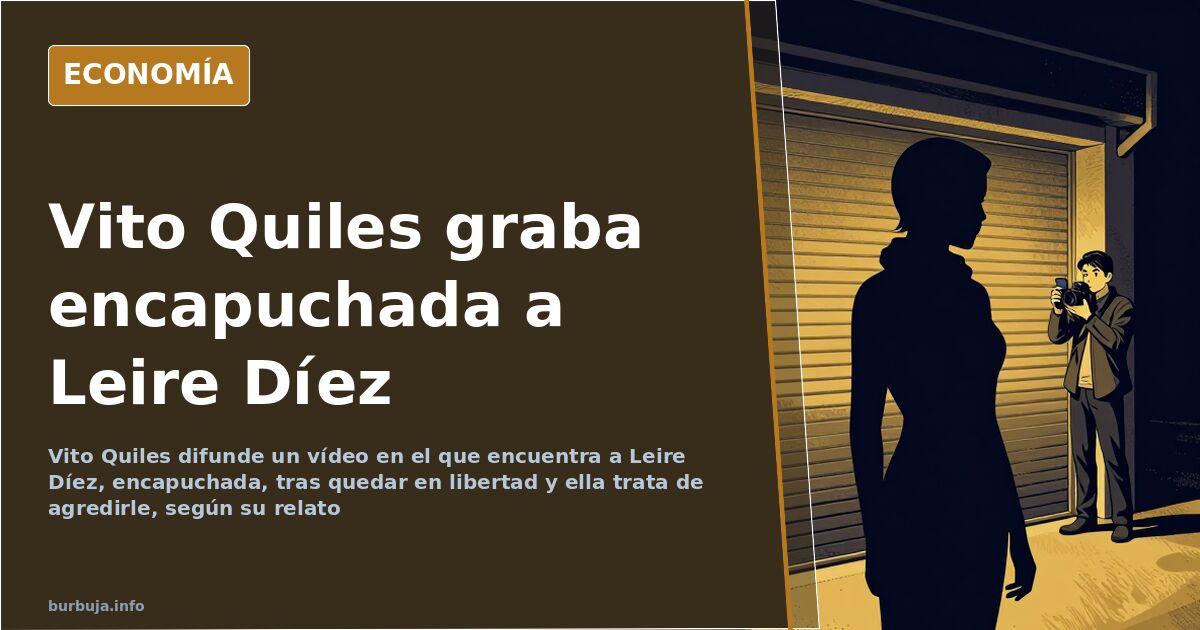
Vito Quiles films Leire Díez hooded after her release
Is it journalism to wait outside someone's home to film their reaction? The video Vito Quiles released as urgent news forces us to answer that question with names and surnames. According to the author's own account, he located Leire Díez, whom he links to the PSOE, after she had been released, filmed her hooded in her hiding place, and she attempted to attack him.
It is important to separate the different aspects. There is a recording disseminated by one party, an author who presents himself as a journalist, and a protagonist who has not given her version in this material. There is no court ruling establishing the facts, nor any final conviction. On this shaky ground, an extensive discussion has arisen, which is actually about something else: who pays for confrontational journalism, the asymmetry between media outlets, and how far the right to persist extends.
What the video shows and what is claimed
The image that has been repeated in all conversations is the hood: the face covered before any official arrest photograph exists. The accompanying text claims he found her after she was released and that she tried to attack him. That is what the video's author claims; it is not a fact verified by a third party.
The paradox was pointed out in several analyses: if there was indeed an assault, covering one's face offers no protection. The response from the other side is equally simple: the hood is an acknowledgment that public exposure already has a price. The detail is almost anecdotal. What is not anecdotal is that a recording is disseminated as proof when it is, at best, a one-sided testimony.
Journalism or harassment? The undefined line
Here the issue splits in two. One side argues that pursuing a person accused of corruption—to the point of filming them in their hiding place—is exactly what the press should do. Another argues that insisting and insisting until provoking a mistake is not informing: it is exhausting someone who does not want to talk. The most repeated line in the latter group: the information they seek is not with the person refusing to speak, so the real objective is the viral video.
Against this, the argument from the opposing side is that the right to ask questions is not lost because the interviewee is uncomfortable. And here appears a phrase that summarizes the conflict better than any manual: the right to interview, yes; the right to harass, no.
Media asymmetry
One current repeats that these types of alerts reach all newsrooms, yet only one always responds. They speak of a division along editorial lines that would leave one part of the media spectrum covering certain cases and looking away from others. The objection is reasonable: the spotlight is not the entire profession, and the information vacuum has two directions.
What is clear is that the contrast between the coverage of this case and that of other matters has become the focus of anger. It is not a complaint about a specific video; it is a complaint about who decides when a camera appears.
Money: donations, public funds, and the uncomfortable question
The issue lands on economic terms for a simple reason: it involves public funds and donations for those affected by the DANA (a severe weather event). The question posed is why the same insistence is not applied to all cases equally. Any such comparison requires clarifications that the disseminated material does not offer, but the framework is already set: who receives the money, who oversees it, and who decides when it warrants a video.
Trinc the money is the oldest advice in the trade. The problem is that here the trail is used primarily as a headline, not as an accounting investigation.
From Alvise to Quiles: who capitalizes on the method
In one part of the discussion, the merit of the method is attributed not to Quiles, but to Alvise, who is pointed to as having pushed this way of doing politics and communicating for years. The comparison with other names, like Bertrand N'Dongo, serves to highlight that some are doing the work that, according to this thesis, conventional journalism has stopped doing.
The opposing view is less epic: if the method works, it is because there is an audience willing to finance it, and that makes it a business, not a crusade.
With the judicial resolution still unwritten and the protagonist without a public statement, the only certainty is that the video has done its job: bringing the case back to the center. It remains to be seen if this is journalism or the product the market demands. Time will tell. Or the next recording.
Is it journalism to wait outside someone's home to film their reaction? The video Vito Quiles released as urgent news forces us to answer that question with names and surnames. According to the author's own account, he located Leire Díez, whom he links to the PSOE, after she had been released, filmed her hooded in her hiding place, and she attempted to attack him.
It is important to separate the different aspects. There is a recording disseminated by one party, an author who presents himself as a journalist, and a protagonist who has not given her version in this material. There is no court ruling establishing the facts, nor any final conviction. On this shaky ground, an extensive discussion has arisen, which is actually about something else: who pays for confrontational journalism, the asymmetry between media outlets, and how far the right to persist extends.
What the video shows and what is claimed
The image that has been repeated in all conversations is the hood: the face covered before any official arrest photograph exists. The accompanying text claims he found her after she was released and that she tried to attack him. That is what the video's author claims; it is not a fact verified by a third party.
The paradox was pointed out in several analyses: if there was indeed an assault, covering one's face offers no protection. The response from the other side is equally simple: the hood is an acknowledgment that public exposure already has a price. The detail is almost anecdotal. What is not anecdotal is that a recording is disseminated as proof when it is, at best, a one-sided testimony.
Journalism or harassment? The undefined line
Here the issue splits in two. One side argues that pursuing a person accused of corruption—to the point of filming them in their hiding place—is exactly what the press should do. Another argues that insisting and insisting until provoking a mistake is not informing: it is exhausting someone who does not want to talk. The most repeated line in the latter group: the information they seek is not with the person refusing to speak, so the real objective is the viral video.
Against this, the argument from the opposing side is that the right to ask questions is not lost because the interviewee is uncomfortable. And here appears a phrase that summarizes the conflict better than any manual: the right to interview, yes; the right to harass, no.
Media asymmetry
One current repeats that these types of alerts reach all newsrooms, yet only one always responds. They speak of a division along editorial lines that would leave one part of the media spectrum covering certain cases and looking away from others. The objection is reasonable: the spotlight is not the entire profession, and the information vacuum has two directions.
What is clear is that the contrast between the coverage of this case and that of other matters has become the focus of anger. It is not a complaint about a specific video; it is a complaint about who decides when a camera appears.
Money: donations, public funds, and the uncomfortable question
The issue lands on economic terms for a simple reason: it involves public funds and donations for those affected by the DANA (a severe weather event). The question posed is why the same insistence is not applied to all cases equally. Any such comparison requires clarifications that the disseminated material does not offer, but the framework is already set: who receives the money, who oversees it, and who decides when it warrants a video.
Trinc the money is the oldest advice in the trade. The problem is that here the trail is used primarily as a headline, not as an accounting investigation.
From Alvise to Quiles: who capitalizes on the method
In one part of the discussion, the merit of the method is attributed not to Quiles, but to Alvise, who is pointed to as having pushed this way of doing politics and communicating for years. The comparison with other names, like Bertrand N'Dongo, serves to highlight that some are doing the work that, according to this thesis, conventional journalism has stopped doing.
The opposing view is less epic: if the method works, it is because there is an audience willing to finance it, and that makes it a business, not a crusade.
With the judicial resolution still unwritten and the protagonist without a public statement, the only certainty is that the video has done its job: bringing the case back to the center. It remains to be seen if this is journalism or the product the market demands. Time will tell. Or the next recording.
Summary of a discussion on Burbuja.info - Foro de economía, actualidad y política., translated from Spanish and reviewed before publication. Read the full discussion (227 replies).
More summaries
-
Vox Ditches Vito Quiles... Alvise Backs Him
Alvise Pérez publicly supports Vito Quiles after his exit from Vox. The activist shares a video clarifying the situation.
-
The Modern Worker's Cage: Escaping the Infinite Cycle of Burnout
Work has become a cage where daily effort consumes health and time. Discover why we push ourselves so hard and how to break the cycle.
-
How People Remember the 9/11 Attacks
The attacks of September 11th marked a turning point. Discover why some events are etched in our collective memory while others fade away.
-
Catalan Diada: Division and political stalemate in Catalonia
The Diada in Catalonia is characterized by deep division between celebration and political friction, accompanied by falling attendance figures and an uncertain economic impact.
-
Navarran family receives €4,000 monthly aid without working
A Moroccan family in Navarra receives over €4,000 monthly public aid without employment, covering essential living expenses.
-
Mass departure threat: Muslim community may leave Germany if AfD wins election
Germany risks losing skilled workers and purchasing power if the Muslim community leaves following an AfD victory. We analyze the economic implications.