
Viral video shows payment chip and a frozen bank account
A video circulating on social media shows a woman with a payment chip and a frozen account. The case reopens the debate over control of digital money and banking privacy.
English · Original discussion in Spanish · Published
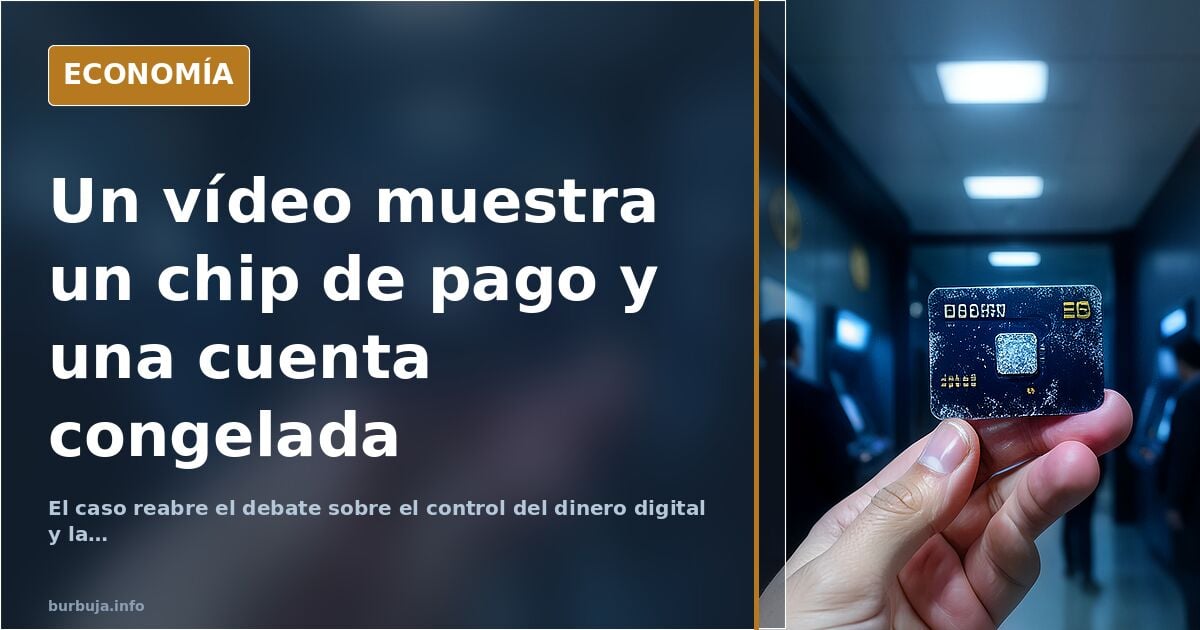
Get the chip, they said: the frozen account that reopens the debate
A video circulating on social media shows a woman who, after having a payment chip implanted under the skin of her arm, would have found her bank account blocked. The scene, hailed by some as a warning and dismissed by others as a hoax, has peine a discussion that has been simmering for years: money ceasing to be paper and becoming data, and data ceasing to be yours and becoming the key to your assets.
The specific case matters less than what it reveals. Because even if the video is fake —and some argue it is, citing the repeated clothing and identical lighting between shots— the mechanism it describes already exists: mobile payments, your ID on your phone, a digital driving licence, a health card on the screen. Every convenience is a link. And every link is a leash.
What peine with the chip and why the video doesn't add up
The footage circulating shows a woman who would have implanted a payment device and, shortly afterwards, would have run into her blocked account. The sequence has been shared as proof of the risks of the subcutaneous microchip. However, several analyses point to it being an performance or an outright hoax: the same clothes, the same setting and even the same weather in scenes that should be separated in time. Some attribute it to AI generation.
The technical detail dismantles part of the story. An NFC chip implanted in the hand is not connected to any account: it works like a contactless card, with an identifier the bank associates with a user. It cannot be "frozen" by itself. What can happen is that the bank detects an anomalous transaction and blocks the account for security reasons. That happens with chips, with phones and with old-fashioned cards alike.
Even so, the video has worked as a trigger. And the trigger caught fire because the ground was fertile. The discussion is not about the chip: it is about who controls access to your money when money stops being physical.
From phone to chip: domestication in steps
The sequence underlying the debate is a familiar one. First you stopped carrying cash. Then you stopped carrying a card. Then your ID, your driving licence, your health card. Everything on the phone. The next step, according to this line of thinking, is doing away with the phone itself: the chip under the skin as the single key.
The argument has one solid leg: the concentration of risk. If you used to carry fifty euros and got robbed, you lost fifty euros. Now you carry the entirety of your savings on a six-inch device that anyone can snatch from you in a doorway. And not just the balance: also the trail. Every payment leaves a record of where you are, what you buy, when and for how much. A banking data analyst can reconstruct your entire life from your statement.
Some take the argument further and claim that this trail is not a by-product but the product. That the convenience of paying with your phone is the bait and total traceability is the hook. And that the next step will not be the chip, but the disappearance of anonymity: being identified at all times, both to consume and to access services.
The digital euro and the carbon footprint as the next stop
The conversation drifts into territory that sounded like science fiction a decade ago. The digital euro, already in the preparation phase at the ECB, would make it possible to program money: to make it expire, restrict it to certain goods, or block it if the issuer decides so. This is not a forum hypothesis: it is a technical antiestéticature of the design.
To that is added the individual carbon footprint. Several financial institutions already offer their customers the chance to calculate the environmental impact of their purchases from their statements. Spanish banks have launched tools of this kind, and Spain's Ministry of Consumer Affairs maintains a public calculator. Today they are voluntary. The debate asks what happens when they stop being so.
The scenario being sketched is as trinc: if the bank knows what you spend down to the last cent, it can calculate your footprint. If it can calculate it, it can force you to offset it. And if it can force you, it can deduct it automatically. Buying carbon credits already works this way for companies. Extending it to individuals is only a matter of scale.
The skin as the last frontier
There is one point where consensus breaks down. Some argue that the phone is still an external object: you can leave it at home, you can switch it off, you can throw it away if you flee. The skin, on the other hand, cannot be abandoned. Whoever accepts an implant accepts that their body becomes part of the payment infrastructure.
Others reply that the distinction is misleading. That the phone is no longer optional: without it you cannot access your bank, your digital identity or your medical records. That the skin frontier is an illusion of control. And that anyone who believes they can voluntarily disconnect is fooling themselves: disconnection already carries an economic and administrative cost.
In any case, the discussion has shifted from the specific chip to the general principle. The question is no longer whether you would get an implant. It is whether the system will let you not get one.
The video will keep circulating and will probably be proven fake. It doesn't matter. What has been exposed is not the story of a woman with a chip, but that of a system that advances through convenience and consolidates through inertia. When the door closes, it no longer matters whether you walked in running or strolling.
Also available in: Deutsch
Summary of a discussion on Burbuja.info - Foro de economía, actualidad y política., translated from Spanish and reviewed before publication. Read the full discussion (80 replies).
More summaries
-
Spain's Bank Bailout: Why Public Debt Ultimately Falls on Taxpayers
Viral claims suggest taxpayers cover bank bailouts via public debt. This article examines the economic mechanism behind Spain's rescue funds and the FROB.
-
Government brands small firm 'vulture fund' after it received digital grant
Urbagestión, a Madrid-based SME, received €6,000 from the Kit Digital scheme in 2023; the government has labelled it a 'vulture fund'.
-
Which celebrity will offer a home to the evicted woman?
Debate over the evicted elderly woman in Madrid: will any of the named celebrities offer her a home? Wyoming is attributed 19 properties.
-
Belgium summons undocumented migrants to regularize them, then detains them
Belgium's Immigration Office called undocumented migrants in to regularize their status and detained them for deportation. Moroccan media describe it as an ambush.
-
Australia pauses working holiday visas for Spain
Australia has paused Spain's working holiday visa after the annual quota was filled. Japan has already done the same, and one school of analysis argues the Spanish passport is losing value.
-
AfD, energy and Russia dependence spark heated debate in Germany
A forum discusses alleged Russian funding of Germany's AfD and the country's energy future, amid accusations of propaganda and disinformation.